
Original title: Where Has Temu's Traffic Gone?
Author: Lanhai Yiguan
Source: Lanhai Yiguan

Cover image source | pexels
Recently, a group of Temu sellers has seen a sharp decline in both store traffic and sales.
One Temu seller in the US market said that their store's average daily traffic was 5,000-6,000 visits, and it began to fall from 8 a.m. on October 24, dropping to zero by 10 a.m. This seller operates several Temu stores, all of which have recently experienced a plunge in traffic.
Another group of US sellers also reported a sharp drop in traffic at their stores.
Temu's situation in Europe is not optimistic either. Many European sellers have seen their store traffic continue to shrink, with some down as much as 30%, while conversion rates remain at a low level.
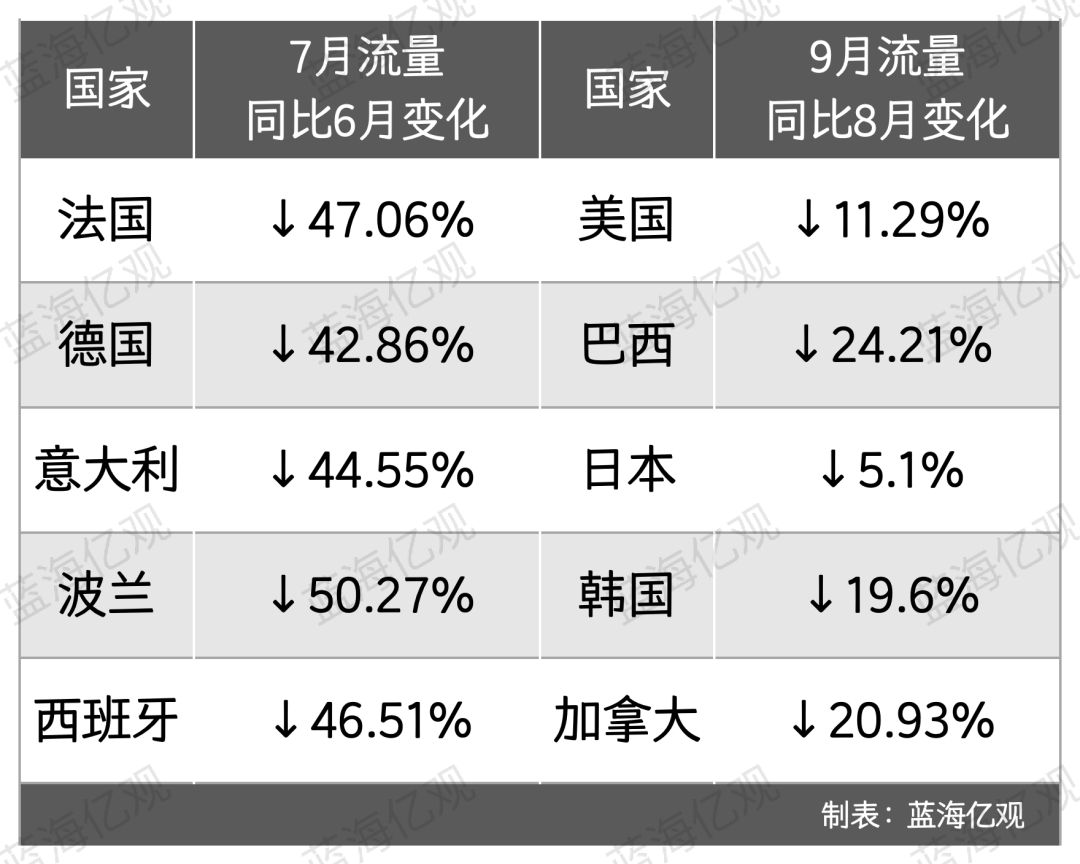
Third-party institutions have also estimated that, from July to September, Temu's traffic in several European countries fell significantly month over month. At the same time, Temu's traffic in markets such as the US, Brazil, Japan and South Korea also shrank to varying degrees.
According to Data.ai, in September 2026 Temu dropped to 8th place in the shopping app download rankings in Spain.
Along with this, Temu's order volume and sales in multiple markets have declined substantially.
Where has Temu's traffic actually gone? What measures is it taking in response?
Temu's Dilemma
Over the past two months, prices of Temu products have risen noticeably. Some consumers have found that many items they wanted to buy more than doubled in price within a short period. In such cases, consumers buy less or lose the desire to buy.
Temu knows where the problem lies. It does not want to raise prices, but it has no choice.
Since July 1, the EU has officially abolished the tariff exemption for “imported small parcels valued at no more than 150 euros” and imposed a flat 3-euro tariff. Combined with the existing 20% VAT, this new tariff has sharply increased the cost of imported small parcels.
Against this backdrop, the number of small parcels entering the EU has nearly halved. For example, Belgium's small-parcel declarations in July fell 53% year over year, and the average number of e-commerce declaration forms at Dutch customs in July-August dropped 46% compared with the first half of the year.
The impact of the EU's new tariff policy spread rapidly within just over two months, dealing varying degrees of blow to Temu's traffic, sales and sales volume.
Starting in July, Temu's monthly traffic in France, Germany and Italy fell 47%, 42.86% and 44.55% respectively. Although the trend eased somewhat in August, Temu's traffic fell again in September and spread to North America, Asia and other regions.
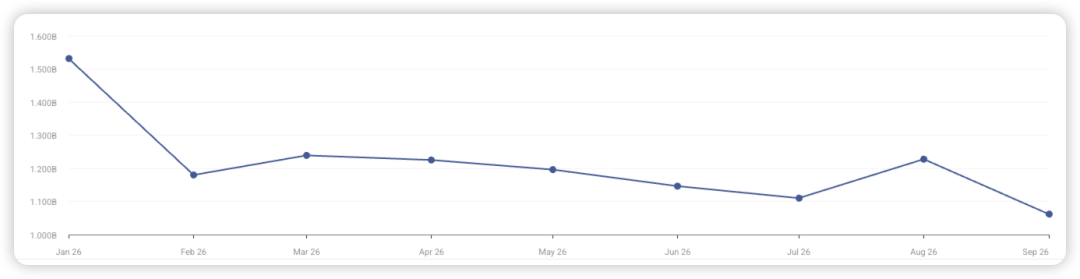
Chart / Temu traffic trend (estimated)
The impact of the traffic decline quickly showed up in Temu's sales performance.
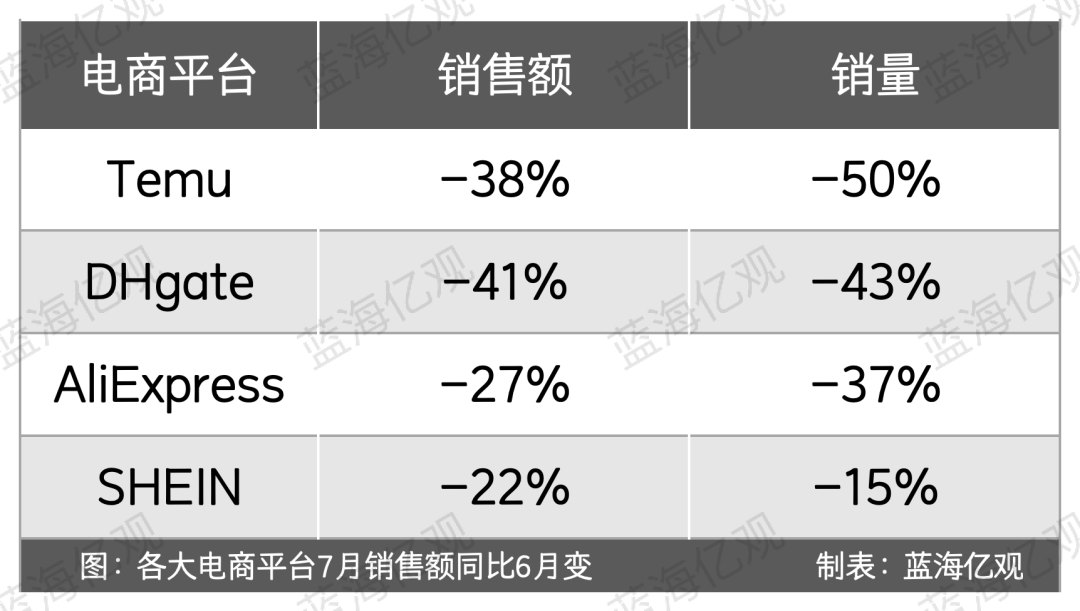
According to data from the French shopping app Joko, in the first month after the EU's new tariffs took effect (July), Temu's sales fell 38% compared with June, and sales volume dropped 50% month over month, a bigger decline than AliExpress (37%).
After July 1, the EU's tariff policy pushed up sellers' product prices, making it hard for consumers to accept the higher cart totals for a time. This greatly reduced the effectiveness of sellers' ad spending and, in the end, left a group of sellers with worsening sales performance.
It is roughly estimated that, after the small-parcel tariff exemption was abolished, the actual combined tax burden per item is about 3.6 euros. For the many Temu sellers offering products priced at 5-10 euros, the 3-euro tariff equals 30%-60% of the selling price.
In addition, starting from November 2026, the EU plans to charge an extra 2-euro customs clearance fee. By then, the combined cost per item for sellers will reach 5-8 euros, exceeding the original selling price of many products.
These added costs have been passed on to front-end product prices. Many European users found at checkout that a cart that used to total 25 euros reached 59 euros after the tariffs were added. If a parcel contains two different categories of goods (for example, one shirt and two pairs of sneakers), double the tariff (6 euros) must be paid.
From June to July 2026, the average order value of products on the Temu platform increased by 30%.
Although consumers are actually paying more, sellers are not earning more because of it. Some sellers say that under Temu's strict price-comparison mechanism, even if front-end prices rise somewhat, sellers' profits do not increase accordingly.
This change has also affected the conversion results of some sellers. Sellers spend money on ads to bring consumers to product detail pages. However, when consumers find the price is higher than before, they often abandon the purchase, ultimately lowering the conversion rate.
Rising prices and falling conversion rates have caused a group of Temu sellers' sales to decline substantially. One European seller said that after the front-end price adjustment, their store's order volume dropped 70%, while traffic and sales both fluctuated noticeably.
Temu's traffic did not simply disappear into thin air.
One of the foundations of Temu's traffic is “low prices”, and this foundation has now been shaken by new policies in various markets. When the foundation wobbles, the structure on top inevitably loosens as well, leaving Temu in a passive position in some markets where both traffic and sales are hit.
Temu Begins Exploring New Paths
Facing the double dilemma of traffic and sales, Temu has started exploring some new paths.
Among them, “localized fulfillment” and “self-operated brands” are two cards Temu values highly.
On the localized fulfillment side, Temu has begun closing a batch of domestic warehouses and shifting its focus to overseas self-operated warehouses.
Starting August 10, Temu's small consolidation warehouses in Guangzhou, Dongguan, Zhaoqing and other places stopped receiving goods, and the remaining inventory was transferred to large central warehouses in Yiwu and Shenzhen. It is understood that these warehouses are leased and independently operated by Temu, mainly handling semi-managed stock products and goods from European “local-to-local” sellers.
At the same time, Temu has built more than 10 self-operated warehouses in Germany, Poland and other places, and its European orders are accelerating the switch from “direct shipping from China” to “local fulfillment”.
A group of fully managed sellers found new stocking orders appearing in the Temu backend, with some best-selling product links recommended for stocking to European “front warehouses”. This means a group of “fully managed sellers” has the chance to become “local fulfillment sellers”.
Some sellers who have never had overseas fulfillment experience are shipping goods overseas for the first time. For them, stocking to an overseas warehouse does not require more complicated operations:
First, platform selection: Temu helps sellers pick, from among the original fully managed products, those suitable for stocking to overseas warehouses based on sales, quality and overall store performance. Sellers do not need to select items or create new links.
Second, seller decision: Temu selects the products and estimates the stocking volume, and sellers can decide “whether to stock” and “how much to stock”, with full freedom of choice.
To encourage fully managed sellers to stock goods locally in Europe, Temu has also provided corresponding support in pricing and traffic.
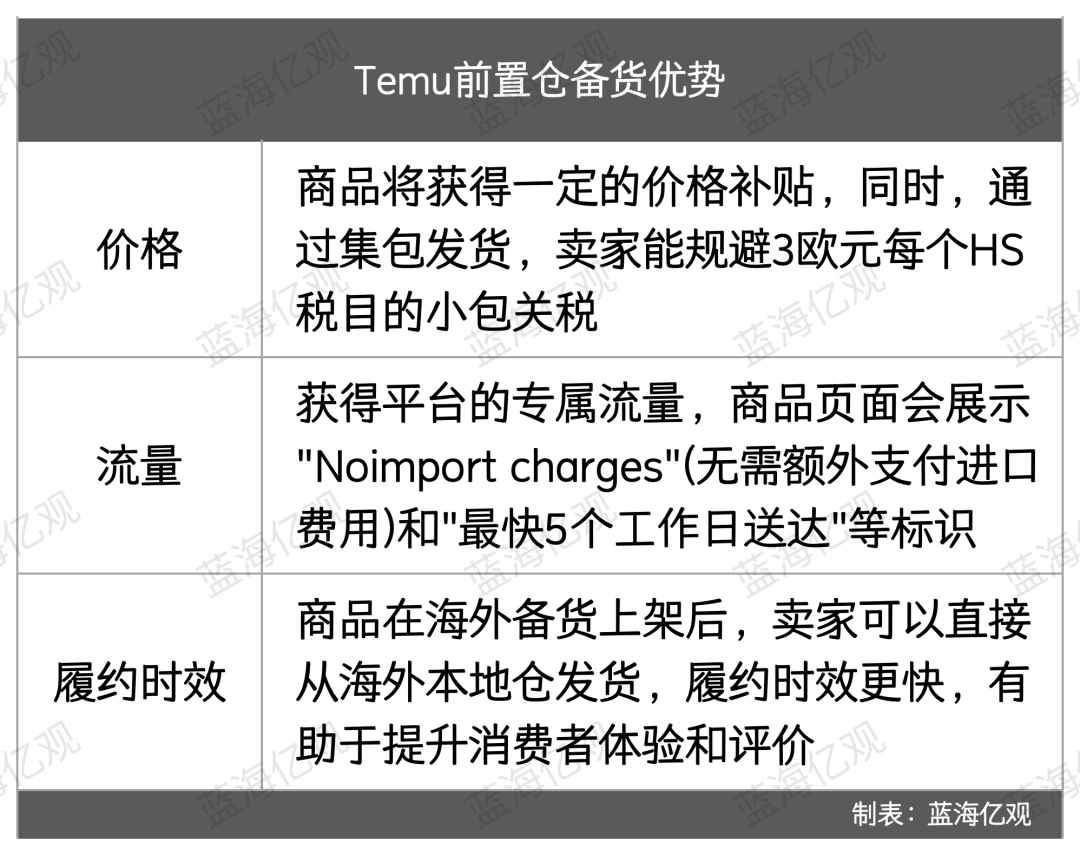
On pricing, products in European front warehouses receive certain price subsidies, and by shipping in consolidated packages, sellers can avoid the 3-euro small-parcel tariff per HS tariff line, preserving some price advantage for their products.
In addition, products in European front warehouses can also get dedicated platform traffic, and product pages display labels such as “No import charges” and “delivery in as fast as 5 working days”.
Industry insiders say that, as of June this year, 80% of Temu's orders in the European market were already shipped locally. This means local fulfillment in Europe will be the model Temu mainly promotes.
It is understood that after some products completed front-warehouse stocking, their average daily sales grew about 14%, and single-day sell-through for some SKUs rose from the previous two-digit figures to 200-300 units.
One seller said that all the products they sent to front warehouses were best-sellers, and after one month of stocking, sales grew about 10%.
However, Temu's front-warehouse model is still in an early stage and has many problems in actual operation.
For example, stocking orders under this model suffer from delayed information. Some sellers found that products whose sales were declining were still required to be stocked in the hundreds. If sellers comply, the goods may sit unsold after entering the warehouse.
At the same time, sellers currently cannot track the progress of goods in “overseas transportation” and “warehouse entry”. Even after products are listed, sellers cannot clearly distinguish whether sold orders came from domestic warehouses or front warehouses.
In addition, the long stocking cycle is also a concern for sellers. One seller said that of a batch of more than 1,000 items sent to a front warehouse, only 60% had been listed after a month.
From this perspective, the local fulfillment story sounds wonderful, but there are many obstacles in the actual rollout.
Self-operated brands are another important part of Temu's layout.
Under fully managed and semi-managed models, the product quality and compliance levels of third-party sellers vary widely, easily dragging Temu into public opinion and regulatory troubles. Under the self-operated model, Temu is deeply involved in factory production, unifying product standards and compliance qualifications and keeping risks in its own hands.
Therefore, driven by parent company Pinduoduo's “Xinpinmu” plan, in mid-to-late August Temu quietly launched a self-operated brand called “BEMUVO” on its Canada and Japan sites. The brand's introduction page shows that products are supplied directly by the brand officially, with brand qualification certificates submitted by merchants (sellers).
The trademark applicant behind BEMUVO points directly to “Shanghai Xinpinmu Hongqiao E-commerce Co., Ltd.”, the main company of Pinduoduo's “Xinpinmu Plan”.
Temu positions BEMUVO as a “brand official store”, supplied directly by manufacturers selected by Temu, covering categories such as bedding, T-shirts, sweatshirts, keychains and small accessories. These products continue Temu's “low price” style, ranging from keychain items under 2 Canadian dollars to bedding sets in the 30-plus Canadian dollar range.
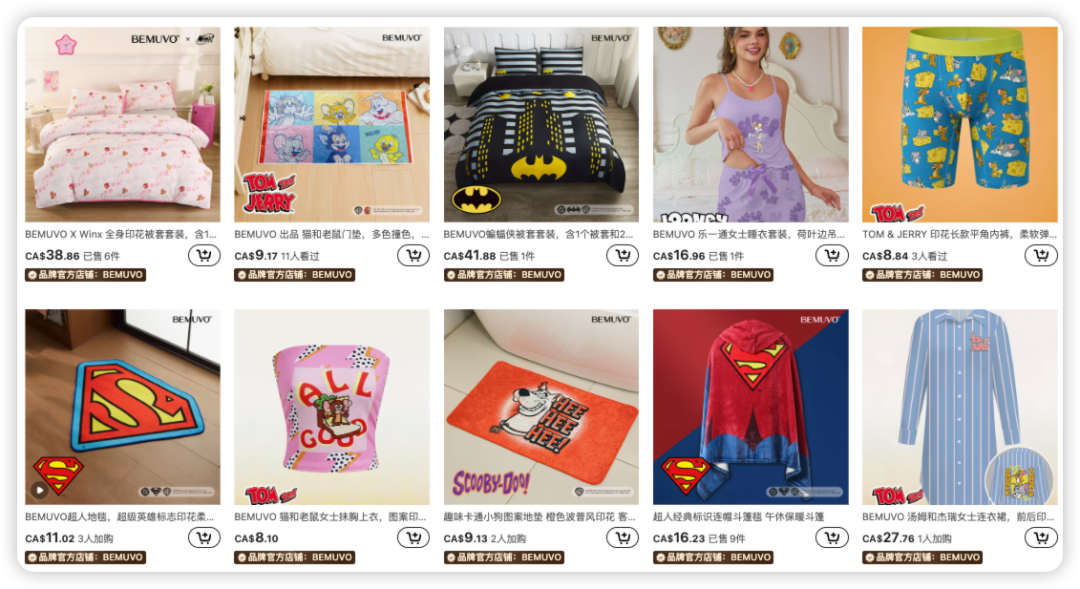
Chart / Some BEMUVO products
On the product side, Temu no longer selects goods from factory inventory. Instead, it digs out and designs products directly from overseas consumer demand data, then selects leading factories to produce to standard, and finally the platform handles buying out inventory, setting prices, marketing and sales. The controllability of the whole process is far higher than that of fully managed and semi-managed businesses.
However, BEMUVO's overall sales are not high at present, and there is still a long way to go before it becomes a true brand.
Overall, Temu is accelerating its layout of localized fulfillment and self-operated brands, shifting from a model that attracted consumers with “ultra-low prices” toward one that puts more emphasis on “product quality control” and “consumer experience”. But whether Temu's transformation will succeed, and whether it can continue its past growth momentum, remains to be verified by the market and by time.
Note: Some data are based on surveys and research of certain samples; website traffic data and sales data fluctuate across different periods and are for reference only.