
Original title: Indonesia's massive KYC crackdown, plus two withholding taxes, withdrawals blocked?
Author: Feng Feng
Source: Southeast Asia E-commerce Watch
Cover image source | Pexels
Entering November, a batch of Indonesian sellers still struggling with KYC verification can no longer withdraw their funds.
The store-audit storm that began in mid-October has spread from ordinary Shopee stores to Mall stores, and the core focus is one thing: the store owner, the bank account and the fund payee must all have exactly matching names.
As Indonesian e-commerce platforms begin withholding the 0.5% PPh 22 income tax, this round of store-data review makes it clear that Shopee wants to find out one thing before regulators step in: "Who exactly are you, and where does your income flow?"
However, the 0.5% income tax is just the beginning. On November 9, a cost item called the "digital tax" appears to have gotten stuck in front of sellers' settlement statements again.
Are Shopee and its peers adding another withholding tax?
The so-called "digital tax" is not a new specific tax in Indonesia. The Indonesian Directorate General of Taxes stated clearly in its official announcement: it is neither a new tax category nor a rate increase, but simply a thorough change in where taxes are collected.
Since 2020, Indonesia has already taxed the digital economy through its e-commerce VAT mechanism. It was only on September 25 this year that SPP-TDLN (the collection system for VAT on overseas digital transactions) officially went live, with the aim of closing the long-standing tax-evasion gap of overseas digital merchants.
From November 9, 2026, the scope of digital-tax collection will be significantly expanded to bring in private banks, fintech companies and e-commerce platforms including Shopee, Lazada and GoTo.
Unlike the 0.5% income tax, this tax targets digital goods and services "provided overseas but used domestically" (such as SaaS software, cloud services, streaming media, and game top-ups), and levies 11% VAT (...).
The most disruptive aspect of this system is its "withhold at payment" technical logic:
When a local Indonesian user pays an overseas digital merchant, at the moment of payment authorization the issuing bank submits the transaction data in real time to the state payment institution PT Jalin. Within one working day, Jalin cross-checks it against the Directorate General of Taxes' list of PMSE withholding agents:
Registered overseas merchants: the platform self-declares and pays on their behalf, with the two mechanisms running in parallel and no double withholding;
Unregistered overseas merchants: the issuing institution directly withholds 11/111 × total payment in real time (a tax-inclusive price, with an actual VAT burden of 11%), intercepts the tax and remits only the net amount to the overseas merchant.
So does this tax create a direct cost burden for sellers? It depends!
Because VAT on ordinary physical goods is already paid at customs clearance.
When Shopee, Lazada and other platforms were included in the withholding-institution list this time, it mainly involves two levels:
For buyers purchasing digital goods: if a user buys overseas software, top-up cards or digital services on Shopee, the platform is responsible for withholding this digital VAT.
Of course, the core intent is to get hold of sellers' bank statements and platform back-end data. Indonesian authorities made clear long ago their 2026 enforcement target: cracking down on the invisible merchants who "trade through e-commerce platforms but have long failed to file and pay taxes in compliance".
SPP-TDLN has in effect built a "data dragnet" that penetrates financial channels. Every cross-border fund flow will become completely transparent to tax supervision. Once the revenue a seller declares on the platform and the funds flowing through third-party collection fail to match the tax system's back-end data, it is highly likely to trigger the tax authority's retroactive tracing and compliance audits.
During the trial run from September 25 to October 11 alone, the tax authority recorded 5.5 million transactions, identified potentially taxable transaction value of about 10 trillion rupiah, with potential tax as high as 1.1 trillion rupiah. The first batch of institutions connected to the system includes five state-owned banks such as Bank Rakyat Indonesia (BRI) and Bank Mandiri, plus the fintech company LinkAja.
However, the November 9 date currently claimed by the Indonesian Chamber of Commerce is not the final legislated effective date. The specific list of withholding institutions and the applicable boundaries still await the final plan from the Ministry of Finance and the Directorate General of Taxes.
Withdrawal channels shut down
Entering November, the compliance storm in Indonesia's e-commerce market has blown its final whistle.
On one side, Indonesia has moved the VAT supervision gate forward and blocked it at banks and payment channels; on the other, it has transplanted the income-tax collection gate directly onto e-commerce platforms.
"If certification is not completed before November 1, store balances will be frozen directly!"
Notices like this have already become the top pending task for most Indonesian sellers, through platform pop-ups and service-agent reminders.
Since October 1, 2026, the four mainstream e-commerce platforms Shopee, Tokopedia, Lazada and Blibli have been officially designated as withholding agents, responsible for withholding Article 22 income tax (PPh22) at 0.5% of sellers' total turnover.
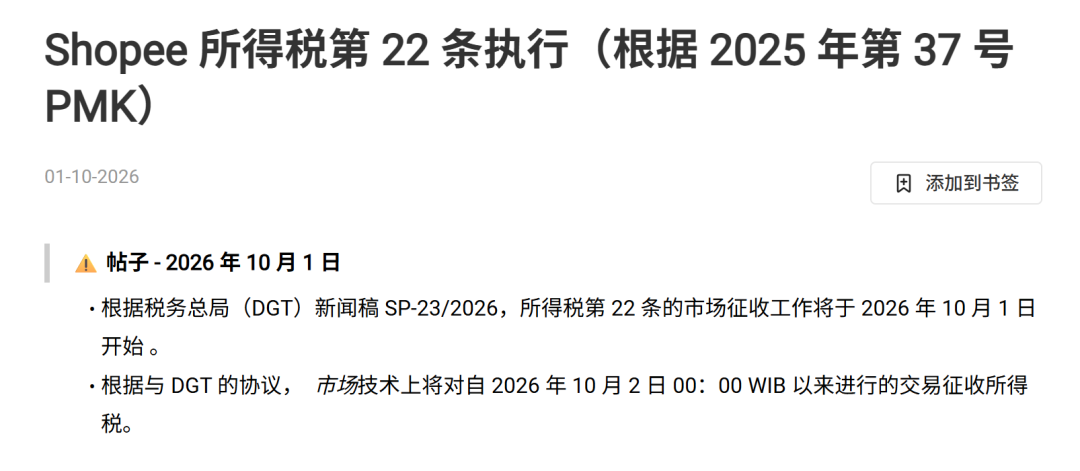
To support smooth collection of this tax, the platforms have simultaneously launched the "strictest ever" mandatory tax-information update.
Shopee requires store account holders to complete verification using their own real identity documents, submitting and cross-checking materials including but not limited to: the business identification number (NIB), NPWP tax number, local bank card/corporate account...
Precisely during this overlap of identity verification and withholding, according to sellers' hands-on feedback, Mall stores have become the hardest-hit area of this round of turmoil.

Stores with complex structures such as "local company + foreign shareholders" in particular often trigger KYC because the platform's verification system cannot precisely match the real identity of the corporate legal representative. To restore withdrawals, sellers need to submit more complete documentation than individual stores.
If any information deviates, or a bank account inconsistent with the updated entity materials is left behind, verification is hard to pass — and this is exactly the core where many corporate-store sellers spent the longest time and met the greatest difficulty in this round of review.
In fact, compliance checks like this come in waves every year. For sellers who lack the conditions to register a compliant entity, paying service providers a few hundred to a few thousand yuan each time to cope may look cost-effective in the short term, but this "patch-up" model carries a huge hidden cost.
During the verification period, delayed new-product launches and capital turnover directly disrupt the store's normal operation rhythm. On top of that, with both policy supervision and platform risk control tightening, the number of service providers that can truly provide full end-to-end coverage is shrinking.
The entity qualification of a store remains the most core foundational asset in e-commerce operations.
With tax gates closing layer by layer, moving away from reliance on temporary qualifications and gradually building a true compliant entity is the only solution for long-term stable store operation.

AI "Knight Cat" Goes Viral Worldwide, TikTok Sellers Rush to Sell Merchandise
An AI-generated knight cat has taken social media by storm, and cross-border sellers are already eyeing the merchandising opportunity.

Two Beihang-Academy Founders Go Global: E-Scooters Bring In RMB 21.2 Billion a Year
Ninebot swallowed up Segway and rode it to global leadership in micro-mobility, pulling in RMB 21.28 billion in revenue in 2025.

Commission Rates Jump 3.24 Points Overnight: Can TikTok Shop Beauty Sellers in Malaysia Still Make Money?
How should sellers adapt to avoid being pushed off the table?