

Original title: Two Beihang-Academy founders go global, pulling in RMB 21.2 billion a year with electric scooters
Author: Ye Nai
Source: Tuke Going Global

Cover image source | Pexels
They say loyal fans have the most say in judging whether a brand is good.
You might not expect that the Segway we're talking about today counts Apple's co-founder Steve Gary Wozniak as its number-one heavyweight fan.
It is said that he rides a Segway balance scooter when he goes shopping and to speech events, and always keeps two in his trunk. This near-indispensable preference has also given Segway extremely high recognition in the overseas tech circle.
Interestingly, this benchmark brand that once swept overseas markets was later acquired by China's Ninebot, now known to everyone as Segway-Ninebot.
Ninebot has grown from a startup back then into the sales leader in the micro-mobility track. In 2025, the company's total revenue reached RMB 21.278 billion, with overseas markets accounting for over 37.26% of revenue.
Many people are surely curious: how exactly did Ninebot "swallow" Segway and open up overseas markets? Let's keep reading with that question in mind.
Generations apart, yet forming one family
In fact, the Segway brand was founded in the United States as early as 1999, and can be called the originator of the self-balancing vehicle category. Its first-generation product launched in 2002, directly creating the balance-scooter track and holding a large number of core foundational patents.
But this era-defining brand also had obvious shortcomings. High pricing and slow commercialization were the two fatal problems dragging it down.
In contrast, Ninebot entered the game rather late. In 2012, two founders who graduated from Beihang University started their business in Beijing.
The founding team's original aspiration was to build mobile robots, but that path required heavy investment and had an extremely high commercialization threshold. So they decided to first enter the short-distance mobility track to become profitable, then feed back into the robotics business, diving headfirst into consumer balance scooters.
In 2014, Ninebot received investment from Xiaomi and Sequoia and officially joined the Xiaomi ecosystem. The funding provided strong support for the company's growth, and with Xiaomi's channel advantages, it quickly opened up the market.
But what truly reshaped the entire industry landscape was Ninebot's "snake-swallows-elephant" full acquisition of industry originator Segway...
What did "swallowing" Segway bring Ninebot?
In 2015, this acquisition that shook the industry was finalized.
Through this deal, Ninebot directly obtained all of Segway's core patents, bypassing overseas patent barriers. After the merger, the company became known as Segway-Ninebot.
It was a brilliant move. Some say Segway was like Ninebot's "protective charm" for expanding overseas, laying the foundation for its globalization.
But what Ninebot gained was far more than patents — it also gained Segway's years of accumulated overseas user reputation and mature global sales network.
On the online channel front, beyond Amazon as the core battleground, the brand also entered mainstream local e-commerce platforms such as Germany's Otto and Southeast Asia's Lazada.
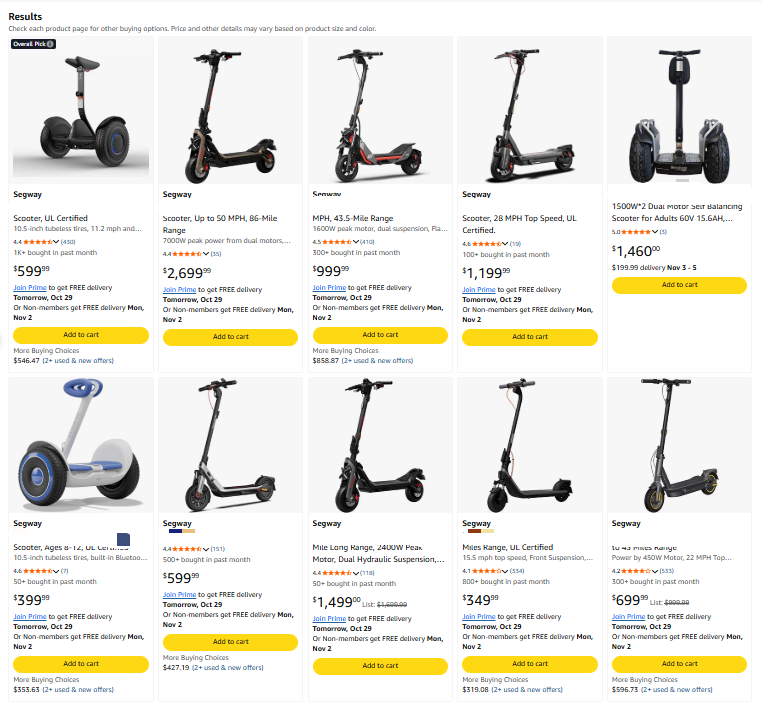
Image source: Amazon
Beyond third-party e-commerce, Ninebot has also built its own brand DTC site, hosting new product launches, crowdfunding, accessory store, after-sales, user community and subscription services, continuously accumulating private-domain users.
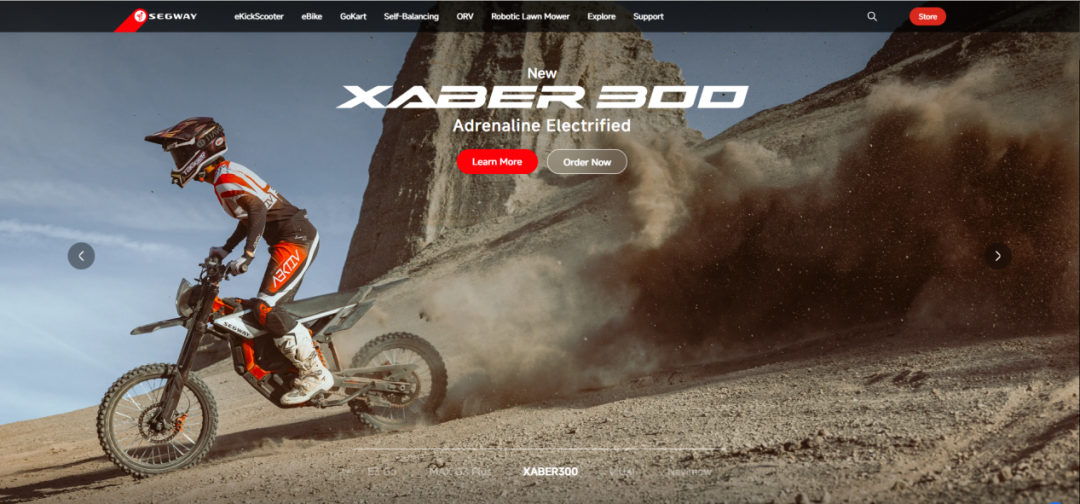
Image source: Segway
On the offline channel front, it not only entered overseas retail chains such as Costco, Walmart, Target and Best Buy, but also kept exhibiting at industry shows like CES and Eurobike, steadily reinforcing its brand image.
Leveraging Segway, but never stopping at Segway
For long-term development, Ninebot kept expanding with a combination of moves, shifting its focus from balance scooters to electric kick scooters, disrupting the bulky traditional products in Europe and the US with lightweight design and smart interaction.
At the same time, supplying overseas shared-mobility operators turned sharing into its first growth curve overseas.
Of course, the team never let go of its original robotics vision. In 2022, the Segway Navimow boundaryless lawn-mowing robot was officially launched, using RTK boundaryless positioning to solve the pain point of wiring in European and American yards.
In addition, high-margin categories such as e-bikes and all-terrain power vehicles have also landed one after another, becoming Ninebot's new growth engines.
By 2025, the company had achieved RMB 21.278 billion in full-year total revenue.
According to Euromonitor data, from 2023 to 2025, Ninebot's self-branded electric kick scooter sales ranked first globally for three consecutive years.
These results prove: Ninebot's overseas journey rode Segway's tailwind, but was never confined to Segway.
Scroll, and you're hooked
Anyone in cross-border e-commerce knows that the hardest part of business today is building user awareness of the product.
Ninebot also recognized the importance of brand-mind building, making content marketing a key lever for cracking overseas markets.
Among them, its TikTok strategy deserves special mention.
Strategy one: build an official account
No matter how platform traffic flows, a stable brand home base is needed. Segway's official account @Segway | Official Account plays this role.
As of now, the account has accumulated 149,700 followers.

Image source: TikTok
The account's content rarely piles up dry product specs; instead, it features real-life riding clips.
On mountains, sand, beaches and urban asphalt, it vividly shows a riding experience that is casual, smooth and full of fun across all kinds of scenarios, letting the product speak for itself.
Whether for daily commuting or escaping the city for outdoor decompression, balance scooters, kick scooters and e-bikes have become choices that enrich many people's lives.
It conveys a feeling to potential users scrolling through the videos: it's not that you need to force yourself to fit the product, but that the product can fit into your life.
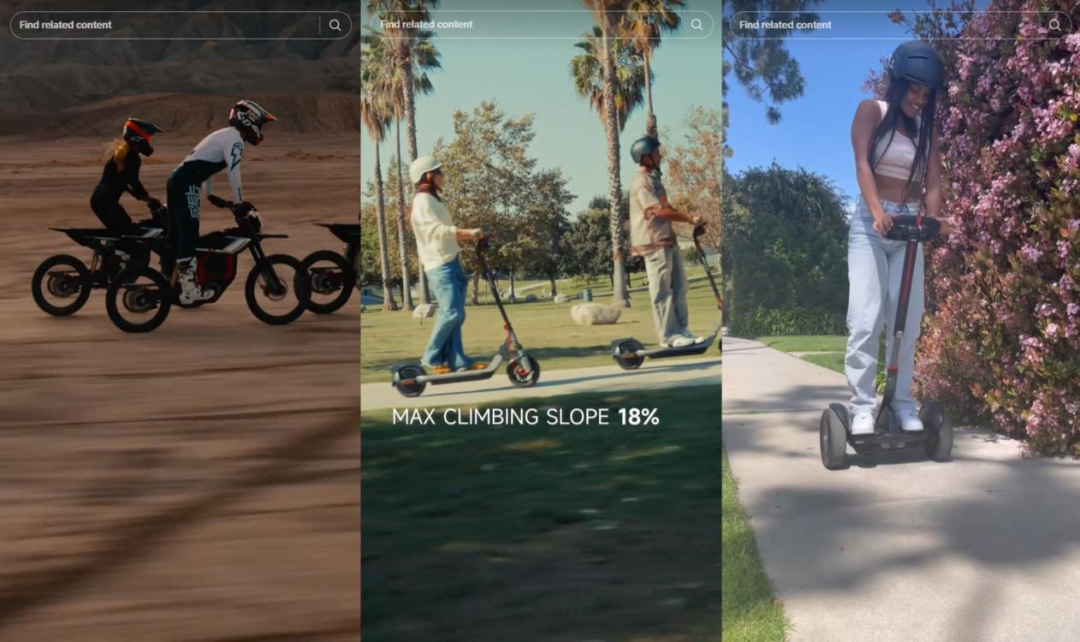
Image source: TikTok
Strategy two: influencer collaboration
The official account focuses on conveying brand tone and lifestyle. But to drive sales efficiently, influencer seeding is a powerful supplement.
For example, tech influencer @Insert Richie, who has 7 million followers on TikTok, is one of the influencers Segway works with.
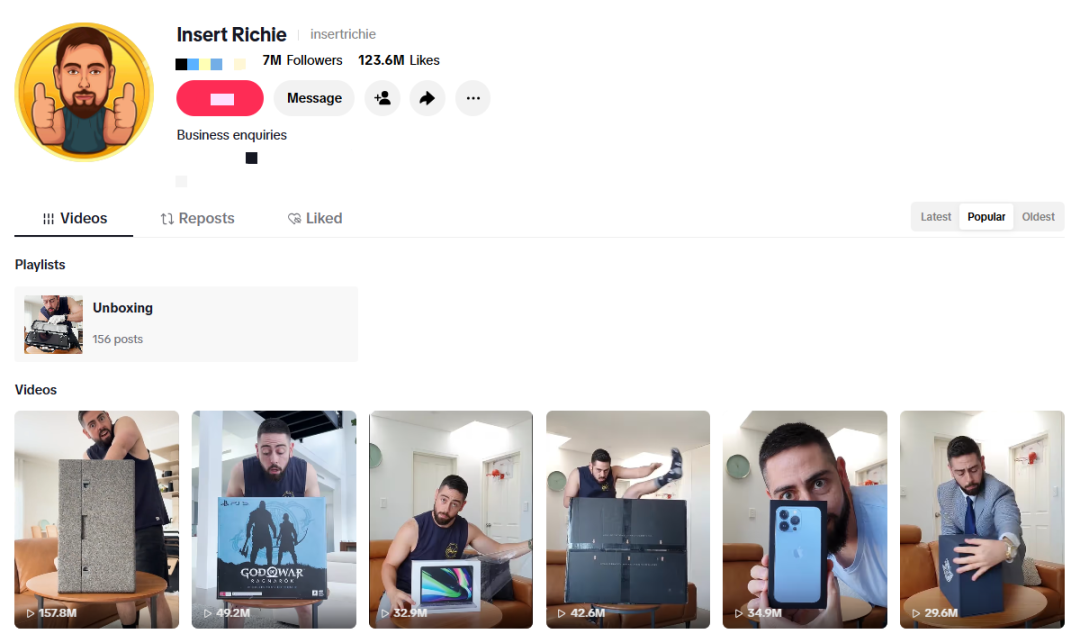
Image source: TikTok
He kept his usual humorous style, documenting the full process of unboxing the product and testing rides outdoors.
Since the video was posted, it has gained 2.9 million views and 122,300 likes.
This type of content makes the audience feel more immersed. When users see a trusted and liked influencer using the product firsthand, their favorability and willingness to try rise significantly, ultimately driving conversion and orders.
Conclusion
In fact, there is no secret recipe for domestic companies going overseas. Product strength is the foundation, channels are the skeleton, and content is the hand that pulls users closer.
Ninebot gained a foothold with Segway's patents and network, then used a DTC site to build private-domain users and TikTok to build awareness. This playbook is nothing novel, but its strength lies in every step being solidly executed.
For domestic companies, the overseas market is not a threshold to look up to, but an incremental space waiting to be explored.
Now is a good time to go global. Competition is fierce, to be sure, but with clear product positioning, stable channel layout and sustained content investment, the opportunities are far more numerous than imagined.

Indonesia Exposes Massive KYC Checks, Plus Two Withholding Taxes, Withdrawals Blocked?
Are Shopee and its peers adding another withholding tax?

AI "Knight Cat" Goes Viral Worldwide, TikTok Sellers Rush to Sell Merchandise
An AI-generated knight cat has taken social media by storm, and cross-border sellers are already eyeing the merchandising opportunity.
Commission Rates Jump 3.24 Points Overnight: Can TikTok Shop Beauty Sellers in Malaysia Still Make Money?
How should sellers adapt to avoid being pushed off the table?