

As Chinese game companies move into a more refined phase of overseas operations, Southeast Asia remains a key focus for many developers. But when it comes to the region, most teams first think of Indonesia, Vietnam and the Philippines — Thailand is often lumped into broader plans without dedicated product and monetization research.
In fact, Thailand deserves standalone study: of its roughly 72 million people, over 58 million are game players, while the whole of Southeast Asia had about 290 million players in 2025 with a market of roughly US$6.6 billion, expected to expand to US$14 billion by 2030. From Free Fire and Arena of Valor to Genshin Impact, Thai players have shown openness to a wide range of genres. For Chinese developers, Thailand is both an important stop for expanding mature products across Southeast Asia and a market for testing localization, community operations and monetization strategies.
I. What are Thai players playing? What signals do the popular titles send?
To study the Thai market, start by observing the games that have sustained local attention over time, then combine app-store rankings, download and revenue data to pin down specific opportunities.
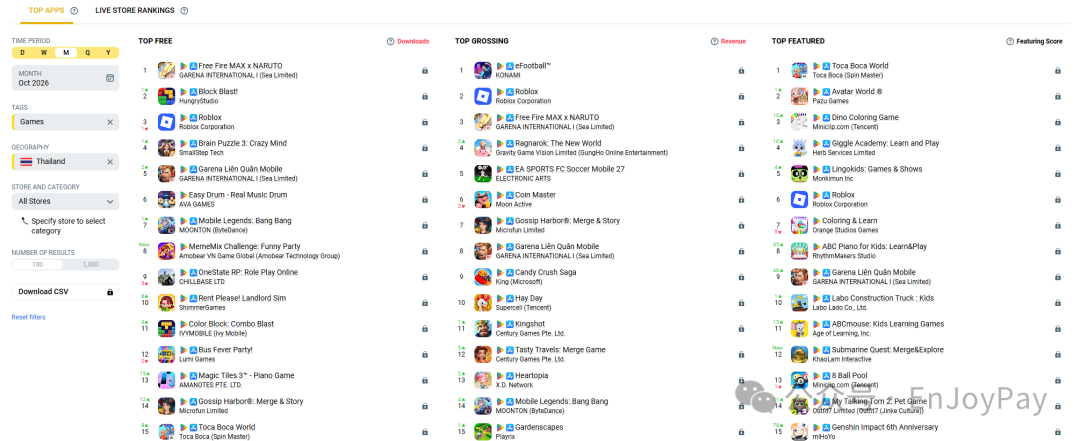
AppMagic: Top 15 grossing, revenue and featured games in Thailand, October 2026
Category one: competitive and multiplayer games
Titles such as Free Fire, Garena RoV (the Thai version of Arena of Valor) and PUBG MOBILE are all worth watching when studying Thailand's mobile gaming ecosystem.
Competition in this category extends beyond the game itself into tournaments, streamers, communities and player-to-player interaction. For developers preparing to enter Thailand, understanding local community culture, how players communicate and the channels through which content spreads is equally important.
Category two: mid-to-heavy role-playing and long-term operated products
Titles such as Genshin Impact and Honkai: Star Rail serve as reference cases for observing Thai players' expectations around characters, storylines, version updates and long-term content operations.
Monetization in this segment is closely tied to version cadence, character launches, limited-time events and sustained player investment. Developers need to watch not just launch numbers, but also retention, event participation and ongoing spending behavior.
Category three: casual, puzzle and simulation-management games
Genres such as merge, puzzle and simulation management are also worth researching against target users and competitor data. Rather than cloning mature products outright, the key is to find specific differentiation — in themes, art style, level design and event mechanics.
Note that the titles above are market research cases, not a live ranking of Thailand's current game revenue or downloads. Before committing to a project, cross-check Google Play and App Store charts, as well as third-party platforms such as Sensor Tower, data.ai and AppMagic, using the same time window and metrics.
II. Where the opportunity may lie for Chinese games entering Thailand — three angles
Mature categories still leave room for niche plays
Mature categories usually mean existing user awareness, but also fierce competition. Developers should study which user needs the leading titles already cover, which gameplay loops have become highly homogeneous, and whether their own product can differentiate on theme, experience or monetization pace.
Localization has to go deeper than translation
Thai-language translation is just the baseline. In-game events, holiday themes, customer-service responses, community messaging and creator collaborations can all shape how well the product is received. Localization should not be a one-time job before launch — keep iterating on reviews, support feedback, event data and user behavior to gradually find the operating approach that fits Thai players.
Shift from user-acquisition thinking to long-term operation
After entering the market, downloads are only the starting point. Developers need to keep tracking retention, paid conversion, customer lifetime value, and how different events affect revenue and repeat purchases. For products capable of long-term operation, communities, creators, in-game events and owned user touchpoints can work together to build more comprehensive player relationships.
III. Thailand is not a simple answer to low-cost growth
Opportunities come with challenges. First, competition: mature games have built brand awareness, player communities and continuous-update capabilities, so new products need clear differentiation — initial downloads driven by paid acquisition alone do not prove long-term viability. Second, the balance between acquisition and retention: performance varies significantly across categories, channels, creatives and user segments, so keep evaluating against retention, paid conversion and LTV. Third, execution issues such as localization quality, customer service, payment experience and compliance requirements can also affect real-world results.
So before entering Thailand, developers should first answer three questions:
1. Who is the target player?
2. What is the product's competitive advantage?
3. Who will operate it continuously after launch?
IV. Payments and store policy: plan the monetization layout early
Besides product and operations, payments and monetization structure are worth planning ahead when entering Thailand. Designing a purchase experience that fits local payment habits helps game teams round out their commercial services.
On payment methods, developers can consider the options below and plan a payment setup suited to their own project based on target users, product type and business needs:
. PromptPay
. True Money
. ShopeePay
. LINE Pay
At the same time, Thai-language checkout pages, price displays in Thai baht, clear payment guidance and smooth mobile flows also help players complete purchases more easily.
For games capable of long-term operation, a Web Shop can also be part of the monetization layout. Developers can design off-platform operations around version updates, holiday events, limited-time bundles and player benefits, creating synergy between in-game and out-of-game touchpoints and giving players a richer set of purchasing and service experiences.
Store policy also deserves attention. Apple App Store and Google Play rules on third-party payments, external links and alternative billing can vary by country or region, developer eligibility and specific project. Policies from the US, EU or Japan cannot be applied to Thailand directly. Developers should plan payment integration, user messaging and related business processes in advance based on the official rules that apply to the Thai storefront.

Overseas Short Drama & App Weekly: Suspense AI Drama Debuts at No.6 on TikTok's Trending Chart as DramaShorts Ad Creatives Surge
In this period's overseas micro-drama app ad-creative ranking, the TOP 30 apps posted a combined 1.255 million creatives. A suspense AI drama debuted at No.6 on TikTok's trending chart, while DramaShorts ad creatives surged.

September Brazil Cash Loan Market: Downloads Hit a Record High Amid High Rates and Debt Pressure
As one of Latin America's core consumer and digital finance markets, Brazil continues to attract global fintech platforms. In September, monthly downloads of cash loan apps surpassed 10.62 million, ranking third globally, while the delinquency rate on household free-credit loans rose to 8.0% — a record high.

Overseas Short-Drama Creator Earnings Across Six Platforms: Pick the Right Platform and Save Two Years of Detours
A boom on one side, a bloodbath on the other — for AI virtual-human creators, entering the game now means either drinking the soup or taking over the plate.