
In 2025, more than half of indie games on Steam earned less than $347 over the entire year. This is the median, not the average — a median means half of all games earned even less than that.
The sixth edition of SUPERJUMP’s “State of Indie” report was written by Andrew Johnston, who has tracked the indie game industry for years. This year’s data comes in two parts: an annual developer survey, plus Gamalytic’s statistics on Steam.
The survey response rate fell to roughly a third of previous years. The reason is concrete: indie developers’ inboxes are widely blocked by anti-phishing and anti-spam filters, so the survey never reached people. Fewer were willing to answer, and those who did were often in more extreme situations.
2. What the industry went through over five years
Why does 2025 look so bleak? You have to string together five years of the industry’s story first.
In 2021, the pandemic pushed a wave of people to switch to making games from home; cloud gaming made “play anytime” possible; subscriptions dragged players’ price expectations down, so premium one-time purchases began competing with free-to-play; AAA entered a golden age, making indie games harder to see in promotion; a batch of publishers died or shrank in those two years; the Unity pricing policy storm made many small teams rethink their engine dependency; and the Chinese market once again became an important growth driver for Steam.
More entrants, lower pricing expectations, and harder player discovery. Stack the three together and the grim 2025 numbers have their origin.
3. Where the money went
In 2025, median indie game revenue on Steam was $347, down 44% over five years. At least a third of titles earned less than $100 for the whole year.
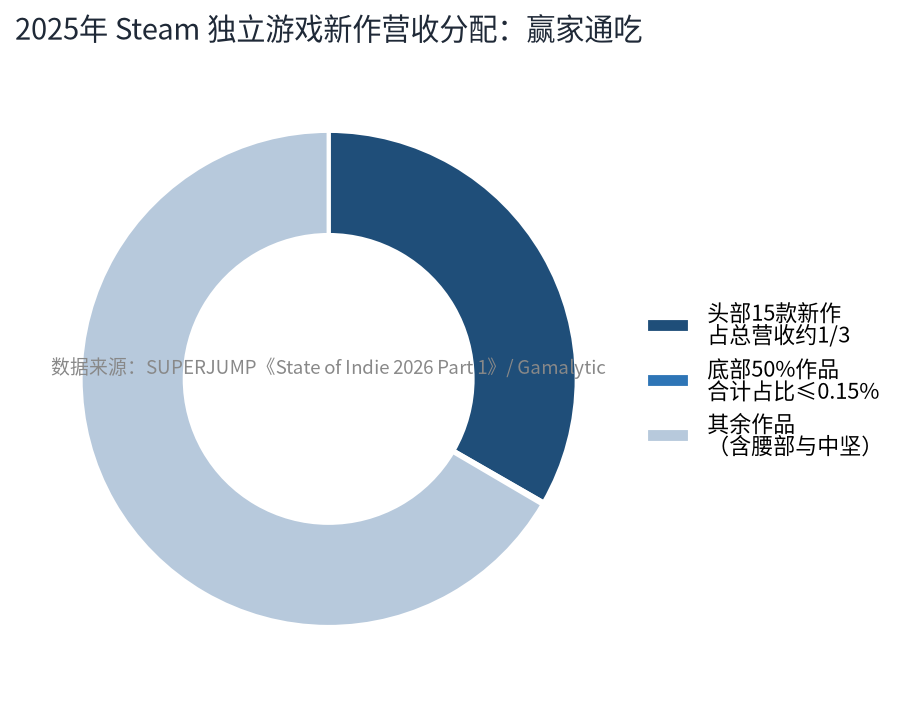
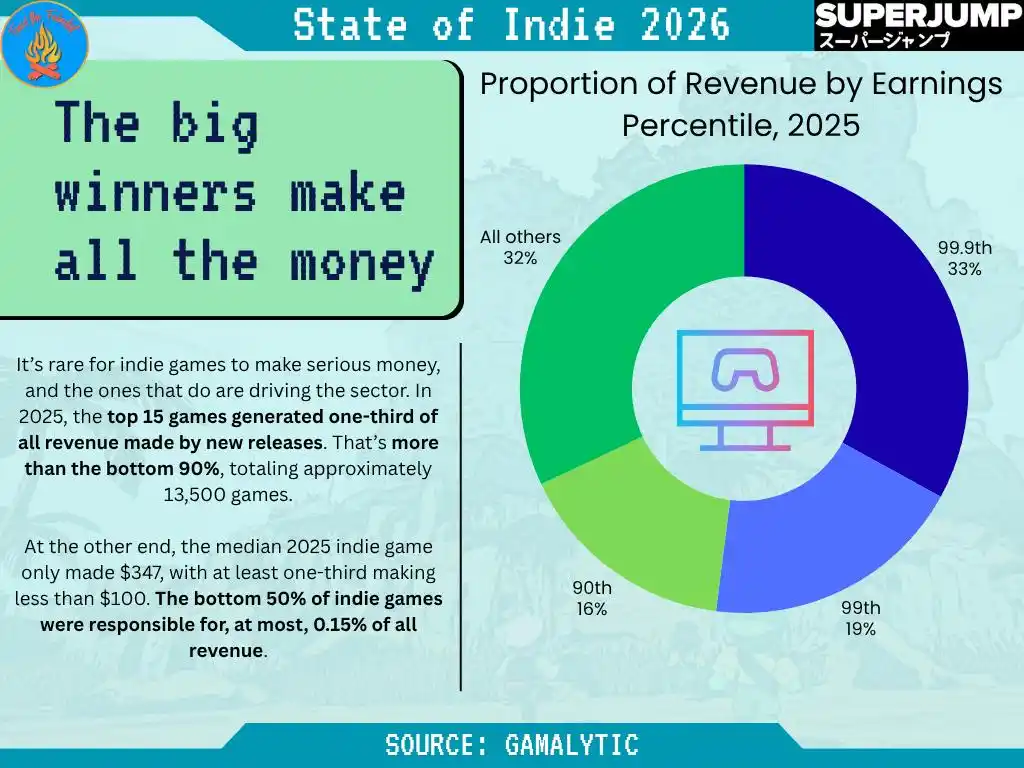
The top 15 new releases took about a third of total new-release revenue — more than the bottom 90% of titles (around 13,500 games) combined. The bottom 50% accounted for just 0.15% in total.
The chart below is from the original SUPERJUMP report (data source: Gamalytic). It is quoted here for illustration only; copyright belongs to the original authors.
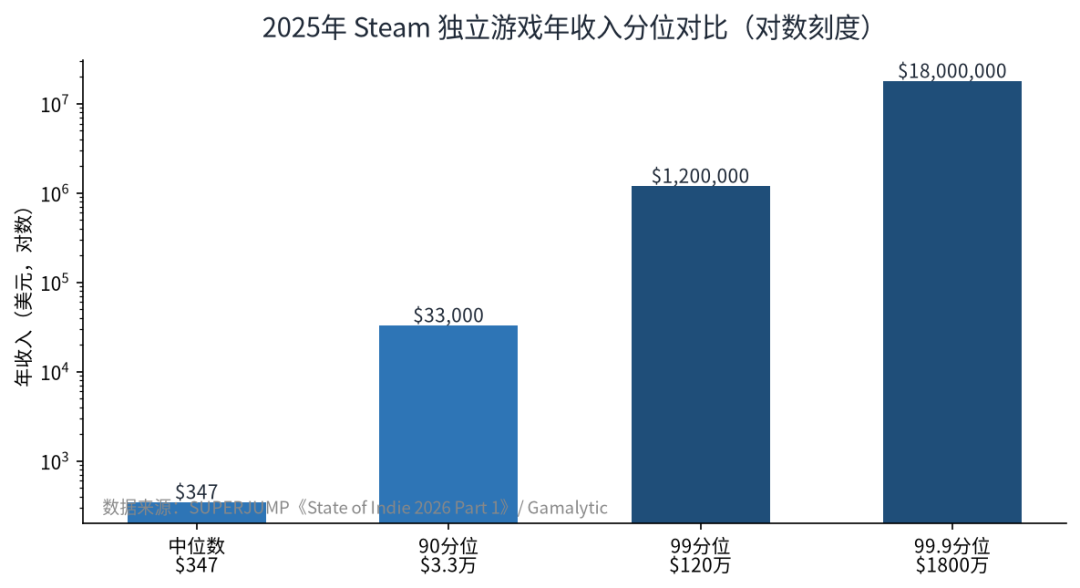
Revenue percentiles make it clearer: the 99.9th percentile was about $18M a year, the 99th about $1.2M, the 90th about $33K, and the median $347. The vast majority of titles are stuck at the bottom of the pyramid, while the winners at the top take almost everything.
4. Gone the moment they launch
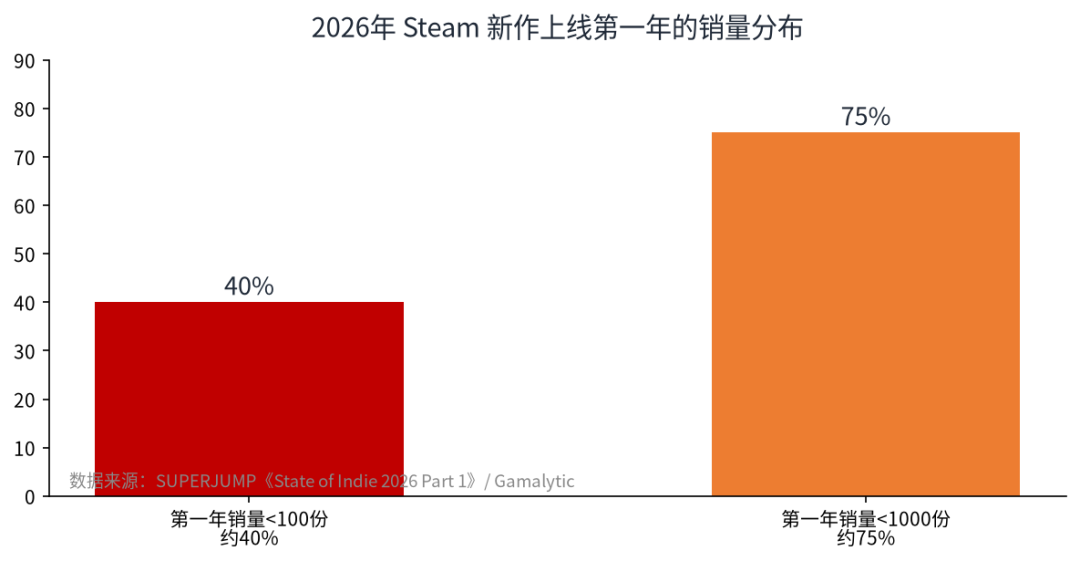
Steam is expected to see 20,000–22,000 new releases in 2026. By historical ratios, about 40% of new games sell fewer than 100 copies in their first year, and about 75% fewer than 1,000. Many games don’t sell badly — they’re simply never seen. They disappear the moment they go live.
One number is widely misread: average review scores have been rising. The truth is that games with fewer than 10 public reviews are excluded from the statistics, so poorly selling titles are silently filtered out and what remains is naturally high-scoring. Rising scores actually show that more low-selling games have sunk to the bottom.
5. Genre decides fate
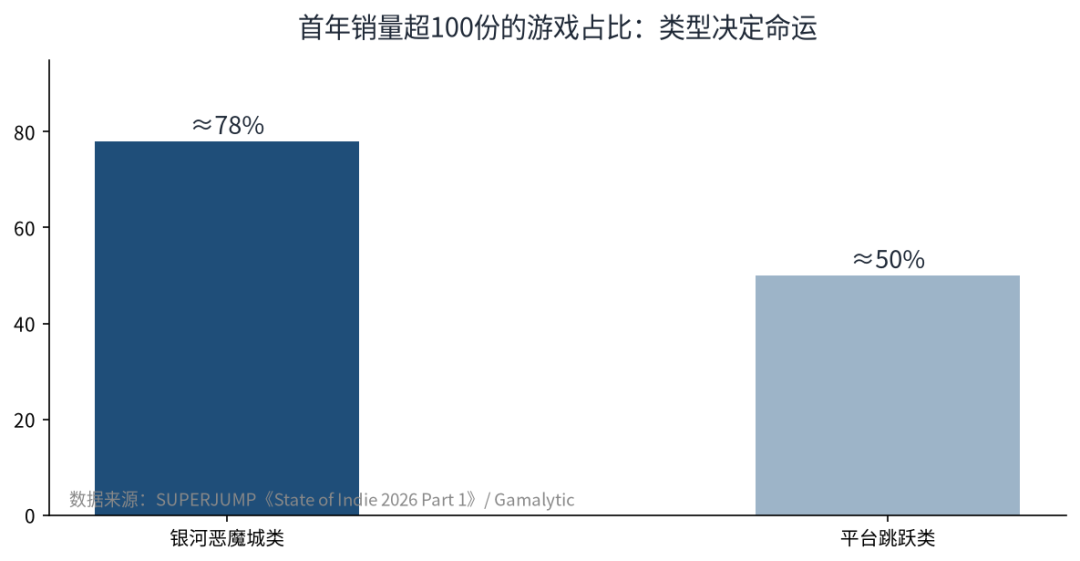
Survival odds differ hugely by genre. Among titles selling over 100 copies in year one, Metroidvanias hit about 78%, while platformers are under 50%. Tower defense, visual novels, platformers and horror are more crowded; open world, immersive sims and Metroidvanias earn more.
The exception is idle games: small teams, high returns, unpredictable outcomes — they’ve become a proving ground for many developers.
6. Co-op is one of the few certain payoffs
The surest growth area in the report is co-op: games tagged with co-op earn 4 times the average indie game. Of new releases so far in 2026, about 6.5% carry a co-op tag, with breakout hits concentrated in open world, action-adventure and horror. GameDiscoverCo data shows the core co-op audience is players under 30.
For small teams, building local or online co-op makes you more visible than quietly grinding away at a solo long-form title.
7. What developers say themselves
Beyond the data, the report interviewed a number of indie developers, and a few viewpoints deserve to be called out. Harrison, who makes simulation games, says the sim genre is barely covered by mainstream promotion channels — store features, press reviews and streamer playthroughs almost all skip sims, so no matter how good the work is, it won’t get pushed out.
Christopher, the producer of Obscure, is blunter: he works in a niche within a niche, and the team grew through community word-of-mouth building up bit by bit, not through any single burst of exposure.
Nishiyama Yasuhiro is a Sega veteran whose method is familiar genres plus unexpected new ideas. Sangokushi BOND turned deck-building into a battlefield rally — the logic of building a deck becomes arranging troops on a battlefield. Old genre plus new layer is one of the few repeatedly proven paths in this industry.
8. In closing: criticized, or ignored
The report’s author argues that games that would have been criticized in the 2010s will simply be ignored in the 2020s. Being criticized at least means someone noticed you; the problem now isn’t whether your game is good, but whether anyone sees it.
For practitioners, the report’s real value isn’t the conclusion that the industry is suffering — it’s three things you can take away: genre choice determines survival odds more than effort; co-op is currently the surest growth area; one burst of exposure is worth less than community word-of-mouth building up.
The number of people making games won’t shrink, but expecting that finishing a game means people will play it is no longer realistic.