
Build the camp by day, fight zombies at night. A little duck holding a gun, together with freshly built defenses, has to hold off monster waves surging from every side.
That is the core scene of 4399’s overseas product Duck Survival. In the past six months it has topped Google Play’s free strategy chart in 39 markets. Per DianDian Data estimates, the international version plus the Traditional Chinese, Japanese and Korean versions have accumulated roughly ¥200M in store revenue (Japan/Korea iOS only). The international version alone has about 10M estimated downloads.
The international version saw about 6M downloads across both stores in June and about 1.4M in July. Estimated store revenue exceeded ¥25M in each of those two months — downloads fell noticeably, yet revenue stayed close to the previous month’s level.
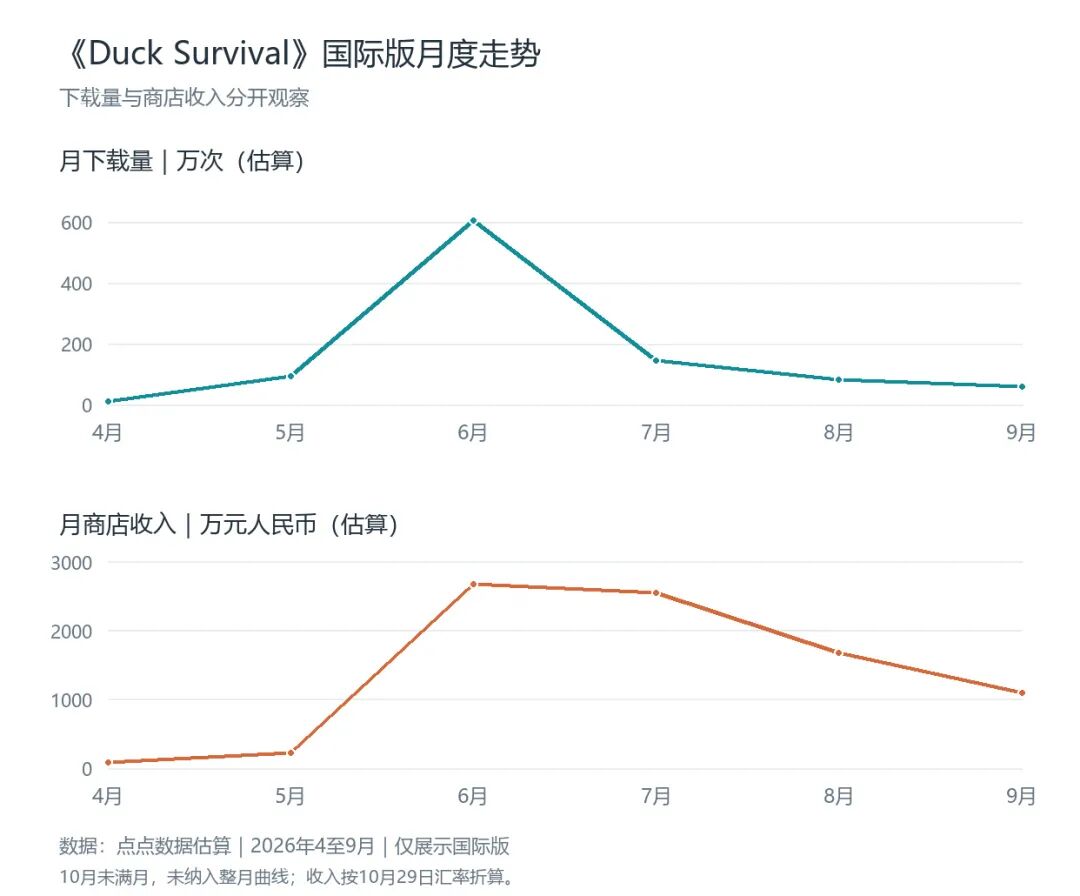
International version download and revenue trend, April–September; DianDian Data estimates
The choices in a defense begin before battle: gold goes into different facilities, and random skills fill out the setup once combat starts. When a defense ends, hero and equipment progression continues.
An accounting exercise before the monster wave arrives
Before the wave hits, Duck Survival is already making players choose.
The camp needs building, but the gold in hand has several destinations. A gold mine steadily produces gold, preparing resources for later construction; a machine-gun turret directly adds defensive firepower. For the same spend, one investment pays off slowly over time, while the other will be put to use in the fight right in front of you.
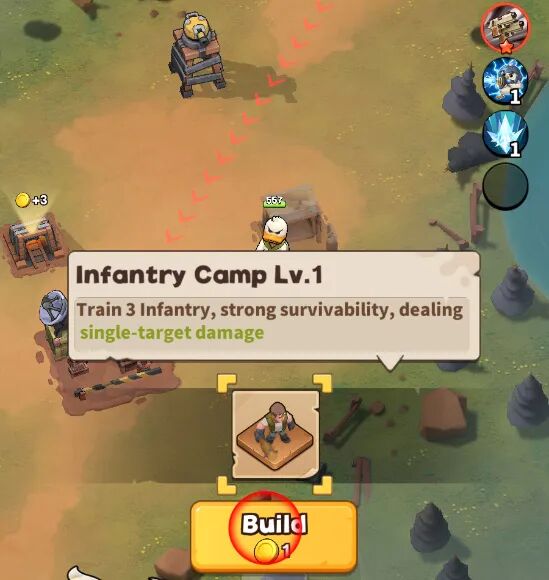
Infantry camp construction screen — buildings take part in camp defense
At night, the duck raises its gun and fights, and the defenses set up beforehand join the battle too. The gold spent during the day becomes firepower in the monster wave.
The three-way choice in combat adds more changes to the setup. Picking the ice spike gives the character a way to freeze enemies; picking dual guns adds rapid-fire ability. When you choose, facilities built earlier are already beside the character, and the new skill joins the ongoing defense.
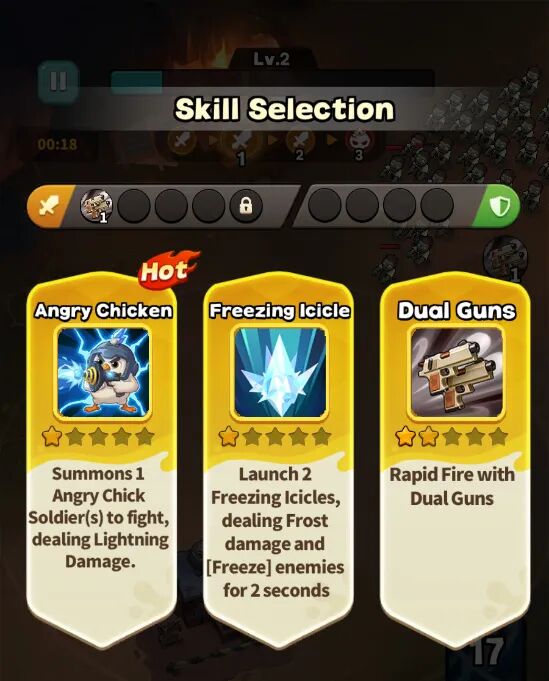
Random skill selection in combat, with the monster wave visible in the background
Part of the defense lineup is built with gold before the battle, while the rest fills in through random in-combat options. Trade-offs in camp construction and random in-combat choices together shape the defense.
The Japanese version’s battle report lists building damage separately, showing its contribution alongside the protagonist, skills and heroes. How much output the facilities you built actually dealt gets direct feedback at settlement.
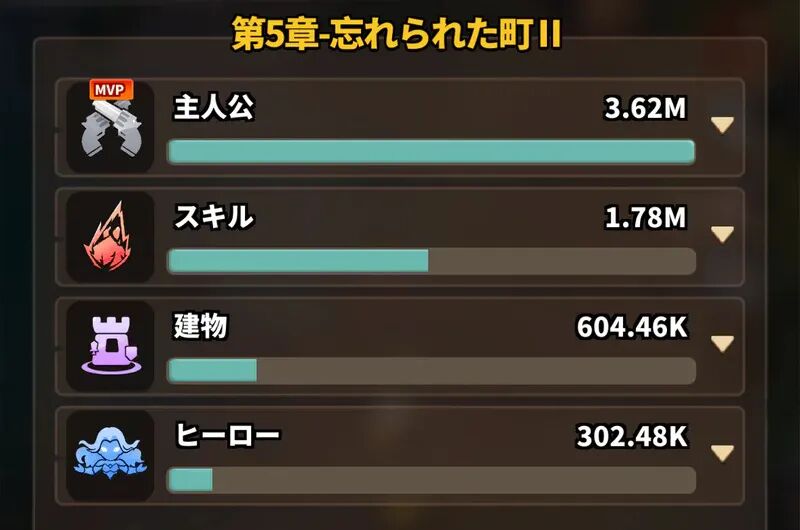
The Japanese battle report breaks down damage by protagonist, skills, buildings and heroes
When one battle ends, the next cultivation path already has clues
The same spinning blade can perform differently depending on hero cultivation. When the bond of axe-wielding hero Gordon activates, the blade splits into 3 extra small blades.
This gives hero cultivation a clear pairing target. When the blade option appears in combat, Gordon’s bond effect can be factored in. In front of a random choice, what your account has already cultivated also affects how well this skill performs.
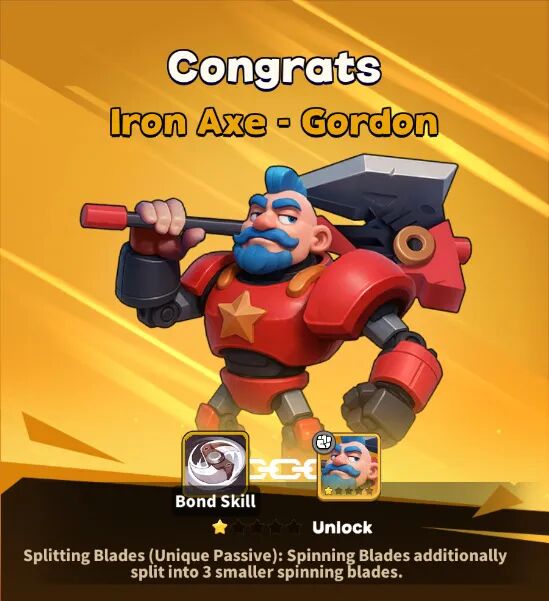
After Gordon’s bond activates, the spinning blade splits into 3 extra small blades
Equipment leaves behind accumulated base stats like attack and HP, with progression carrying across runs. When you enter the next chapter, the character keeps fighting with existing stats, and in-combat random choices stack on top.
The Japanese version’s equipment enhancement page shows both the current upgrade’s stat changes and the bonus effects of later nodes. Materials and funds first push the current level, while future energy damage bonuses are shown in advance — one enhancement and the next stage’s goal are visible on the same page.
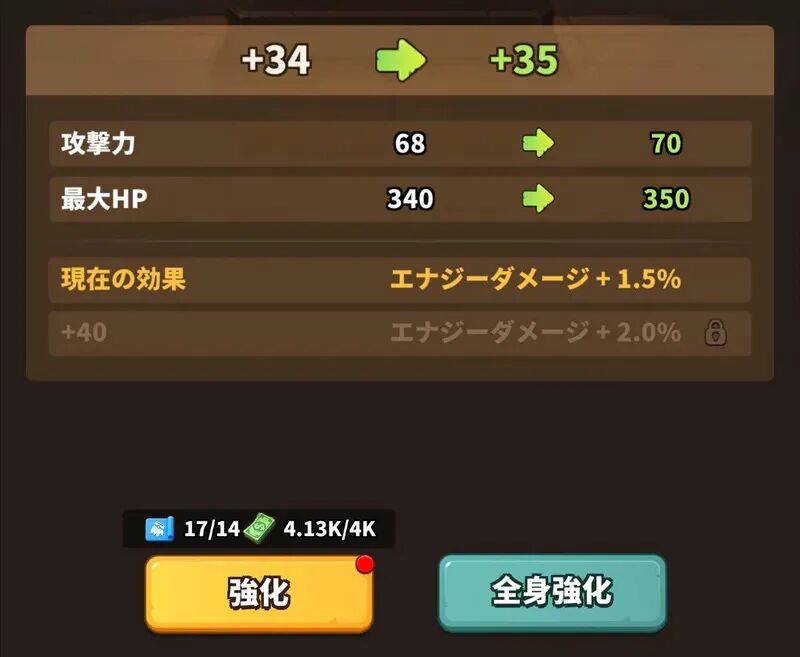
Preview of current upgrade stats alongside still-locked later enhancement effects
The stat accumulation left by equipment and the skill changes brought by heroes give later battles different cultivation directions. Beyond chapter defense, the game also offers dungeons, guild bosses and arenas.
At the same price point, two different growth rhythms
The game puts weapons in players’ hands, and also puts the resources needed to cultivate them into items.
At the Japanese version’s launch, a weapon pack priced around ¥14 bundled a weapon with enhancement resources, complete with a countdown and purchase limit notice.
Another item at the same price, the “Departure Support,” spreads rewards across a 7-day check-in schedule. After purchase you can claim the already-unlocked portion, and the coming days’ rewards are shown in advance.
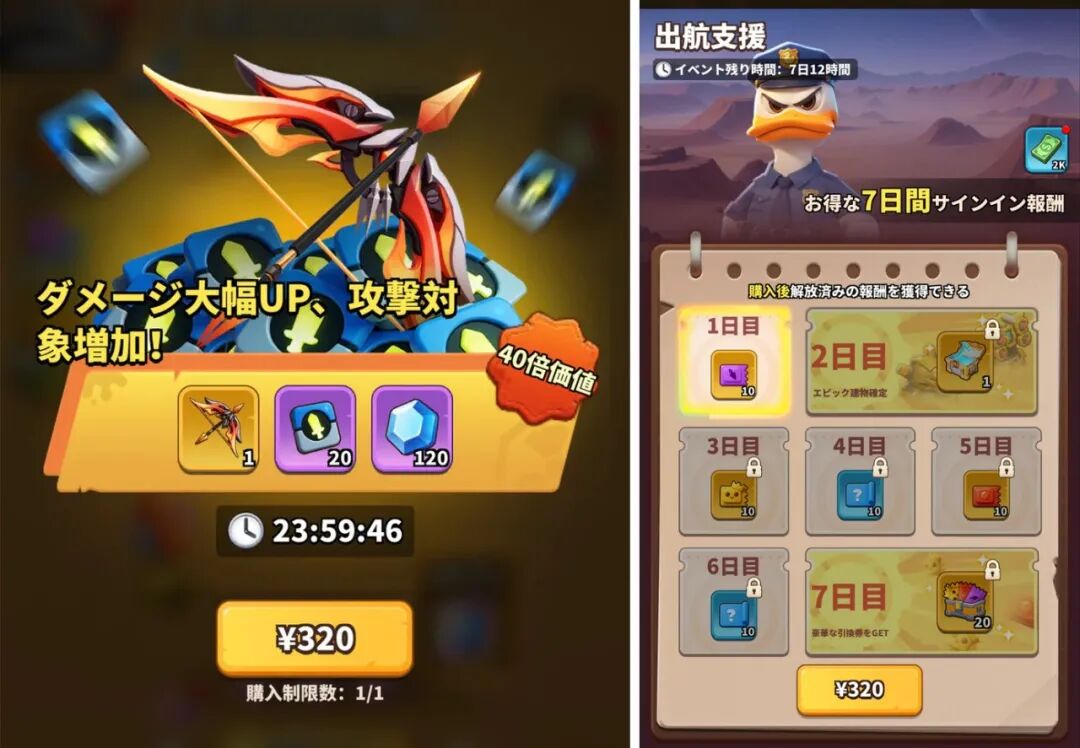
The weapon pack and 7-day “Departure Support” are both originally ¥320 (about ¥14)
The difference between the two items comes down to how resources reach players. The weapon pack organizes content around one specific piece of gear; “Departure Support” ties claims to the check-in schedule. At the same price, the arrangement of what’s sold already splits into different rhythms.
The “Battleship Repair” event at the Japanese version’s launch adds a shared goal to existing gameplay. During the event, clearing main-story stages for the first time earns 5 parts every two stages, and completing fund collection earns 3 parts. Advancing chapters and gathering resources each had their own purpose before; now both also accumulate repair parts for the same battleship.
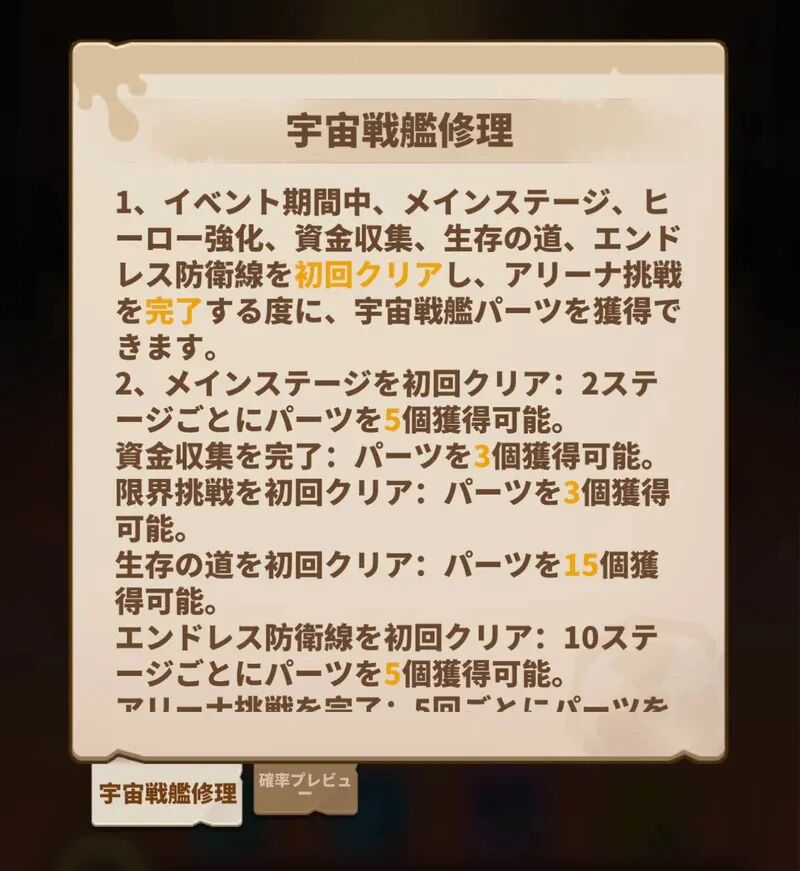
During the event, main-story clears and fund collection jointly accumulate battleship parts
The reward claims area is arranged accordingly. The Japanese version’s Chapter 5 victory settlement offers a “Double Claim” entry with a video icon while keeping the normal confirm button. Clear rewards are right in front of you, and the option to grab extra resources appears right after.
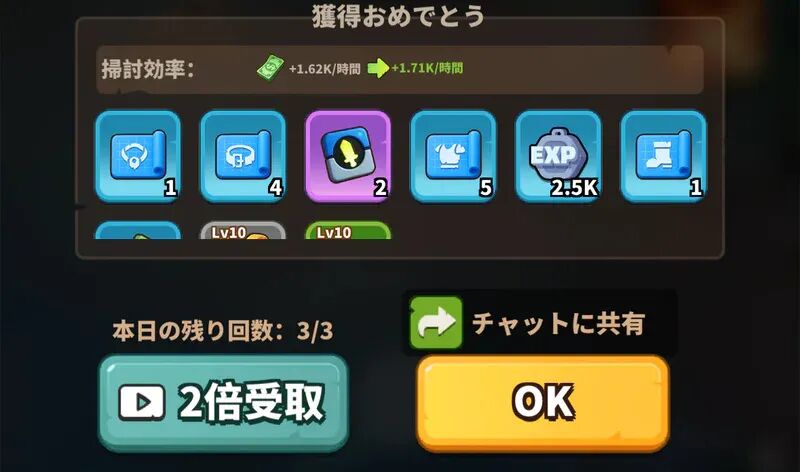
Settlement offers a double-claim entry with a video icon alongside the normal confirm button
After 39 markets, new revenue shows up across different versions
The international version’s estimated store revenue over the past six months is about ¥91M. Russia leads in downloads, while the US is the top revenue market, contributing about ¥34M.
The regional split between downloads and revenue has diverged, and the regional versions that launched later keep reshaping the product’s revenue structure.
The Traditional Chinese version, Quack Attack, launched officially on August 28, distributed by Hele Integrated Marketing for Taiwan, Hong Kong and Macau. In September, its estimated store revenue was about ¥53M, versus about ¥11M for the international version the same month. In that full month, the regional version already contributed a substantial share of revenue.
The Traditional Chinese version’s cumulative estimated store revenue is about ¥84M, mostly from the Taiwan market, already approaching the international version’s scale. Beyond the multi-market download record built by the international version, this later-launching version has become another important revenue source.
The Korean version launched on September 18, and the Japanese version on October 16. The Japanese version’s estimated iOS revenue in its first 11 days was about ¥15M, with day 11 hitting about ¥2M — the single-day peak of that launch window.
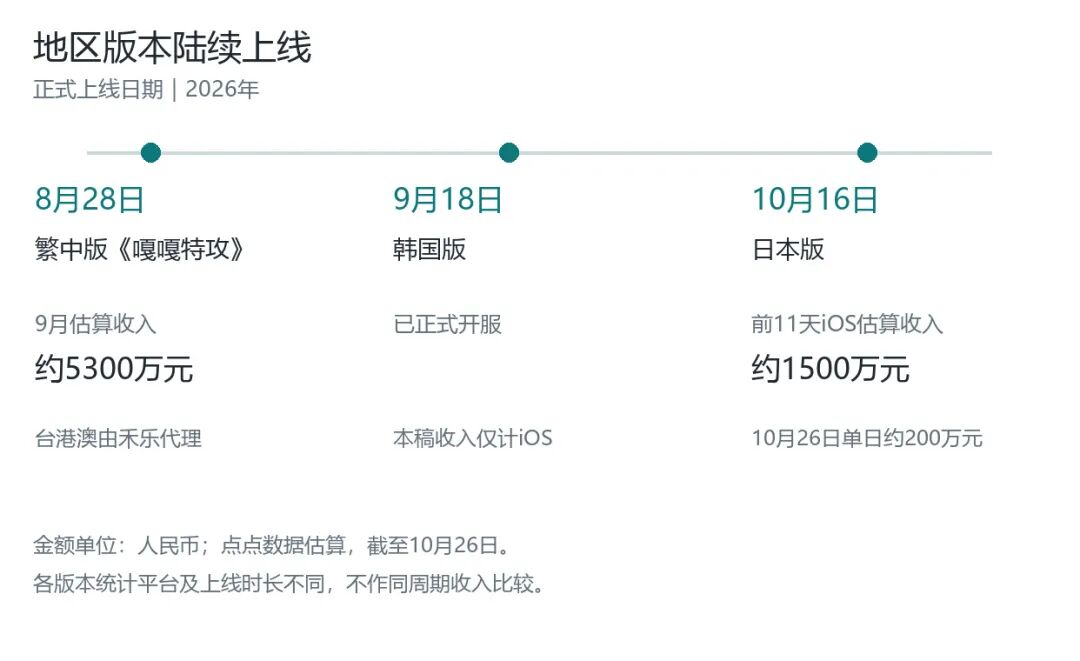
Regional versions rolling out sequentially; amounts are DianDian Data estimates
The international version first built up downloads across markets, the Traditional Chinese version then contributed revenue, and the Japanese version produced a new revenue peak early in its launch. Lining these versions up over time, the cumulative ~¥200M scale comes from different launch stages and regional versions working together.
From Mushroom Hero to the duck, what changed at the product entry point
4399’s earlier Mushroom Hero Legend put gear acquisition front and center. You tap the magic lamp to get equipment, then keep cultivating around the character, with class choice pointing the way for later growth. The result of one draw quickly lands on the character.
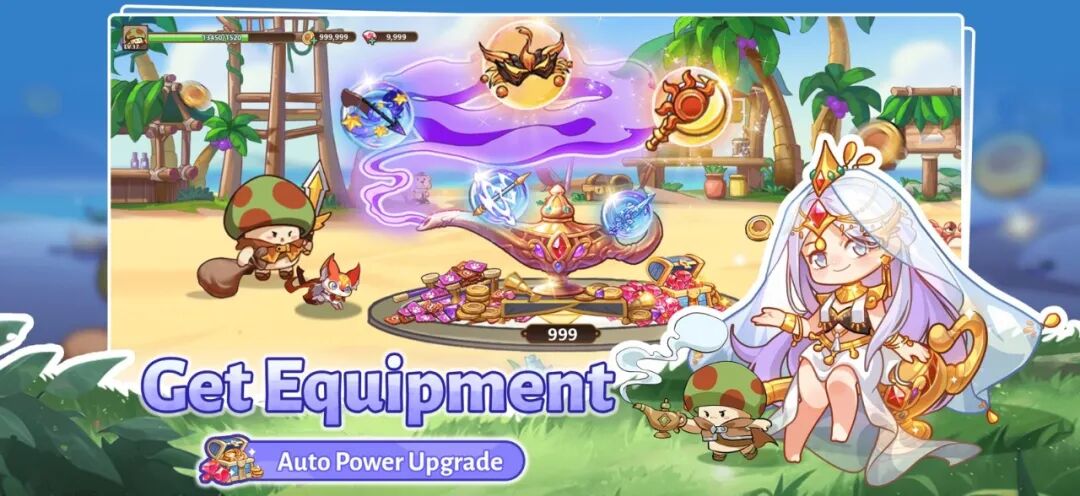
Mushroom Hero Legend’s magic lamp and gear acquisition
Duck Survival makes players face a camp that needs defending first. Where resources go and how facilities take part in defense — the defensive payoff of these choices only shows up when the monster wave arrives. The character and pre-built facilities open fire together, giving earlier construction investment a combat sequence to demonstrate itself.
Both titles can keep expanding content around character cultivation, but the starting points differ. Mushroom Hero Legend first hands out the gear-acquisition result through the magic lamp; Duck Survival lets construction and defense unfold in sequence. The former organizes the screen around a new piece of gear, while the latter can present change through the process of resource investment and the incoming monster wave.
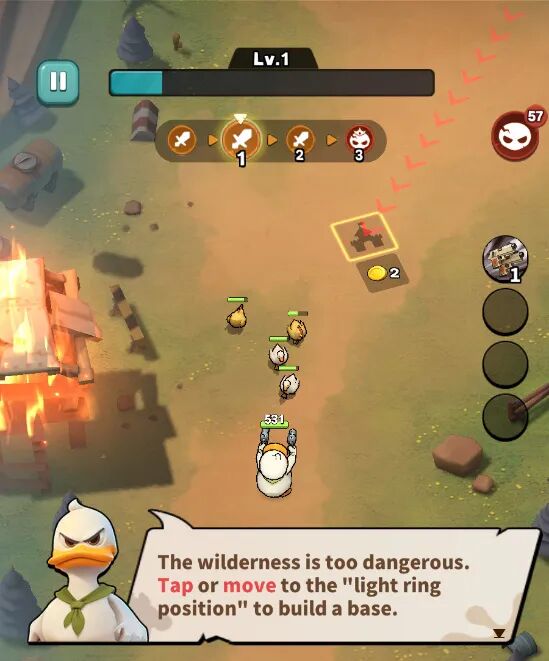
Duck Survival unfolds the experience through camp building and defense
Ads pick different selling points, each mirrored in-game
The camp demands both management and combat, so ads can open from different angles.
One management-focused creative strings together collecting gold, buying buildings and choosing buildings with the voiceover “making money is the real business.” The screen’s attention stays on where the money goes: gold gets collected, then converted into new construction, and only after that do these investments take part in defense.
This kind of creative can narrate how a pool of resources gets used. Construction is the main action in the frame, defense gives the earlier investment its purpose, and management and combat gain a before-and-after relationship in the ad.

The ad puts “making money is the real business” into the wave-defense scene
The other creative hands the camera to a duck moving and shooting along a forest road. The character passes a container area, enters a camp set with defenses; monsters then get denser and denser, the character and surrounding facilities open fire together, and a victory settlement appears at the end.
This ad organizes the frame through road progression. The character advances and shoots; after entering the camp, the scene shifts from roadside encounters to concentrated defense. The changing density of the monster wave gives the second half a pressure unlike the opening, and the facilities enter the frame as combat unfolds.
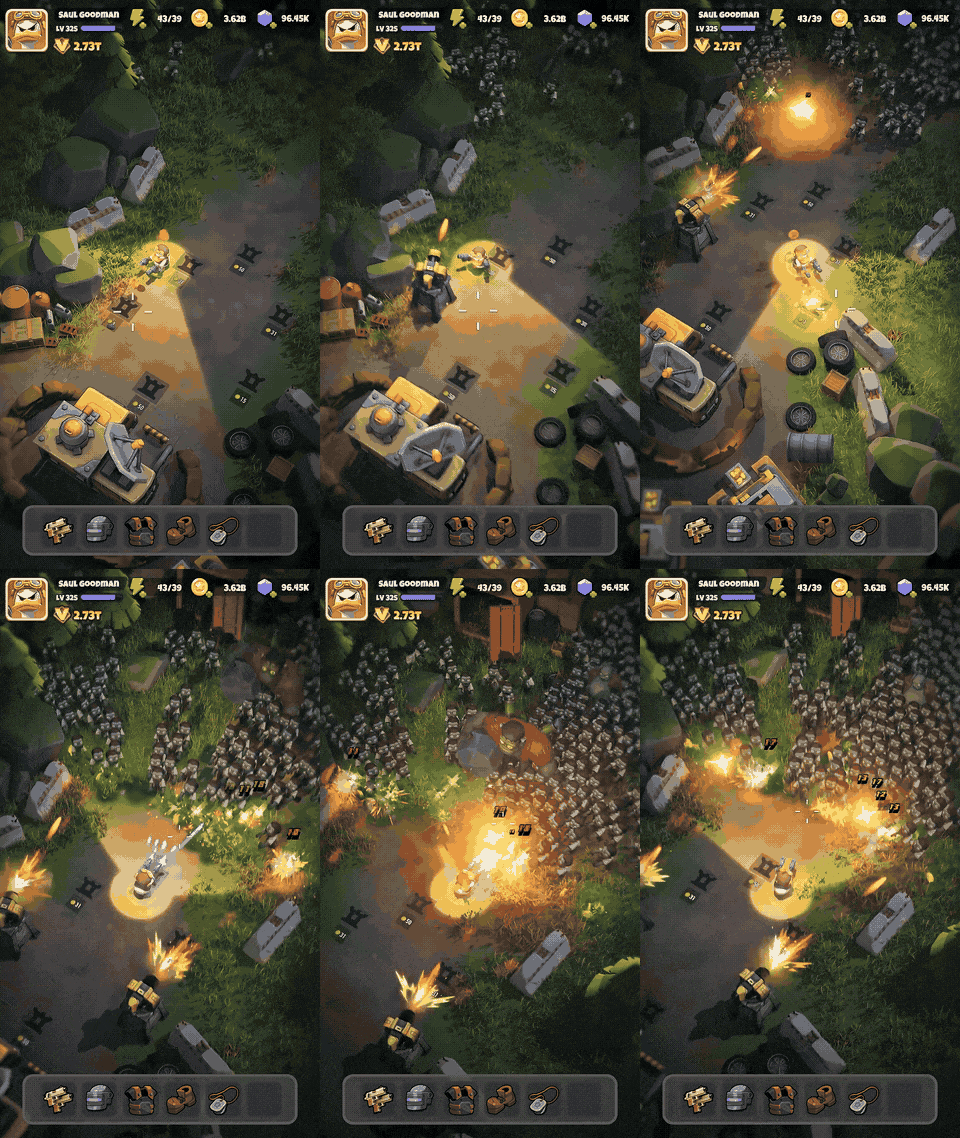
The ad moves from road shooting to camp defense
The two creatives use different narrative orders. One starts with collecting gold and buying buildings, then shows the defensive purpose; the other first shows shooting and spatial progression, then concentrates the monster wave and camp firepower in one place. The management choices and combat scenes in the product each support a fairly complete ad on their own.
In the Japanese market, promotion added growth rewards and local topics. Pre-registration rewards include up to 777 draws, putting obtainable rewards right up front; the official theme song MV “Shachiku no DUCK Keikaku” (roughly “The Office Worker’s DUCK Plan”) places the duck in the “office worker” context.
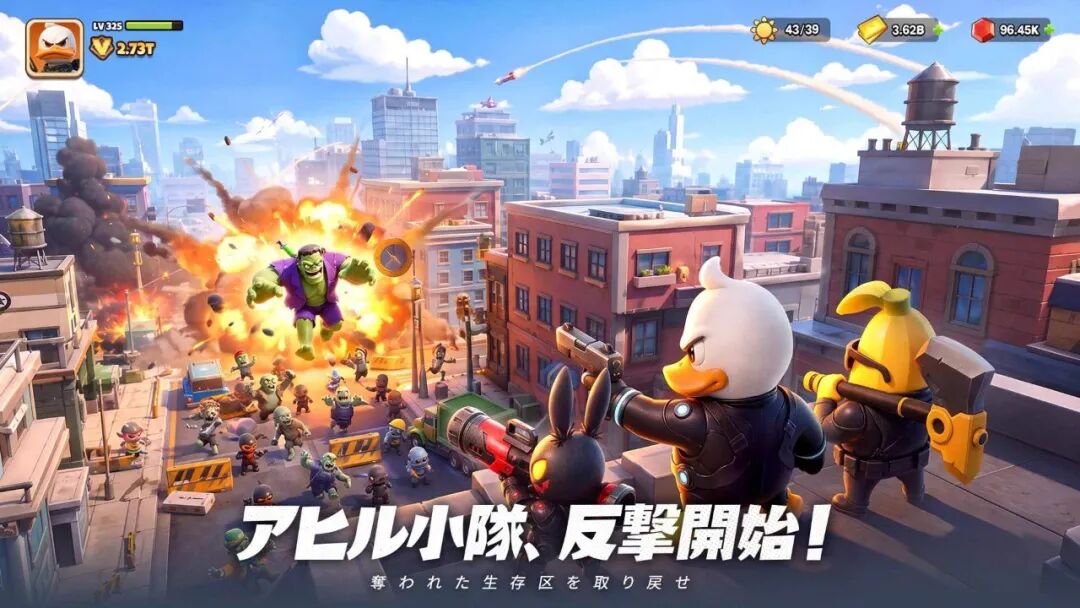
Japanese official promo art showing the duck squad fighting zombies
Conclusion
Gold spent during the day becomes home-defending firepower at night; changes from hero cultivation affect the skill choices of the next run. Duck Survival strings construction and combat together, and ads find different entry points too — starting from management or showing shooting first, there’s corresponding content to keep unfolding in-game.
On the publishing side, the product’s revenue accumulation continues. The international version built downloads across markets first, and the later Traditional Chinese version’s cumulative estimated revenue has approached the international version. The nearly ¥200M in estimated store revenue is jointly contributed by these regional versions. Understanding this flock of ducks’ overseas results means looking not only at how it makes defending a home fun, but also at how regional publishing kept revenue coming afterward.