

In the second half of the year, many sellers in Southeast Asia's e-commerce market have felt it: order growth is sluggish, mega sales no longer explode the way they used to, and with several markets' local currencies weakening, doing business has become especially awkward.
Yet while some sellers watch exchange rates eat into profits, PDD's main site has been running its 'free shipping on one item' push for Southeast Asia at full steam, and local consumers with shrinking purchasing power have been pushing their carts toward a batch of domestic merchants.
PDD's heat spreads from Singapore, Malaysia and Thailand to Manila
PDD's domestic main site rolled out 'free shipping on one item' in Singapore, Malaysia, and Thailand one after another — overseas consumers can pick items tagged 'free shipping' without meeting any minimum order, then simply wait for delivery.
The result: Singaporeans scrambling to buy Xiaomi purifiers on PDD, piles of green oversized parcels piling up outside apartment buildings in Malaysia, and Thai-Chinese shoppers with hundreds of in-transit orders sitting in their 'pending receipt' list...
Singapore, Malaysia and Thailand all have large Chinese consumer bases, and local users were already well educated by domestic e-commerce — so the buying frenzy is hardly a surprise.
But after the Philippines site launched 'free shipping on one item' in August, the frenzy exceeded all expectations. Some netizens shared that even bank tellers in the Philippines were discussing how to buy cheaper.
The Chinese community is certainly part of the push, but as the editor browsed social media, large numbers of local consumers are also joining the buying spree — and it's already hitting sellers on other e-commerce platforms.
Some Shopee and TikTok Shop sellers report order volumes down over 20%, partly blaming PDD's low-price free shipping.

To be sure, the logistics infrastructure, localized payment systems, and user-trust moats that leading platforms like Shopee built over years of deep cultivation can't be shaken at the root overnight. According to Momentum Works data, the head effect among Philippine e-commerce platforms remains extremely solid: Shopee leads the first tier with 42%–52% market share; Lazada holds second place at around 28%; and TikTok Shop is growing fast, grabbing roughly 15%–19%.
So if the legacy giants' moats are still solid, why does PDD deliver such a strong shock?
The colder the market, the better PDD does
At bottom, the chill of the macro environment is the biggest tailwind.
The most striking sign is FX: the Philippine peso has hit 34 record lows this year. Money is losing value while prices keep soaring — Philippine Statistics Authority data for September shows headline inflation hitting 7.2%, the highest in three years.
Many Philippine buyers found local platforms' goods getting pricier too, while PDD's 'no lowest price, only a lower one' pricing base precisely hits the pain point of tightening wallets.
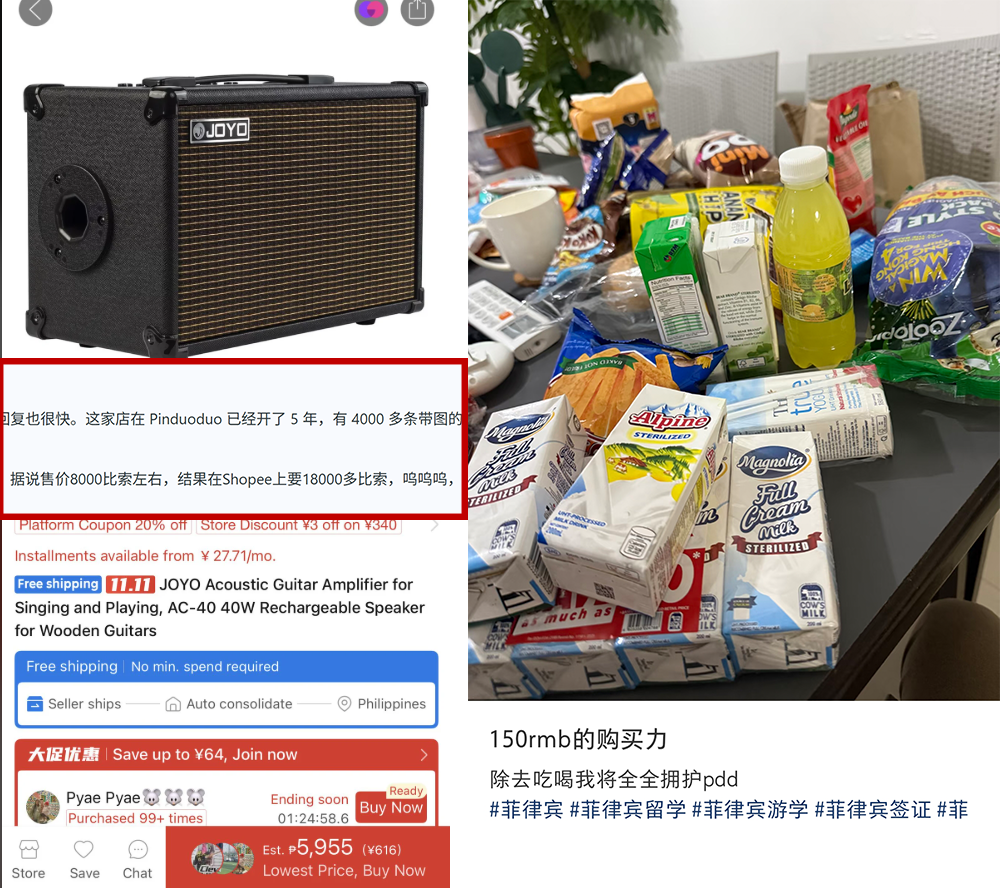
The willingness to spend hasn't changed — consumers' purchasing power has simply shifted. According to the Philippine central bank (BSP) Q3 survey, the consumer confidence index fell to -29.8%, stuck in negative territory for over three years, with the pessimism index for the bottom group earning under 10,000 pesos a month as high as -39.2%. An even more direct signal: the next-quarter consumption outlook plunged to 45.7%, and big-ticket purchase intention over the next 12 months fell to -71.3%.
That's when PDD's supply-side advantage fully unlocks — from household essentials and fashion accessories to niche collectibles and even scarce goods hard to find offline, almost everything can be bought.
More crucially, this budget squeeze has brought out Southeast Asia's sharpest calculators. Lazada and Cube's report shows as many as 36% of Philippine online shoppers rank as the highest tier of 'smart shoppers' — far ahead of the other five Southeast Asian countries. This group, extremely good at comparing prices and scrutinizing seller qualifications, found that PDD isn't just cheap — items from different sellers can be automatically merged into one package delivered to their doorstep before shipment.
That combination of moves flattened the once-high barriers to cross-border shopping — and in this economic winter, it ignited Philippine consumers' purchasing power almost overnight.
For Southeast Asian sellers whose performance has been under pressure for months, PDD's overseas surge is unquestionably a new money-making path. Lately, sellers' groups have indeed been asking how to onboard and start overseas shipping.
But is this deluge of traffic really that easy to catch?
Hidden pitfalls under the traffic deluge
Facing suddenly inflowing overseas orders, many domestic merchants lacking cross-border experience step into one trap after another before tasting any sweetness:
On Heimao Complaints, some merchants complain they simply cannot find the switch to turn off cross-border consolidated shipping orders. Large numbers of orders are directly rejected and returned for failing the consolidation warehouse's size or category standards, leaving the resulting freight losses and after-sales costs to be borne unilaterally by the merchant.
Other merchants report sending parcels through standard processes to PDD's designated domestic consolidation warehouse for shipment to Thailand — only to have the warehouse refuse to ship even after 10 full days.
For domestic merchants used to the domestic supply chain, the complexity of cross-border logistics far exceeds their expectations. And for Southeast Asian consumers used to speed-first service, the experience feels like 'opening a mystery box.'
Netizens report that PDD cross-border orders often take twenty-plus days or even over a month to arrive, with damaged or lost parcels along the way being routine.
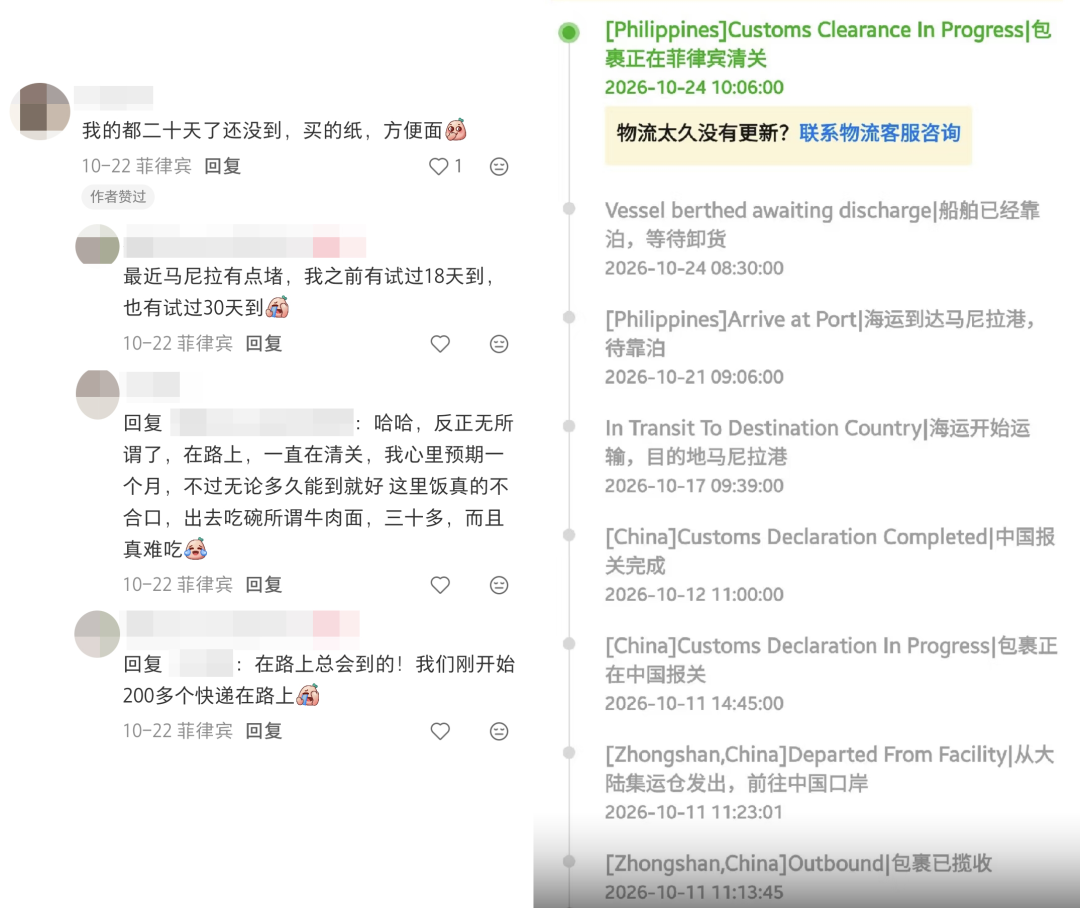
The wait is so long that some buyers are even planning to pick up goods themselves at ports or transit warehouses. Perhaps due to food-safety concerns, netizens say PDD has stopped shipping food to Thailand.
The problems above are closely tied to PDD's current cross-border selling mechanism on its domestic main site:
Everyone joins by default: store products automatically participate in cross-border consolidation by default — merchants don't need to sign up, but opting out isn't easy either;
Traffic goes abroad automatically: as long as a store enables in-site promotions, the system automatically pushes products to overseas regions, with the platform subsidizing overseas users' low prices and cross-border freight by taking a cut of merchants' ad spend;
Segmented long logistics chain: the whole process splits into 'merchant → domestic consolidation hub (Shenzhen, Dongguan, Langfang, etc.)' and 'hub → overseas customs clearance, bundling, last-mile delivery.' The platform only assesses the front-end pickup timeliness of shipments to the domestic warehouse and covers cross-border freight, but the handoffs rely heavily on the hubs' processing capacity;
Uncontrollable auto-bundling: multiple items to the same address are automatically combined for shipment by the system — merchants can't manually split or intervene in distribution, and one misstep can trigger the consolidation warehouse's rejection rules.
Sellers can probably see that this is a completely different operating code from local-warehouse shipping or cross-border POP models. On platforms like Shopee, sellers have relatively concentrated control over inventory, delivery timelines, and after-sales communication; PDD, by contrast, hands logistics bundling, cross-border transit, and customer service entirely to the platform.
This lack of control means sellers not only absorb losses from orders rejected and returned by consolidation warehouses, but also face negative-review damage from overseas buyers fed up with long consolidation waits, missing items, and wrong shipments.
More realistically, PDD doesn't compete on operations — it competes on sourcing cost.
PDD is essentially a 'digital discount retailer.' Its play isn't refined operations or mega sales like traditional platforms — it uses extreme bestseller volume to squeeze the supply chain in reverse, forcing manufacturers to cut prices — the 'horse-race mechanism' as the industry calls it.
Traffic flows toward items with the lowest prices across the entire network. Most products that get system recommendation come from source factories or large wholesalers with strong supply-chain bargaining power. The 'information gap' and 'localized product selection' that Southeast Asian sellers once prided themselves on are flattened entirely by the flood of domestic mass-market goods on the main site.
At the same time, PDD product pricing is often squeezed down to a few cents. That works in a purely domestic environment where returns are convenient — but once a long cross-border chain is added, the thin-margin model collapses.
If Southeast Asian sellers blindly jump in, they won't just fail to transfer their existing operational advantages — they'll be gnawing at source factories' hard bones with their own razor-thin profits, burning energy and capital on uncontrollable hidden costs and after-sales risks.
Hitting the policy wall
Sustained demand heat is bound to draw the attention of local regulators. Although no country's policy explicitly names PDD, every one of them lands precisely on the platform's model fulcrum.
First to take the hit is the 'low-value duty exemption' dividend that underpins rock-bottom prices. Vietnam has already scrapped duty-free treatment for small parcels, and Thailand cut its 1,500-baht threshold to just 1 baht while requiring taxes to be folded directly into listed prices. That leaves the Philippines as the only major Southeast Asian market still clinging to its small-parcel exemption.
Yet facing the impact of up to 57.4 billion pesos of duty-free inbound goods a year, the Philippine retailers' association has been publicly pressing, and the Finance Department has officially confirmed plans to lower the exemption threshold, cap exemption frequency, and roll out comprehensive taxation. Once this last duty-free pocket is closed, PDD's price advantage gets discounted right at checkout.
Beyond the tax siege, the iron fist of administrative and compliance regulation is coming down too. As low-priced cross-border goods hit indiscriminately, local merchants have voiced strong concerns over tax disparities. In response, the Malaysian government — on top of the 10% low-value goods tax — plans to force overseas platforms like Temu and PDD to connect e-invoicing systems, and to require platforms and their partner suppliers to set up local offices subject to full daily oversight.
As regulatory nets tighten across countries, the low-price soil PDD depends on is being stripped away fast.
Of course, that doesn't mean PDD's overseas expansion has run out of steam. On the contrary, judging from the strategic resolve visible in its financials, this may only be the start of a long campaign.
Looking at PDD's books: 2025 full-year revenue hit 431.8 billion yuan (up 9.65% YoY), yet cost of sales jumped 22.68% — which the company attributes to higher fulfillment fees, bandwidth and server costs, and payment processing fees.
Entering 2026, the trend has become even clearer: as early as Q1, PDD's 'transaction services revenue' reached 56.3 billion yuan, 53% of total revenue — surpassing online advertising for the first time in history to become PDD's biggest revenue source. By Q2, the trend kept amplifying: transaction services revenue grew 13% YoY, while traditional advertising revenue inched up just 3.5%.
Of course, given Southeast Asia's weight in PDD's global map, the region likely accounts for only a sliver of that tens-of-billions transaction services revenue.
But with profits falling double digits for multiple straight quarters, cost growth more than double revenue growth, and cash reserves still as high as 456.4 billion yuan, it's clear PDD is willing to swap short-term profit for the heavy fulfillment, subsidy, and compliance costs of early international expansion — buying future growth with today's margins.
The current regulatory squeeze and ecosystem pains are just one mandatory question in PDD's globalization exam. Backed by its massive cash moat and supply-chain base, PDD's long-term imagination in Southeast Asia and beyond should not be underestimated.