

While reviewing the charts recently, our editorial team noticed an unusual jump in the monthly revenue of the AI language learning app Midoo. According to AppMagic, Midoo's revenue after the app store share came within a hair of $1 million in September.
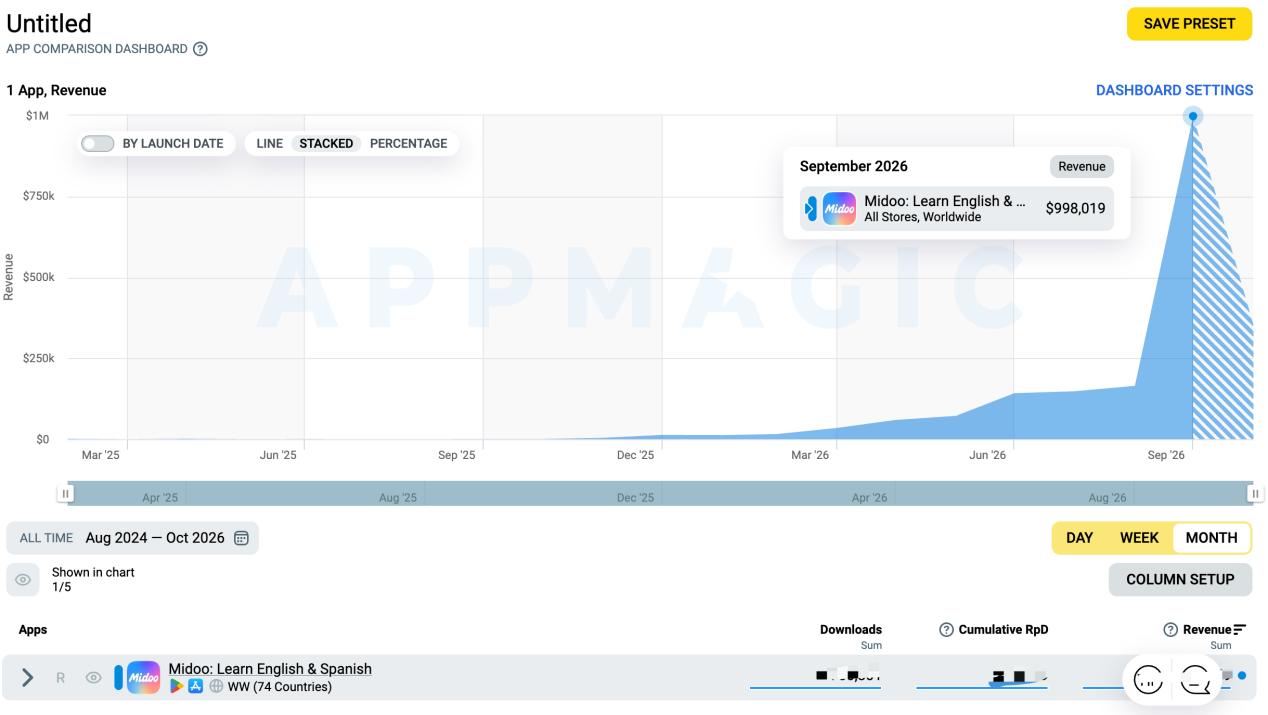
Midoo revenue | Source: AppMagic
This result is not new for AI language learning products, but in recent years most of the breakout hits have been overseas products, with few Chinese teams delivering. Midoo is an exception. Founder Mark previously built TalkAI, a spoken-English practice app that became very popular in China, and co-founder Leo helped develop Fellou, the once-famous AI browser. For a long time after launch, Midoo's downloads numbered only in the hundreds and revenue was almost negligible. At the time, the prevailing assessment was…
1. No vertical slicing: one product serving “everyone”
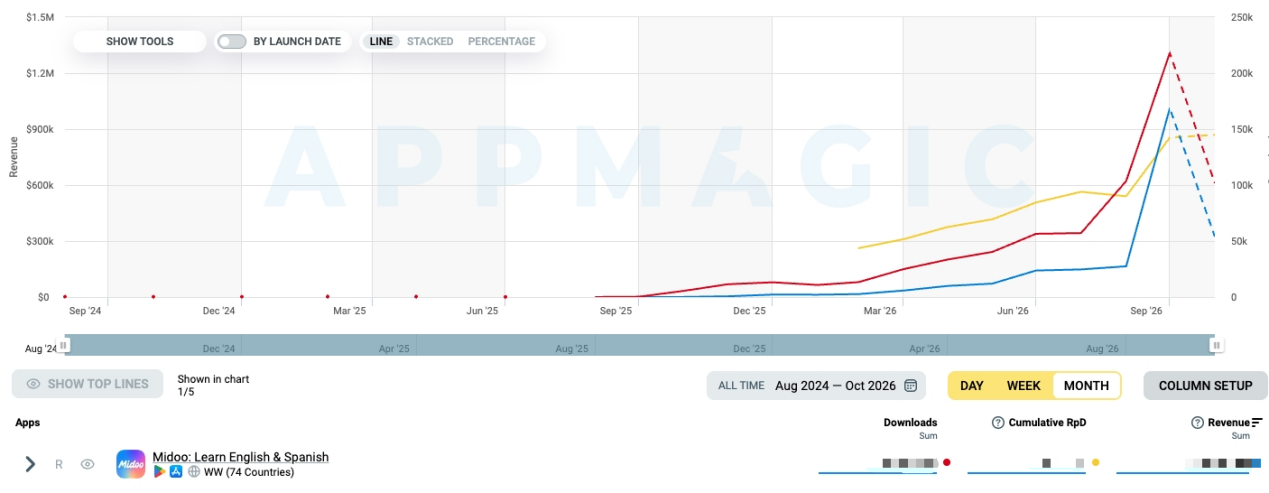
Midoo downloads (red line), monthly revenue (blue line), RPD (yellow line) | Source: AppMagic
Looking at the downloads, monthly revenue and RPD data from AppMagic (excluding domestic Android, so the real numbers may be higher), all three metrics jumped in September at the same time. RPD in particular is now close to or even above that of products at the same revenue level, such as Loora and ELSA. This means the revenue surge did not come simply from more people downloading the app — revenue per download also went up.
On the acquisition side, Midoo's core strategy is influencer marketing on Chinese social media. Searching Midoo on Xiaohongshu (RED) and Douyin shows a wave of promotional content that appeared in late August, mostly posted by study-abroad, study and workplace bloggers. Interestingly, the promotions split into two clearly different directions by audience.
One direction targets users with clear exam goals — study-abroad students preparing for IELTS, high school students facing the gaokao, and college students going for CET-4/6. The core feature showcased is “AI customization”: users enter their goal on Midoo's AI chat page and the AI generates matching course content. In these videos, Midoo is presented as a personal coach that “sets tasks based on your goal”, rather than a one-size-fits-all course.

A coffee shop ordering mini-game demoed in Xiaohongshu content
The other direction targets office workers with weaker goal orientation, with the selling point shifted to “gamified painless learning”. Bloggers role-play a coffee shop ordering mini-game: users play the customer and hold English conversations with an AI barista, passing a level once the order is complete. Some bloggers even call Midoo the “4399 of English learning”.
Taken together, the two types of promotion show Midoo's acquisition audience is quite broad: IELTS-bound students, gaokao-prep high schoolers, and office workers wanting to pick English back up — covering everyone from weak-goal to strong-goal users.
This approach is unusual among the language learning products that have broken out in the past two years. Most products start from a narrow niche, validate it, then gradually expand. Speak launched in South Korea first, later entered Japan, and only in the last two years added Spanish and French courses for Western markets. ELSA started with pronunciation correction alone and only later added AI conversation and grammar/vocabulary. Learna's core audience is still immigrant English learners in the US. Midoo's first wave of growth, by contrast, directly uses AI to…
On the other hand, by steering users toward higher-priced subscriptions, Midoo's revenue got a second boost.
Midoo puts its paywall on plan generation and study time: free users get only 5 minutes of study per day and can generate an extra plan just once, making the app barely usable without paying. Subscription prices are RMB 118/month, 268/quarter and 368/year; the monthly and quarterly options are clearly priced high, deliberately steering users to the annual plan. According to the China in-app purchase structure from Diandian Data, the design works: annual subscriptions contribute about 30% of IAP revenue.
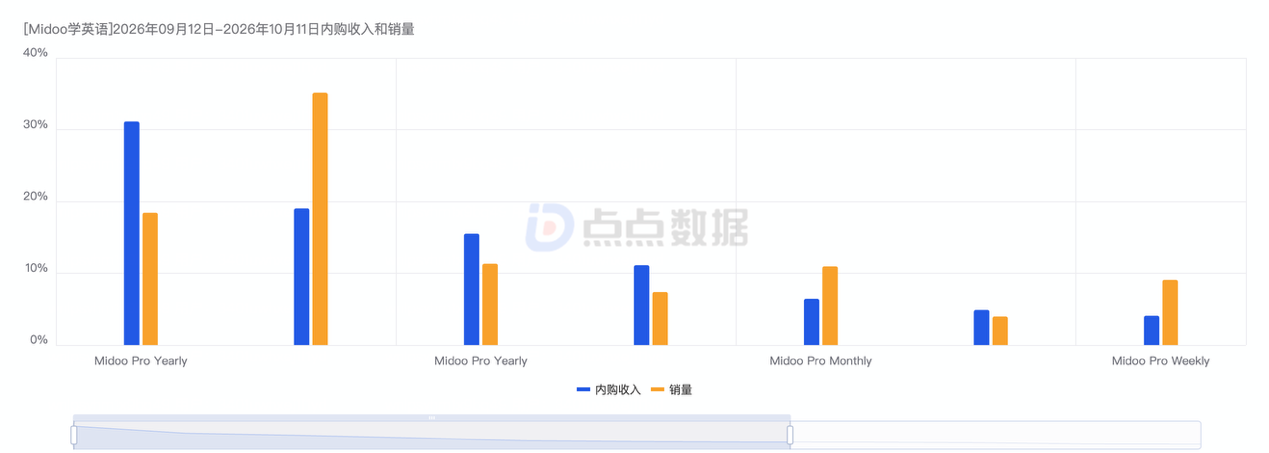
Subscription prices: RMB 118/month, 268/quarter, 368/year | Source: Diandian Data
But widening the audience also means Midoo has to face competitors in every vertical. Can one product truly serve both IELTS-bound students and office workers picking English back up?
2. AI can customize “what to learn”, but not “how to learn”
As Midoo's founders have previously revealed, the product's underlying logic is a unified “skeleton” built on a knowledge graph and a competency-level model, with AI dynamically generating specific learning content based on each user's goals, interests and real-time performance. To test whether this mechanism can truly serve diverse audiences, we ran two very different goal-based trials.

Opening Midoo, the first thing you see is an AI chat page that asks about your needs and language level through conversation. Users can reply by typing, voice, or tapping preset options; once done, the AI generates a “course” based on your needs. During use, you can also create new study plans via the center “Midoo” tab — free users get one extra generation, subscribers can generate unlimited plans.

Opening the app asks your level (left), multi-plan switching supported (center), AI ChatBot page (right). Users can switch between study plans on the course page (see image 2); the ChatBot in the Midoo tab also supports updating plans, completing reviews, and scenario practice.
We first tested with the goal of “preparing for an in-depth conversation in the advertising industry”. The AI produced three sections — “establishing a professional conversational tone”, “handling deep follow-up questions”, and “wrapping up with polish” — along with some quite practical expressions. The course volume is substantial, enough for more than half a month at a daily-study pace, and plans can be adjusted anytime.

Learning is delivered through AI digital-human instruction, mainly in the form of repeat-after-me with pronunciation correction, and practical expressions are taught through example sentences.
Conversation itself is a speaking scenario, and Midoo's core teaching method matches other competitors: “repeat after me + speech-recognition correction”. The practice content can be used directly in real scenarios — under this goal, “what to learn” and “how to learn” align.
In speaking scenarios, Midoo performs well and the AI can design courses around fine-grained user needs; in its screenshots and description, the developer also positions Midoo as a “speaking product”. But when we tested the “IELTS prep” scenario from the social media promos, “what to learn” and “how to learn” started to diverge.
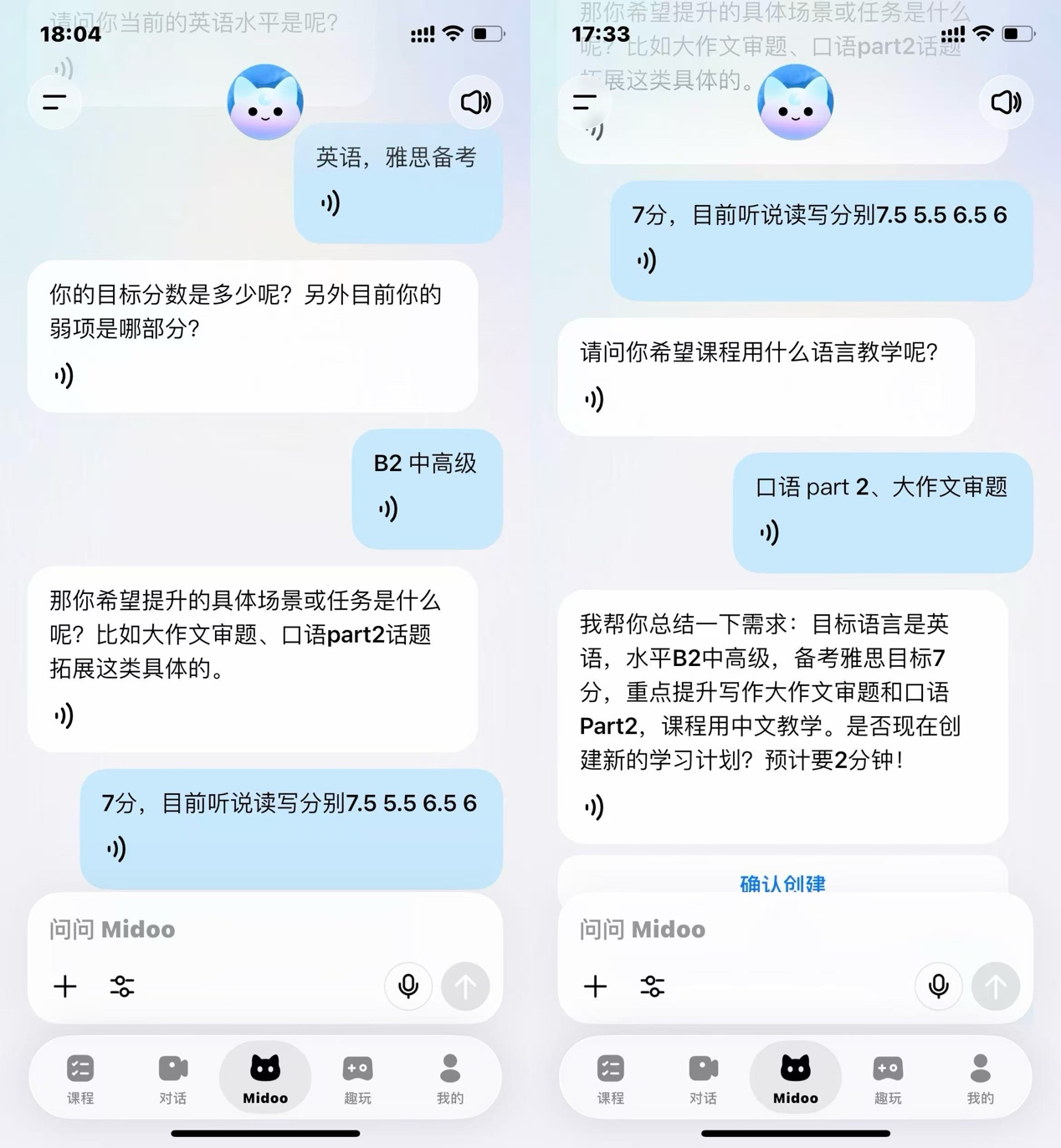
Interacting with the AI for IELTS prep: the AI offers options and the user simply taps to select.
When we set the goal of “IELTS prep”, the AI first asked for the specific task and offered options such as “essay task analysis” and “Speaking Part 2 topic expansion”. After selecting these and generating the course, the speaking scenario was identical to the earlier test. But in the writing scenario (essay task analysis and thesis building), the learning goal and the learning method mismatched.
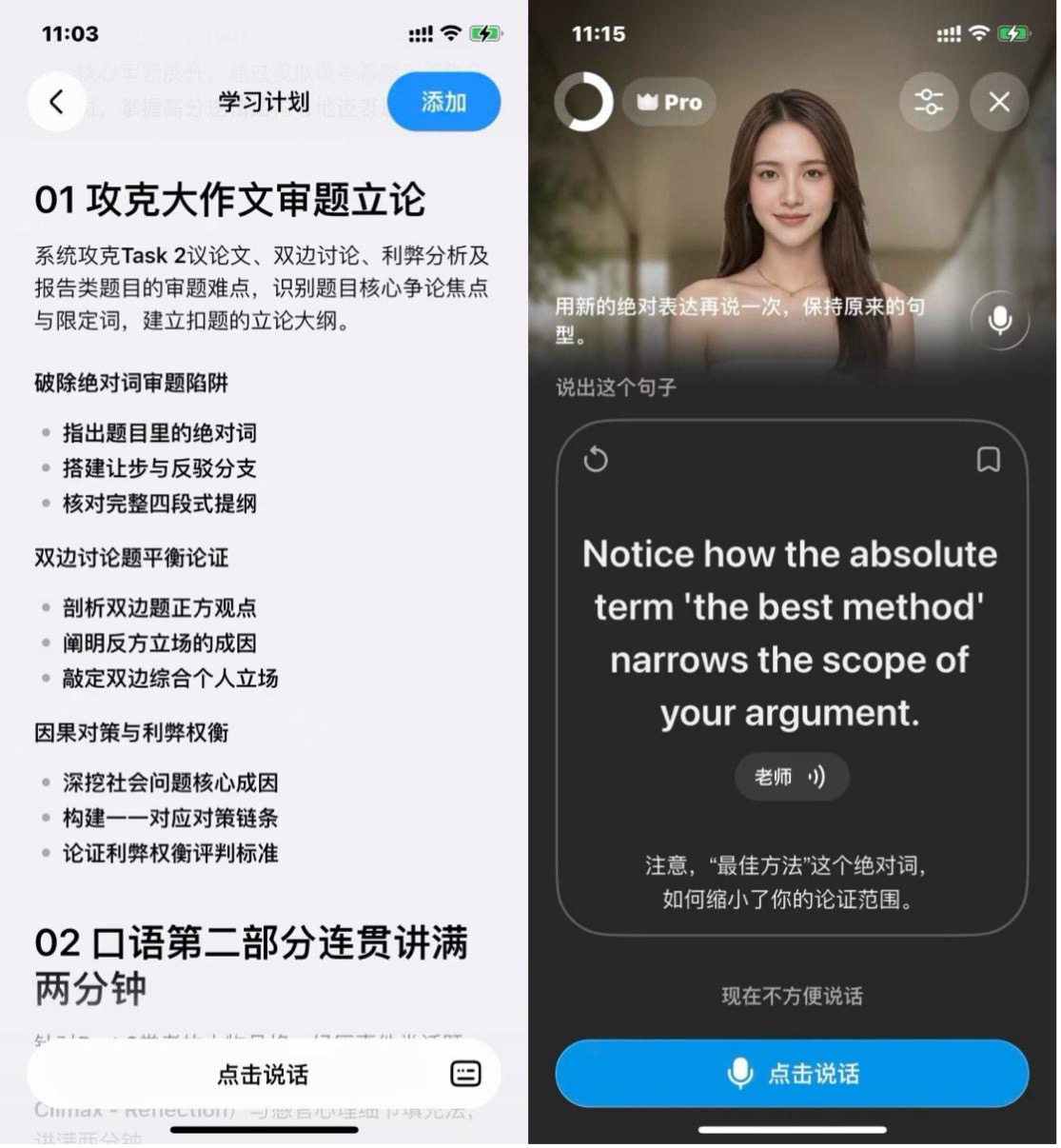
The author chose two directions — “speaking practice” and “writing essay task analysis”. The AI did generate a correctly-directed course (left), but the teaching method was identical to the speaking scenario (right).
In our tests, the AI's plan remained correctly directed, covering key stages such as prompt decomposition and argument structure, and the course included some practical expressions — that is the good side.
But on the other side, although the course explicitly targets the writing scenario, the teaching method is still the speaking playbook. For example, in the lesson “how to spot absolute words when analyzing a prompt”, Midoo gives a sentence meaning “notice how the absolute word 'best method' narrows the argument”, then asks us to repeat it, paraphrase it, and get pronunciation corrections — and the lesson lasts only 5 minutes, covering just 3-4 absolute words like “only” and “best method”. In reality, common absolute words in IELTS Task 2 essays include…
Even in the narrow scenario of “writing task analysis”, Midoo still trails IELTS vertical products by a wide margin — not to mention that vertical products also offer essay grading, regularly updated past papers, and more.
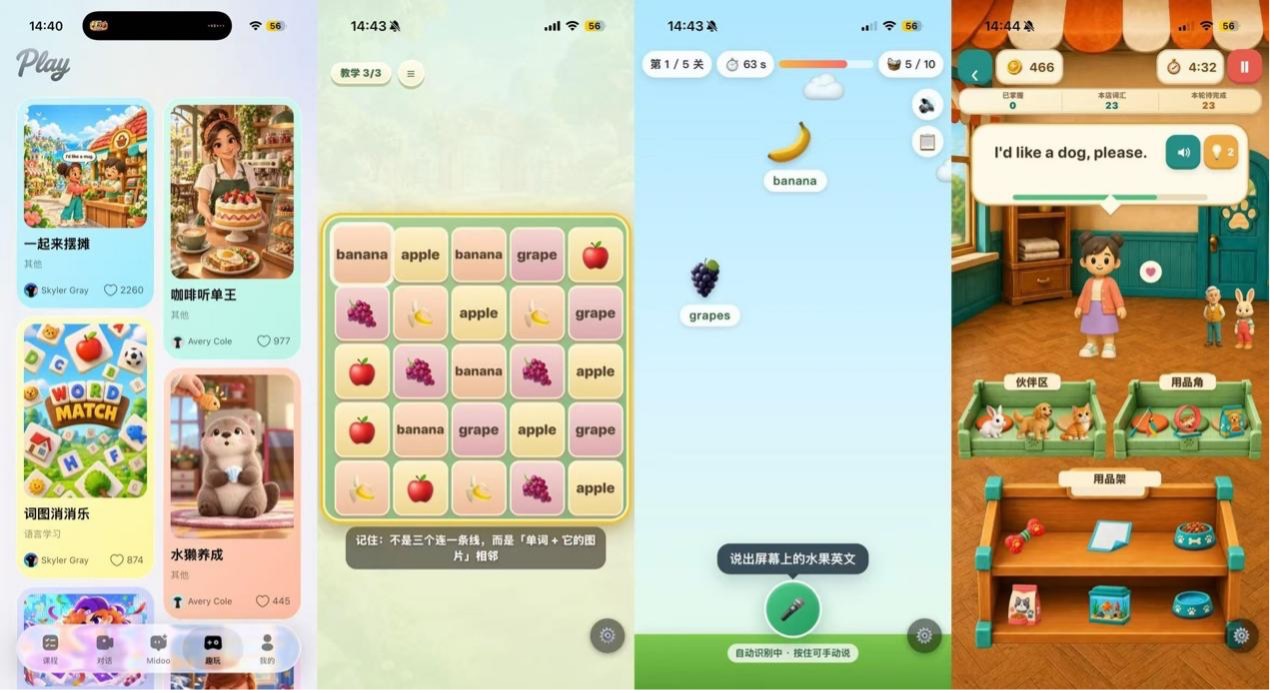
Another selling point, “gamified learning”, sits in the fourth tab, “Fun Play”. The games — simulation management, match-3 and more — teach everyday vocabulary; besides games there are bedtime English podcasts, virtual pets and so on. But in practice, the games barely connect with the “courses”, feeling more like a “leisure zone” to relax in after studying.
The problem is becoming clear. Midoo's approach — using an “AI skeleton” to customize “what to learn” for different users — genuinely works in speaking scenarios and can cover niche needs other speaking products miss. But when Midoo targets, undifferentiated on social media, users with clear goals like IELTS and gaokao whose needs are not speaking-only (IELTS writing, gaokao cloze tests, etc.), it plants the seeds of a mismatch between marketing and product delivery.
Final Thoughts
Back to the opening question: Midoo managed to push revenue up this much in a month through three things stacking together. AI-generated courses fill the personalization gap vertical products don't cover; influencer marketing carves out goal-specific entry points by audience, pulling in IELTS students, high schoolers and office workers alike; and the pricing design concentrates payments on annual subscriptions, lifting RPD.
Midoo won this round of acquisition by “going broad”, but whether it can keep making money depends on whether the product can actually serve the people it pulled in. If only speaking-scenario users stay, “serving everyone” remains stuck at the acquisition stage, and the audience Midoo can ultimately serve steadily will still be far narrower than imagined.
AI has largely solved personalization of content. Personalizing the teaching format itself is the next real problem that may need solving.

A "Watershed" for Two Tech Giants' Ad Businesses: AI Empowers Meta, but Becomes a "Straightjacket" for Google Search
AI is helping Meta improve ad delivery efficiency and expand monetization opportunities, while it may be eroding the traditional search-advertising model on which Google depends.

From Character.AI to OOC: After the Old King Restructures, How Does the New King Break Through? | A Frontline Dialogue
From the bankruptcy restructuring of Character.AI to OOC reaching $70M ARR, three practitioners in AI interactive entertainment unpack what the new generation of AI companionship products did right, why they hide real-time generation, and what creation really means.

96 Minutes a Day, 8x Growth in 9 Months: ByteDance's Overseas Short-Drama Apps Approach the 'Hongguo Threshold'
Is ByteDance about to replicate Hongguo's growth path overseas once again?