

Overseas short drama may really be about to produce a Hongguo-level player.
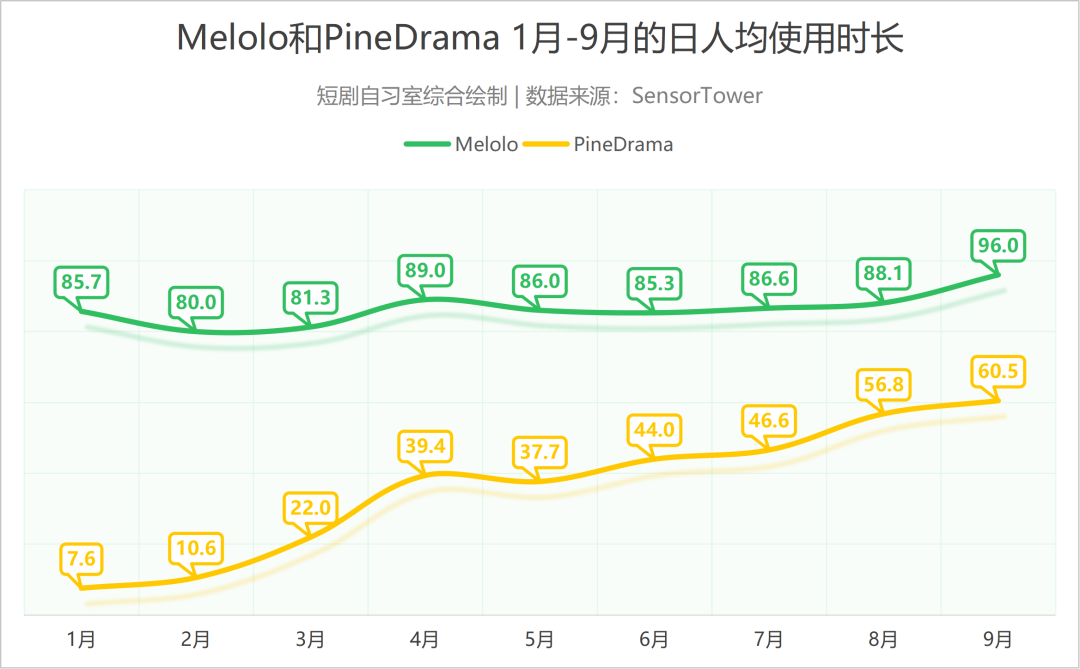
Look at two numbers first: 96 minutes, 60.5 minutes.
These are the daily average time-per-user of ByteDance’s two overseas short-drama apps, Melolo and PineDrama, last month — meaning users spend on average an hour and a half a day watching short dramas on Melolo, or an hour on PineDrama.
What does that mean?
Among the top 36 overseas short-drama platforms tracked by Duanju Zixishi, the median and average daily time-per-user in September were only 13.6 and 17.1 minutes; no other app exceeded 30 minutes.
Whether 1.5 hours or 1 hour, these are striking numbers in the battle for user attention.
Not long ago, PineDrama drew attention with its download numbers: launched less than a year ago, it has surpassed 100M cumulative downloads with about 7M daily active users.
SensorTower data further shows PineDrama’s DAU has stayed above 8M since October, breaking 10M on October 18.
Remember the days when Douyin and Hongguo short drama repeatedly disclosed user scale and playback numbers: a new business still growing suddenly produced results the whole industry had to stare at.
Now Melolo and PineDrama are ramping up fast overseas, and it’s hard not to ask: is ByteDance about to replicate Hongguo’s growth path overseas once again?
Four short-drama apps in a horse race, two pulled ahead
Based on public information, PineDrama is ByteDance’s fourth card played.
In the first three rounds, two apps had basically stopped growing.
From January to September this year, PineDrama, Melolo, LimeShorts and PikoShow tried different markets and product models, with 230M cumulative global downloads, almost all of them free-model downloads.
Seen this way, what ByteDance bet on is still free short drama; both main apps Melolo and PineDrama follow this route.
Competition among short-drama apps can’t be judged only by who pulls users in; it also matters whether users keep watching and keep generating revenue once inside.
Duanju Zixishi recorded Melolo’s September MAU at 52.25M and DAU at 15.31M, with fairly deep user engagement and a D30 retention of 10.08%; PineDrama’s MAU was about 38.17M, with D30 retention of 4.66%.
If downloads prove ByteDance can push products overseas, then continuously growing usage time means it is starting to win user attention.
A user may install an app because of an ad, or leave after finishing one drama. Only when users keep opening the product and repeatedly consuming content does the download really have a chance to settle into long-term value.
We tracked 36 top overseas short-drama apps, and the differences in daily average time-per-user are striking — Melolo and PineDrama lead on multiple dimensions by a wide margin.
First, the absolute time numbers for September.
Melolo and PineDrama had 96 and 60.5 minutes of daily average time-per-user respectively; the month’s median and average were only 13.6 and 17.1 minutes, and no other app’s number exceeded 30 minutes.
Over an hour is no longer the consumption intensity of occasionally opening a short drama; it’s a fairly substantial daily time commitment.
From January to September, people spent on average about 31.5 billion minutes a month on Melolo and 5.214 billion minutes on PineDrama.
Now the growth in time.
Melolo’s daily average time-per-user has stayed above 80 minutes all year with little fluctuation, breaking through 90 minutes in September with steady growth; PineDrama’s user-time growth line is strikingly steep, nearly tripling since the start of the year.
QuestMobile data shows Hongguo’s monthly average daily time-per-user in Q3 2026 was about 151 minutes.
Hongguo launched in August 2023 and grew to 151 minutes in three years; Melolo launched in November 2024 and exceeded half of Hongguo’s time in 22 months, approaching 100 minutes; PineDrama, launched in April 2025, has been climbing steeply since June this year.
Clearly, with the free model ByteDance can chase acquisition and retention at the same time, rapidly widening its short-drama path overseas; it now holds one product that has accumulated large amounts of user time and another still rapidly raising user engagement.
For going overseas, ByteDance starts with the easy parts
So the next question is: where is ByteDance heading overseas?
The answer: Southeast Asia, North America and Latin America.
From January to September 2026, Indonesia was the best market for both Melolo and PineDrama; other key markets differ a lot: Melolo is concentrated in Southeast Asia with Indonesia contributing over 60%; PineDrama has a more even distribution across regions.
Interestingly, though both come from the same house, the two apps’ Indonesian users overlap heavily.
From January to September 2026, 42.81% of PineDrama’s active users also used Melolo, while only 15.12% of Melolo’s active users also used PineDrama.
The big gap may be because Melolo started earlier in Indonesia, has a larger user base and has built a degree of usage habit.
In terms of users and market coverage, part of PineDrama’s product significance is taking ByteDance’s short-drama business to broader markets — in Brazil, PineDrama’s downloads are about five times Melolo’s.
Overseas short drama is not a unified market, which means PineDrama’s development path can’t fully copy Hongguo.
What Indonesian users like may not fit the US; a free strategy that works in one market may not earn the same revenue in another. Language, culture, willingness to pay, ad prices and acquisition costs in different regions can all change a product’s business outcome.
So ByteDance chooses to spread the eggs, exploring content preferences, user scale and monetization space in different regions.
In an era of exploding AIGC capacity, this can clearly be done quickly — the old cost and cycle barriers have been knocked down, which is also one reason PineDrama’s numbers started surging this year.
TikTok short drama monthly revenue share tops 200M, aiming at the ecosystem
TikTok’s moves this year all focus on letting short drama enter users’ familiar content-consumption scenarios directly, aiming at a full-loop closed chain and ecosystem: users can discover series in the recommendation feed, search and other entry points, and enjoy a native in-app short-drama viewing experience.
Last week, Duanju Zixishi recorded TikTok’s native short-drama market staying at a high level, with a combined 8.13B play increment and more than 90,000 titles growing.
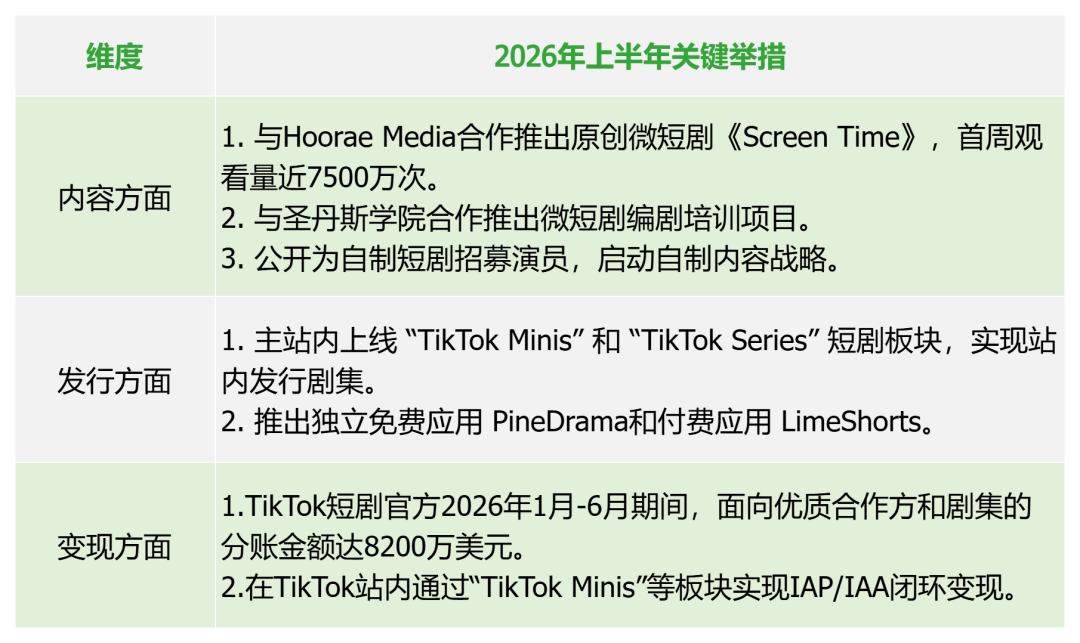
Let’s break it down:
At the product level, TikTok launched the “TikTok Minis” and “TikTok Series” short-drama sections in the main app this year, enabling in-app series distribution and closed-loop IAP/IAA monetization.
In June, TikTok launched the in-app ad system “TikTok Growth Max: Mini Dramas,” supporting paid traffic to specific series inside mini programs.
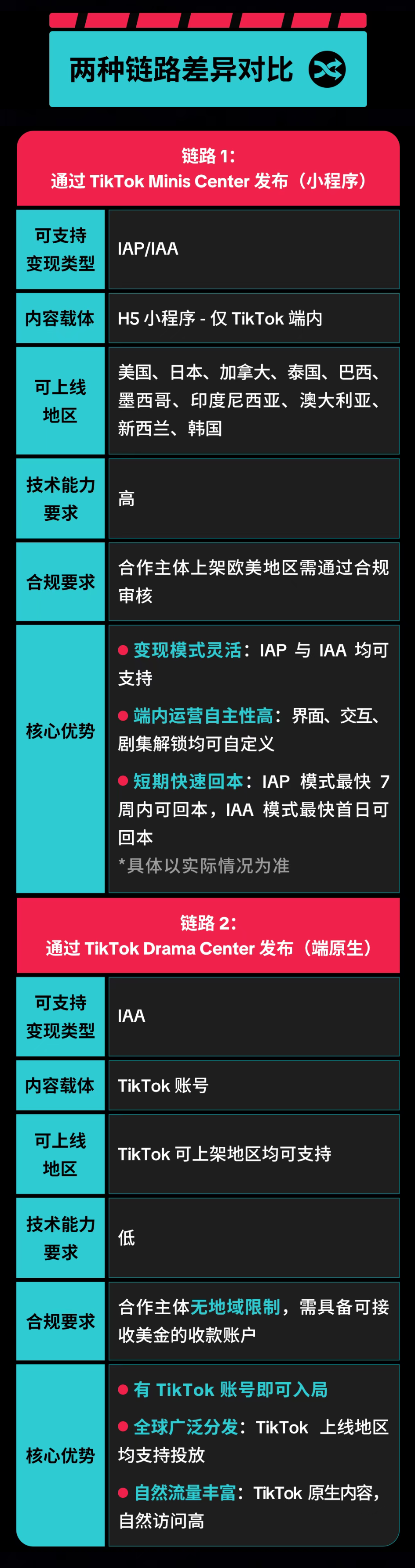
Two core paths now exist inside TikTok:
First, publishing via TikTok Minis Center (mini program), supporting hybrid IAP and IAA monetization;
Second, publishing via TikTok Drama Center (native), built around TikTok accounts with IAA as the main monetization.
Source: TikTok for Business
On the policy side, TikTok published collaboration recruitment as early as January, opening a short-drama cooperation channel to global content parties, production companies and creators, with incentive multipliers up to 20x, uncapped revenue share, and a focus on supporting new-hot, exclusive and first-run content.
Since then, TikTok’s support for AI short drama has grown exponentially, launching three special policies: AI hit short-drama incentives, quality script licensing incentives, and AI short-drama production incentives. On monetization, TikTok’s Q1 total revenue share broke through 200M.

Clearly, TikTok is accelerating the build of a native content ecosystem, upgrading from a short-drama traffic entry to a native content platform; through in-app short-drama sections, content revenue share and cash incentives, it pulls production, distribution and monetization into a closed in-platform loop, deeply affecting local creator supply.
Putting the above layout together, ByteDance is doing three things at once.
First, testing content and business models in different markets through products like Melolo and PineDrama; second, using TikTok’s content distribution to explore shorter user discovery and viewing paths; third, through Drama Center, opening an in-app ecosystem for short drama to outside content and production partners.
The core of this playbook is turning the business of selling stories and selling traffic into something systematic, supporting the ecosystem with a mature production chain to withstand the risks of the overseas short-drama market.
Of course, whether Melolo and PineDrama can keep acquiring and retaining users, and whether TikTok’s in-app short drama can keep attracting users and give content partners stable returns, all need time to prove.
What’s certain is that ByteDance truly wants this system to run in more countries, letting the platform ecosystem truly take root globally and grow flesh and blood.