
Original title: RMB 6.3B net profit, RMB 14B sales expenses—Century Huatong’s Q3 report hides its substance no more
Author: Game Gyro | Source: Game Gyro | Cover: pexels

On the evening of October 28, Century Huatong released its 2026 Q3 earnings report.
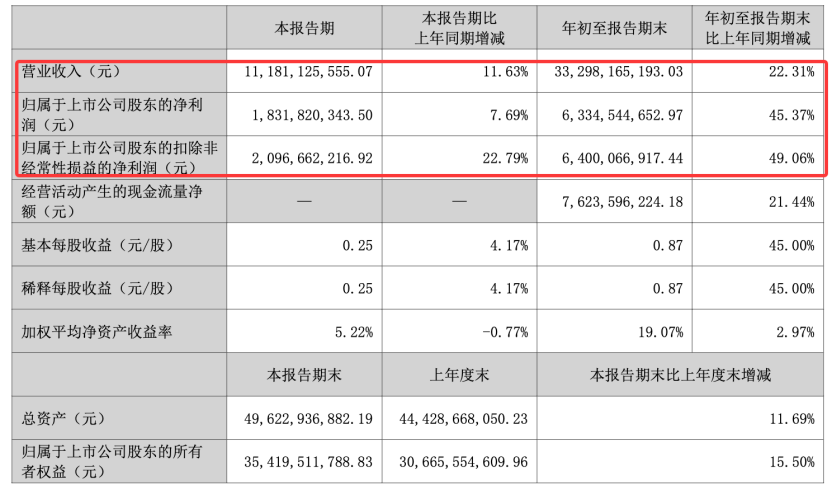
Single-quarter revenue reached RMB 11.181 billion in Q3, up 11.63% YoY, extending the streak of quarterly revenue growth to 14 consecutive quarters. Net profit attributable to shareholders was RMB 1.832 billion, and non-GAAP net profit was RMB 2.097 billion, up 22.79% YoY.
For the first three quarters, cumulative revenue was RMB 33.298 billion, attributable net profit RMB 6.335 billion, and non-GAAP net profit RMB 6.400 billion—both profit metrics already surpassing the full-year 2025 levels. Operating cash flow came in at RMB 7.624 billion, up 21.44% YoY.
The financials look strong, but what we at the report care about more is product performance.
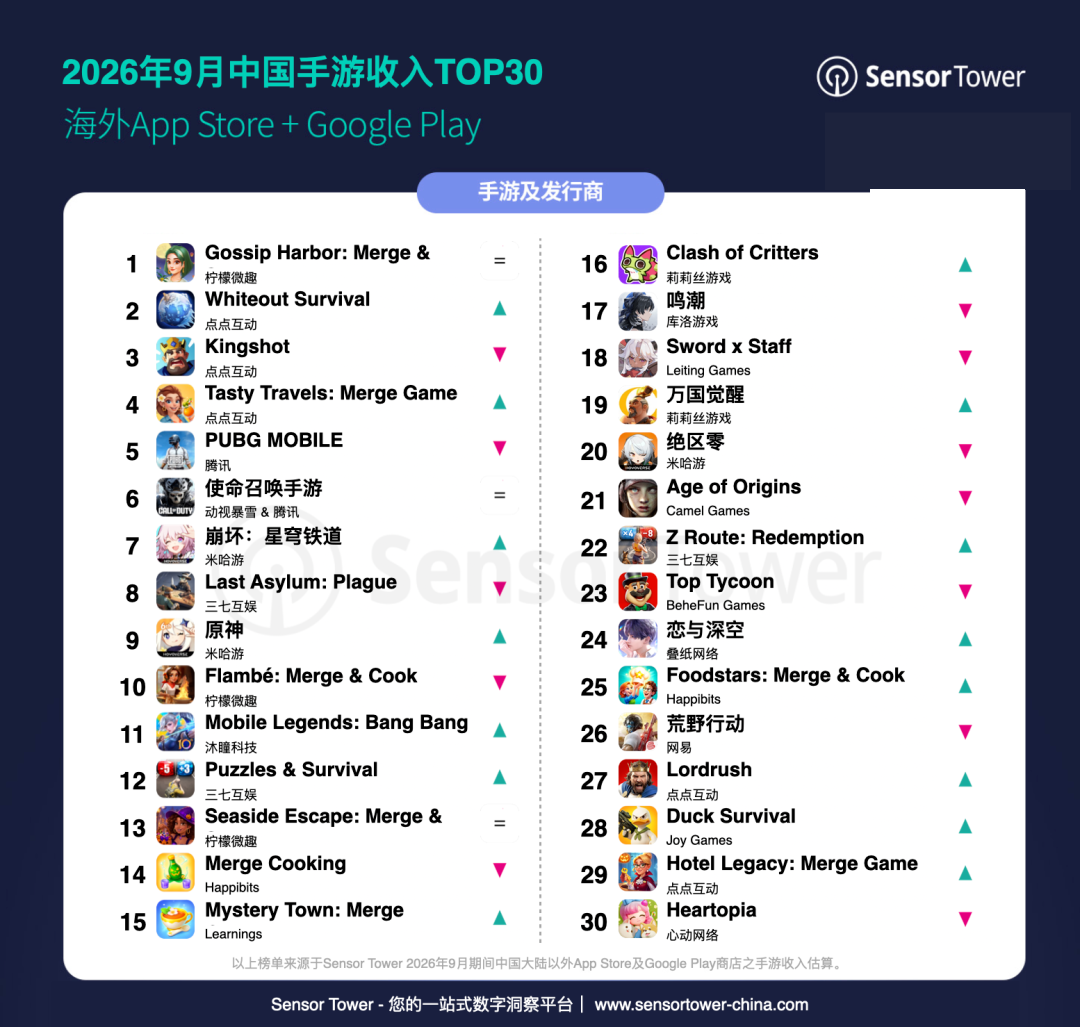
In Sensor Tower’s September going-global chart, Century Games—Century Huatong’s overseas arm—placed five titles in the TOP 30, with Whiteout Survival, Kingshot and Tasty Travels: Merge Game taking the 2nd, 3rd and 4th spots.
An SLG title live for more than three years still ranks first globally by revenue, a new-themed SLG holds firmly in the overseas top three, and the merge genre has climbed from the top-ten range earlier this year to fourth. This is no longer a one-hit wonder: Century Huatong has proven its ability to keep producing top titles across genres on top of a unified R&D and publishing platform.
A “hit assembly line”?
Previously, market attention on Century Huatong focused largely on the single product Whiteout Survival.
That has changed. SLG is now Century Huatong’s foundation: Whiteout Survival sustains the long-term base, while Kingshot ports the same framework into a medieval setting to scale up quickly.
The merge genre supports its second growth curve—Tasty Travels relies on version iteration to build long-term LTV rather than buying traffic and fading away, while Lordrush, Top Force and Hotel Legacy: Merge Game fill in behind, forming a deep pipeline.
Four product lines—4X strategy, merge, light strategy and simulation management—are advancing in parallel. Century Huatong no longer depends on any single product; it is building a multi-product matrix.
Kaiyuan Securities noted in a research report that Diandian Interactive’s moat comes from three capabilities honed through massive A/B testing: faster assessment of content potential, more precise user acquisition, and higher monetization efficiency. Once these capabilities are solidified into a platform system, new products no longer start from zero—they iterate on proven hit models.
Overseas growth, domestic stability
The overseas segment carries the growth burden, while the domestic segment supplies steady cash flow.
According to public data, Diandian Interactive’s Whiteout Survival (CN: Endless Winter) ranks in the top ten of both iOS and WeChat mini-game bestseller charts, and Benben Kingdom absorbs the base users. At Shengqu, multiple servers of the MapleStory nostalgia edition are running at full capacity, and Legend World: Invincible has climbed back into the iOS top 100.
Some industry voices argue that nostalgia editions merely consume the residual value of established IPs.
But market data often points to the opposite conclusion: the user acquisition cost of legacy IPs is an order of magnitude lower than for new genres, and nostalgia coupled with seasonal content refresh gives lifecycles that outperform most new products launched from scratch. This is clearly visible at Century Huatong.
The company has turned Legend, MapleStory and Dragon Nest into content assets that can be periodically refreshed.
On the pipeline front, Hunger in the Wilderness, which has exceeded 20 million pre-registrations, is set to launch on November 24, while MapleStory Classic, Aion Classic and Aion 2 are advancing toward domestic release. This pipeline does not bet on a single new title but compounds the value of IP assets with certainty.

Beyond products, the Q3 report carries another set of numbers: R&D expenses of RMB 1.713 billion in the first three quarters, administrative expenses of RMB 853 million, financial expenses down to RMB 66 million, and sales expenses up to RMB 14.064 billion—but against revenue above RMB 33 billion, user acquisition efficiency is still improving.
On AI, Century Huatong embeds tools into R&D and operations: Tianyou Software is piloting decision models, and the internal “IDEA-X” initiative explores AI-native games. It treats AI not as a concept but as a practical lever for cost reduction and scheduling.
Conclusion: Seen through the Q3 report, Century Huatong opens up incremental growth overseas with a multi-product matrix and consolidates its domestic base through classic IP operations, presenting a healthy profile where profit growth outpaces revenue and cash flow covers expansion. This suggests the company no longer needs a single hit to survive—it has built the platform-type constitution to ride out cycles.