Original title: AI video: Is Runway making a comeback?
Author: BelugaGlobal Editorial
Source: BelugaGlobal
Open today's leaderboard for video generation model capabilities, and the top-ranked models all come from big players such as Google, ByteDance, and Kuaishou. Three years ago, Runway was unavoidable in the AI video race — today it is no longer in the first tier.
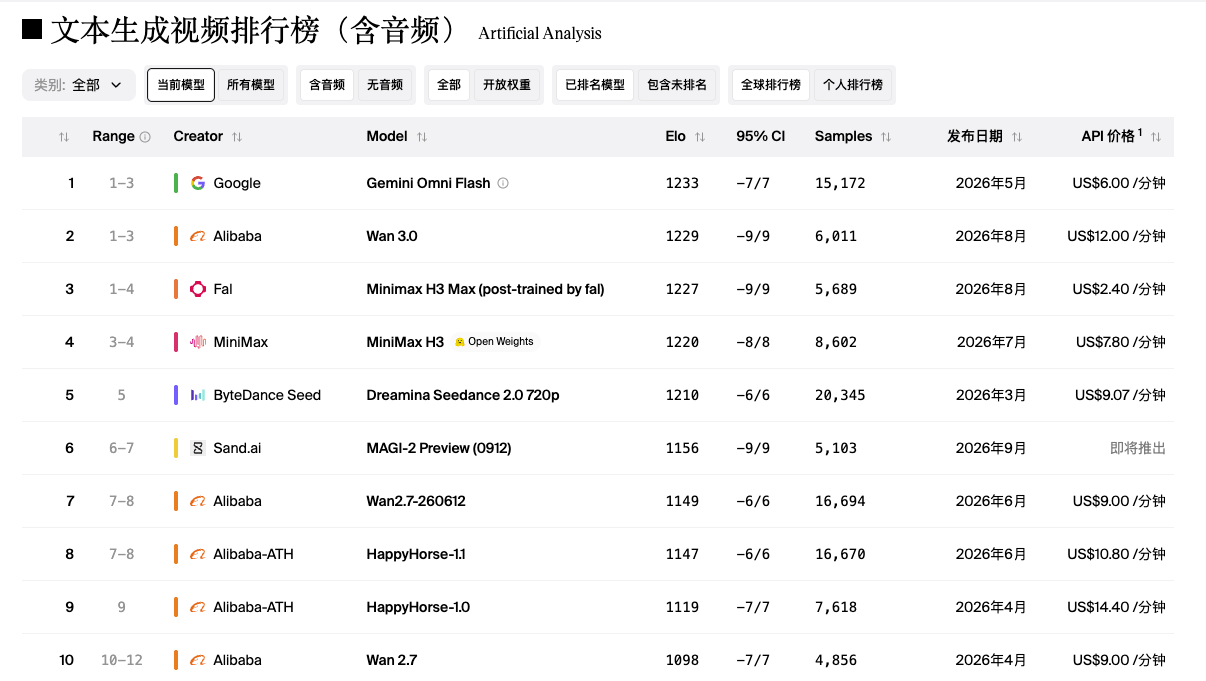
On the Artificial Analysis leaderboard, Runway's latest model Gen-4.5 no longer cracks the top 10 | Image source: Artificial Analysis
In December last year, Gen-4.5 briefly topped Artificial Analysis, but its ranking quickly slipped as models from other big players caught up. For more than half a year since then, Runway has not released a new model.
By contrast, Runway's business has quietly been growing. In early September, co-founder and CEO Anastasis Germanidis shared on LinkedIn that ARR had neared $200 million — nearly doubling from $100 million in April, in just half a year. AppMagic data corroborates the trend: mobile-only monthly revenue has climbed from under $1 million last September to $2.7 million in the last 30 days, roughly enough to crack the global top 3.
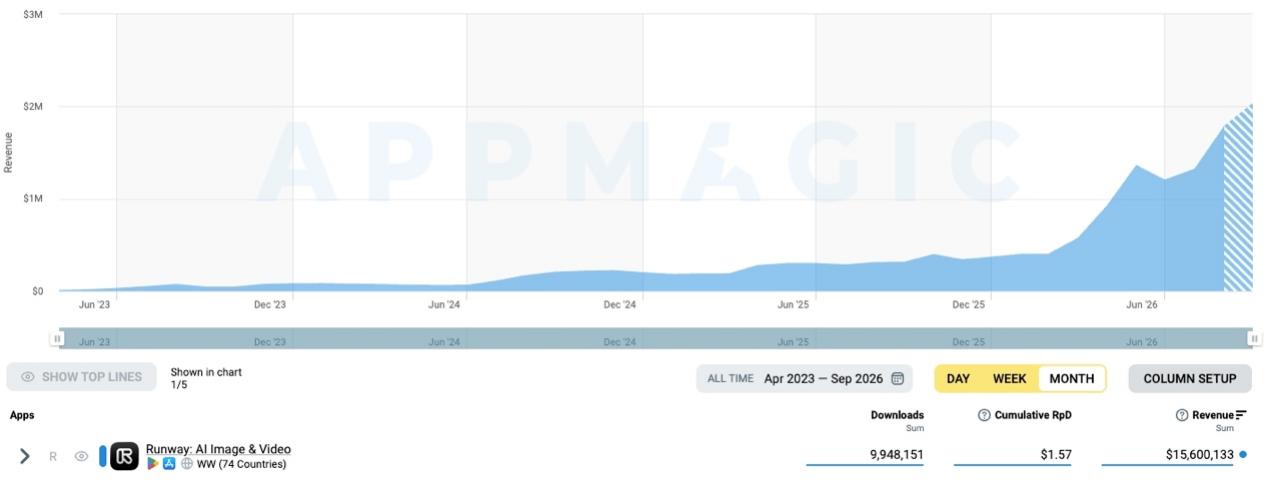
Runway's revenue trend | Image source: AppMagic
Looking at Runway's growth data over the past six months, we found two obvious inflection points.
The first came in May. AppMagic shows Runway's downloads and revenue both jumped that month, coinciding with the launch of a model called Aleph 2.0 — but it doesn't generate video from scratch. Instead, it "edits" video.
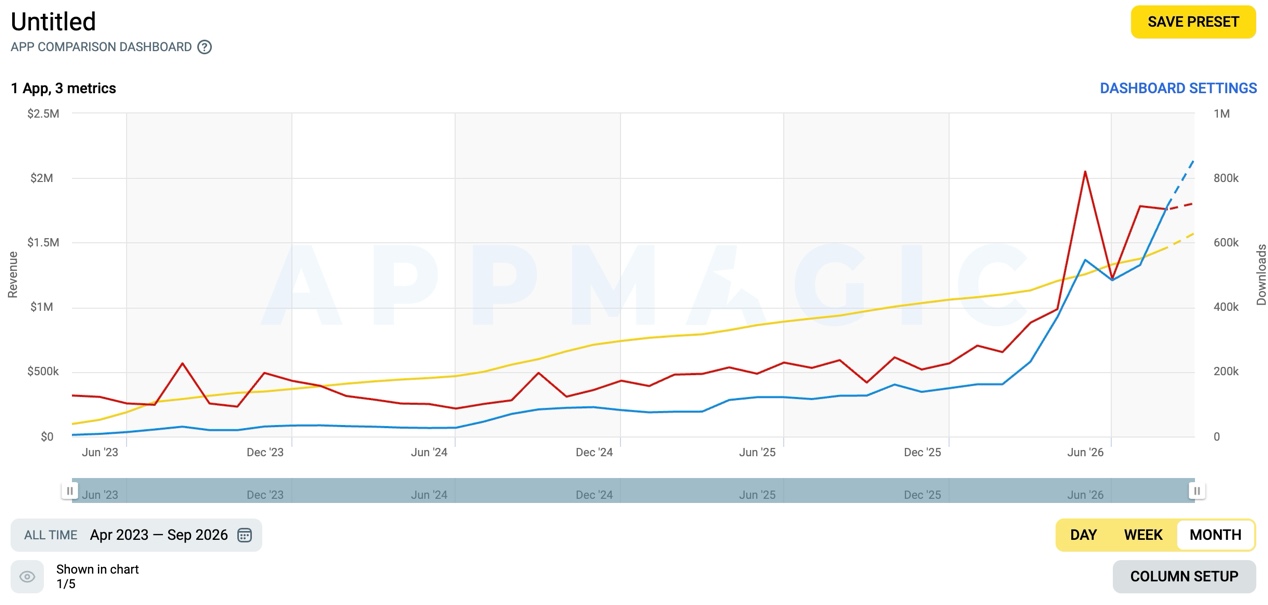
Runway's downloads, revenue, and RPD: red line = downloads, blue line = revenue, yellow line = RPD | Image source: AppMagic
According to the official description, Aleph 2.0's core capability is understanding the visual content of existing videos and modifying specified elements per user instructions while keeping everything else — other visuals, motion, and scenes — unchanged. Users can also edit a single frame first and then apply it to the whole video, and can synchronously modify or replace subjects or backgrounds across multiple shots.
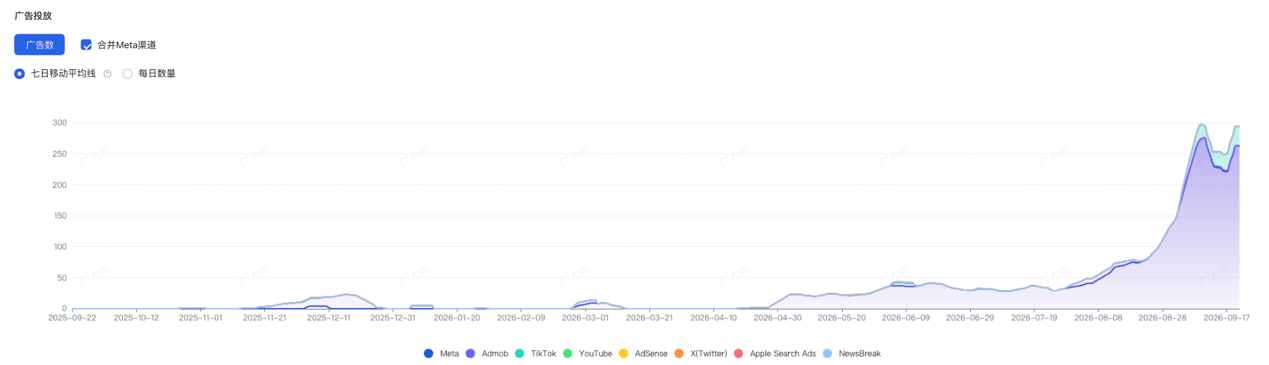
Ad creative count | Image source: Guangdada
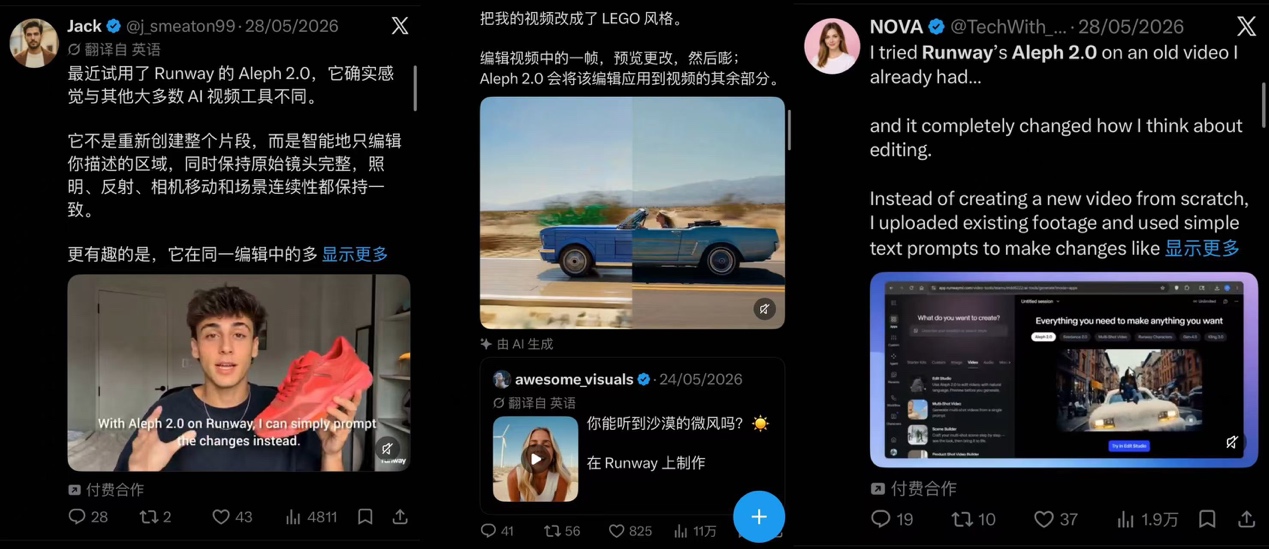
Combined with Guangdada's ad data: in May, Runway had fewer than 50 creatives, far below recent levels, but a large number of influencers posted Aleph 2.0 review videos on X around the same time. At the model's launch, Runway adopted a strategy of "social media promotion at the core, with small-scale ad spend alongside." After downloads peaked in May, June and July saw fluctuation. | Image source: X
Runway built an easily shareable selling point around this capability: "edit video with one sentence." Upload a complete video, type "add a panda on the shoulder," and a panda appears in the frame while everything else stays unchanged. In May, a wave of influencer-driven Aleph 2.0 reviews on X brought the first downloads; after ad spending scaled up in late August, a second wave of growth followed. The two waves used different strategies, but the core selling point was the same: editing video.
Even though it shifted from generation to editing, Aleph 2.0 remains Runway's in-house model. But in its overall core design, Runway had long since stopped being a single-model product, just like other model-aggregation players (note: only a few top products like Kling still offer only their own models).
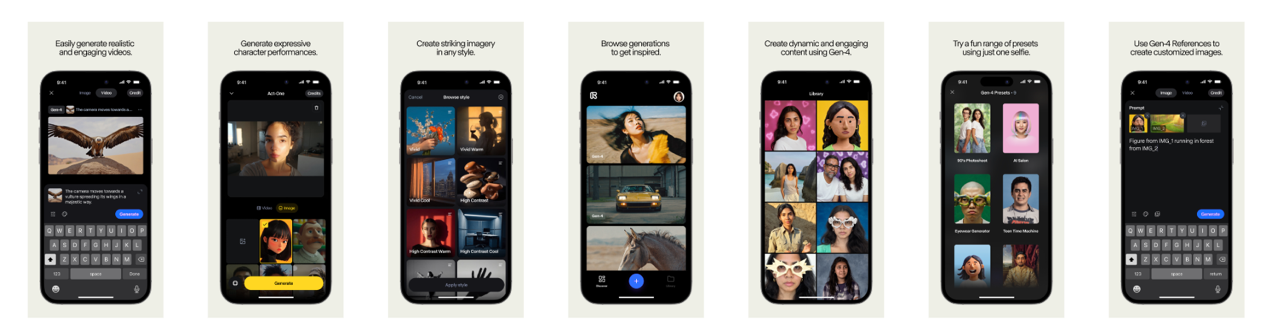
After trying the current version of the app, we found the product form has changed fundamentally. Compared with screenshots of the late-2025 version — where the in-house Gen-4 model was the face of the product — the default video model in the app is now Seedance 2.0, and the default image model is GPT Image 2. The model picker aggregates mainstream generation models on the market; Gen-4.5 can still be manually switched back, but it is no longer the default.
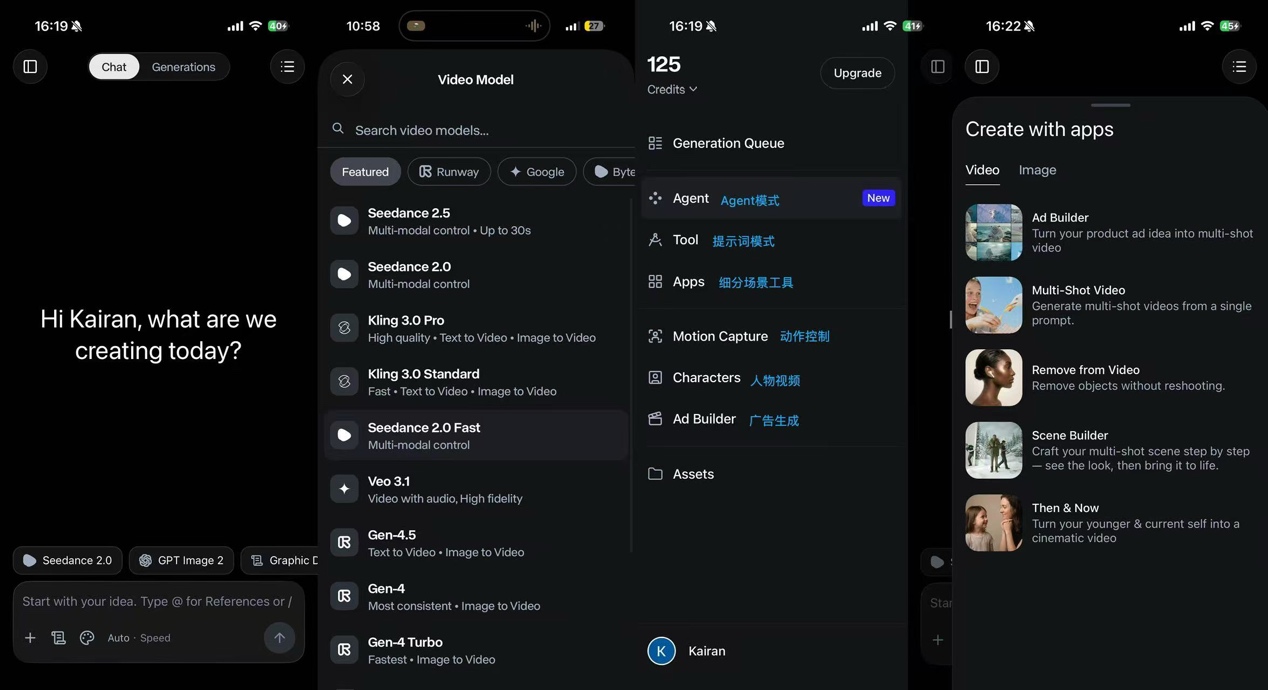
Agent mode page (Fig. 1), model picker (Fig. 2), feature selection (Fig. 3), and vertical-use-case Apps (Fig. 4). Apps include ad generation, one-sentence multi-shot video generation, storyboard-first then render, removing objects without reshoots, character motion control following a real performer, and talking-head video.
The previous Runway mainly pushed 90s-style portraits, AI hairstyling, style filters, and other consumer-facing playfulness. The revamped product is more like an Agent-centric creation tool — Agent is a conversational generation mode, Tool is the traditional prompt mode, and Apps for vertical scenarios such as ad generation, storyboard rendering, motion control, and talking-head video form a third section.
Among the AI video products we track continuously, those that actually generate revenue (there are many definitions of "making money" — positive profit is the most fundamental, which is different from having revenue; to be rigorous) have largely followed two paths.
One path targets ordinary consumers and is template-driven, relying on "single-point features plus social media virality" to drive downloads and revenue. The "pet and baby dancing" trend early this year and the "baseball stadium effects" in May were both hits on this path. The other path targets professional creators and small B users in advertising and marketing, using model aggregation plus Agents to provide one-stop creation capabilities. Representative products include Higgsfield, whose ARR has reached $1 billion, and OpenArt, Pollo.ai, and others with ARR in the tens of millions.
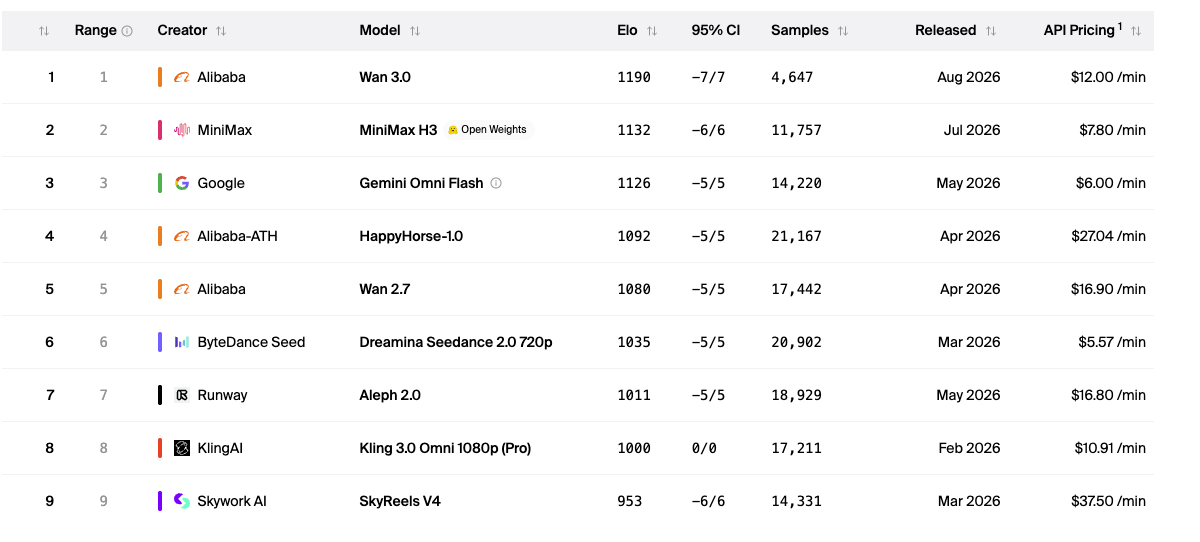
Runway has switched wholesale from the first path to the second. Its in-house Aleph 2.0 entered the market through video editing, then used "model aggregation + Agent" to absorb users' other creation needs. Its models no longer rank at the top of leaderboards, but the product-side transformation has produced real revenue growth.
Still, by August's roughly $1.8 million in mobile monthly revenue, the app contributes only about 10% of the total. The bulk of the near-$200 million ARR sits on the enterprise side.
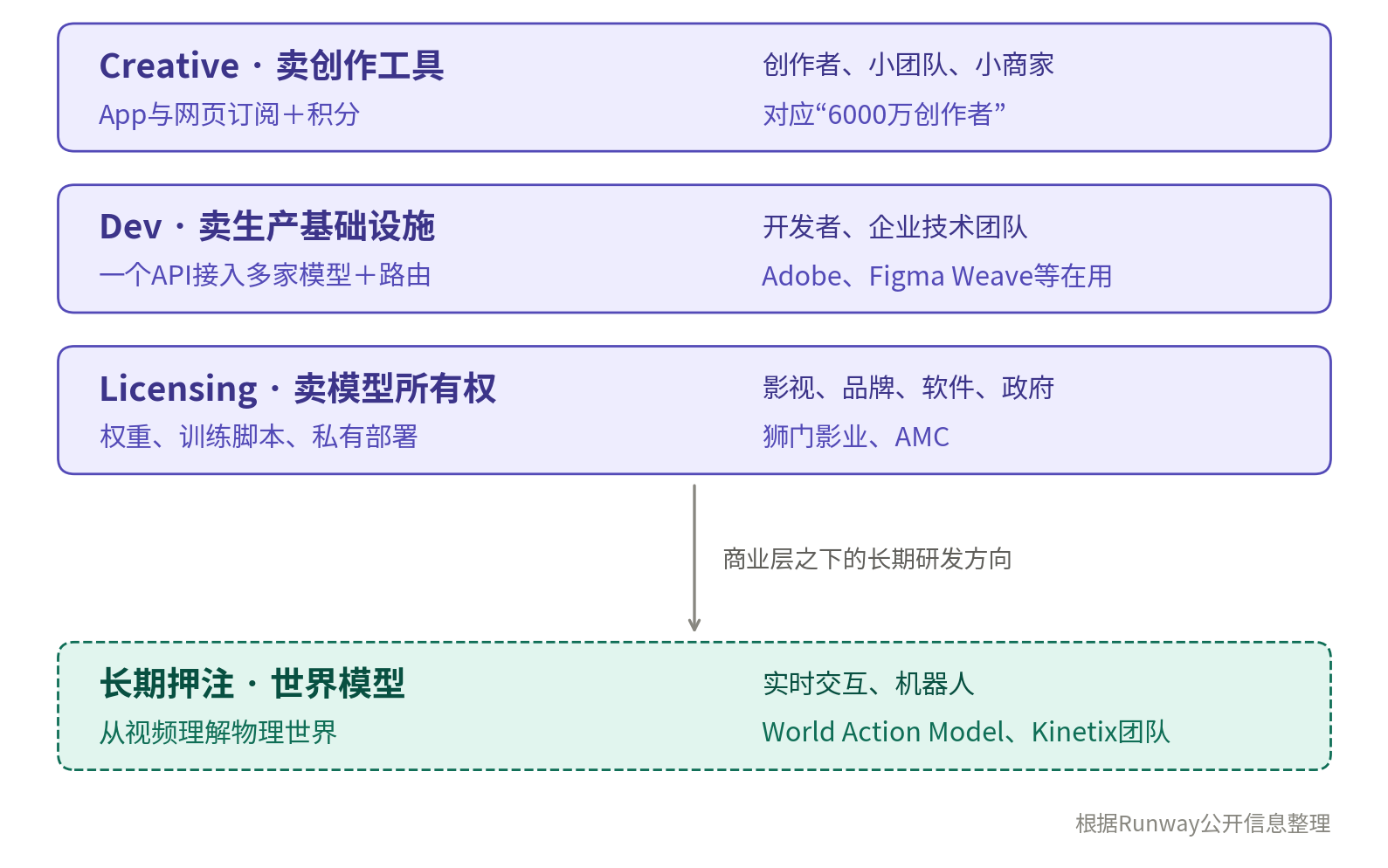
Image source: LinkedIn
In early September, Runway co-founder and CEO Anastasis Germanidis posted public data on LinkedIn: Runway serves more than 60 million creators, and 95% of Fortune 100 companies are also its customers. Judging from the official site and public information, enterprise-side revenue comes from two layers of business; combined with the consumer creation tool, there are three layers in total, serving different customers with completely different delivery models.
The first layer is the creation tool — the app and web offerings aimed at creators and small merchants, with a core business model of "subscription + credits." It is Runway's most user-facing entry point, so we won't elaborate further.
The second layer is the API, whose core product is Runway Dev, aimed at developers who don't need a proprietary model. Unlike other model vendors whose API services revolve around in-house models, Runway Dev also follows the "aggregation" route, integrating multiple video models including Seedance and Google's Omni Flash.
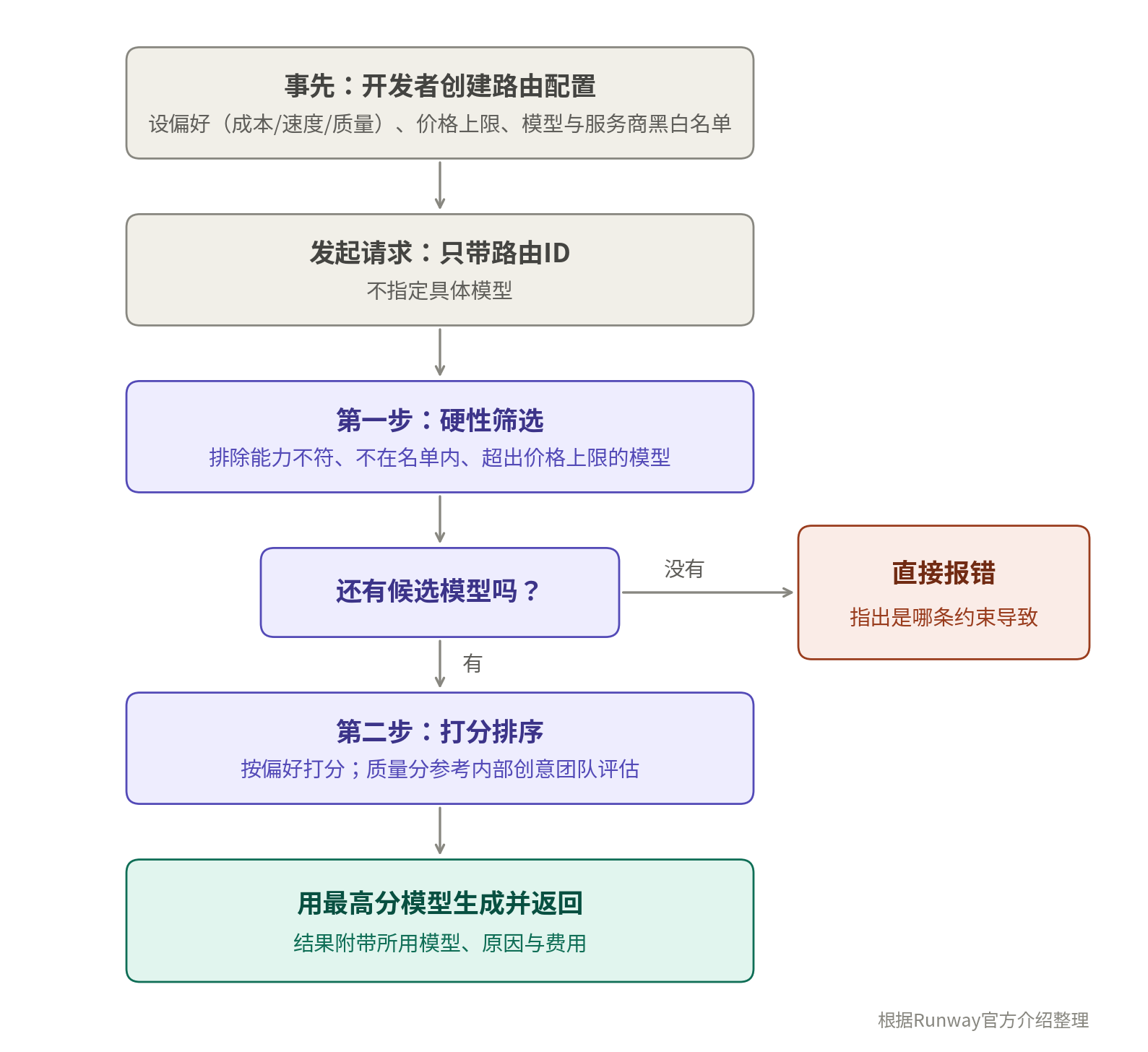
Even more notable is the "model routing" mechanism — Runway Dev's biggest selling point. To understand it by example: a developer creates a "route" for a given creative scenario, sets model preferences (prioritizing among cost, speed, and quality), selects candidate models, and caps the price per generation.
In actual use, every request carries the corresponding "route ID." The system first runs a hard filter, excluding models whose capabilities don't match, that aren't on the candidate list, or that would exceed the price cap; if no model qualifies, it errors out and states why. After filtering, the system scores the remaining models against the user's preferences, picks the highest-scoring one, and executes, noting in the result which model was called, the reason, and the cost.
In text, OpenRouter has long offered something similar; mechanically, Runway's model routing is nothing new. But in video, where generation costs are high and evaluation dimensions are complex, only products aimed at specific scenarios can polish internal auto-routing around a concrete task flow and brand it as "low-cost and efficient" to attract users — auto-routing at the API layer, however, is rare. According to Runway Chief Product Officer Anthony Maggio, the company's internal creative team evaluates models on dimensions such as motion, composition, and lip-sync...
Runway Dev also offers Workflows for chaining multi-step generations, Recipes that package common marketing scenarios like ad generation into single calls, and MCP services that let AI assistants and coding agents invoke Runway.
Across both the creation tool and the API, Runway's selling point is no longer the model itself, but differentiation built on top of aggregation. And while the API solves calling flexibility, it's still not enough for another class of customer: large enterprises that own substantial proprietary IP, have their own compute, and demand strict data security need to bring models into their own environment for private deployment.
On that basis, even though Gen-4.5's capabilities are no longer leading, it can still make money — the third layer: model licensing.
In this layer, Runway again takes a different path. Runway signs licensing agreements with certain companies or organizations, granting them rights to deploy its proprietary closed-source models (such as Gen-4.5) for enterprise use. Enterprises can deploy them themselves, fine-tune with their own data, and keep the commercial revenue generated; Runway only collects a license fee.
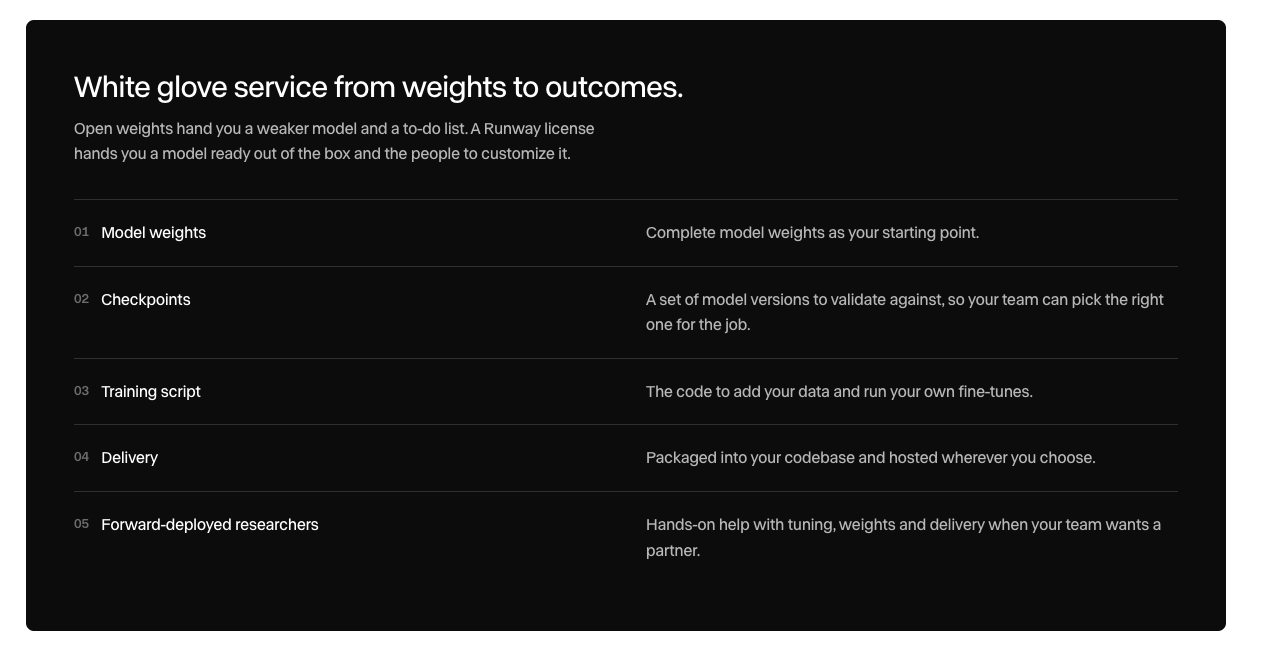
This path sits between closed-source and pure open-source. Closed models like Kling and Seedance are only accessible via API and don't support private deployment; pure open-source models have open weights, but the costs of adaptation, tuning, deployment, and ongoing maintenance are all borne by the enterprise. Runway's approach hands the model weights fully to the enterprise, alongside multi-version checkpoints and training scripts, and dispatches technical staff to assist with fine-tuning and maintenance. In a sense, what enterprises buy is a "worry-free deployment" package: the security of private deployment...
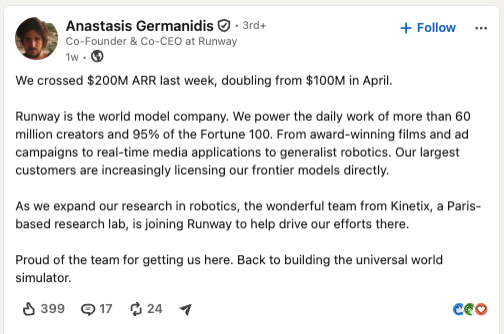
Image source: Runway Model Licensing official site
The founder said in his LinkedIn post that "Runway's largest customers are increasingly licensing Runway's frontier models directly." Still, the "worry-free deployment" enterprises buy is ultimately built on Gen-4.5, a base model that is no longer "top-tier" on leaderboards. How well the worry-free experience performs may depend on how much the fine-tuning stage can achieve.
Final thoughts
Looking at the three layers together, Runway's logic is clear and forms a funnel: different users, different delivery models. What supports this funnel is not "a strong model" but packaging the same architecture capabilities into different forms, matched to delivery models each layer of customer is willing to pay for.
Runway's choice is to exit the AI video arms race and differentiate on commercialization path.
However, when model capability is no longer a moat, whether "packaging" itself can become a moat remains to be seen. Founder Germanidis has emphasized on multiple occasions that Runway is a "world model company" — video generation is not the end point but one path toward understanding the physical world. World models will build internal representations of environments, support real-time interaction, and predict what happens after an action executes — for robotics, autonomous driving, and scientific research. But until that future arrives, Runway may need its commercial differentiation to buy it more users...
This article is original to BelugaGlobal. Reproduction requires prior authorization; unauthorized reproduction is strictly prohibited.