In a world swept by AI, going-global players are flooded with information every day. But in an age of overload, some questions are better answered by talking face-to-face with people who have actually been through the trenches than by asking AI to explain them a hundred times.
While planning the AI agenda for GTC2026 Global Traffic Conference (Shanghai), we ran a small survey among hundreds of going-global practitioners in our community. The results were telling: over 60% said what they care about most is not grand trend forecasts, but the real problems stuck in their daily business — ones that a web search returns only press releases for, and AI can’t give a standard answer to.
From the feedback, the topics going-global players most want to discuss cluster around the following directions. If it were you, what would you like to talk about during GTC2026 Shanghai? Join the survey:
AI Going Global: AI tools, AI games and pan-entertainment products heading global — where do compliance red lines, cultural localization and traffic growth logic differ across markets? How do frontline teams avoid the “homesickness” of domestic experience and find sustainable commercialization paths?
AI Games: AIGC is reshaping the game production pipeline — assets, stories and dynamic NPCs are at full capacity. How do we protect the core gameplay while solving copyright risk, content homogenization and the performance challenges of real-time interaction?
AI Entertainment: Short dramas, interactive narratives, digital humans and other generative entertainment are surging in output while traffic dividends fade fast. What content is truly worth continuous payment from users? How should durable new entertainment forms be built?
Personal AI & AI Tools: From single-point efficiency tools to agents that act autonomously, where is the boundary of AI automation? How do we escape the trap of “impressive demos, idle daily use” pseudo-needs and build real user dependency?
AI Implementation: Many AI projects stop at POC. From pilot to large-scale replication, what unavoidable hurdles exist on the business, organizational, cost and assessment sides? How do we turn token consumption into real business value?
AI Hardware: How do on-device AI and industry-specific smart hardware balance compute, power, cost and privacy compliance? Which scenarios are truly irreplaceable needs for on-device AI rather than gimmick products with AI bolted on?
These questions are not “small”, but they are real. They come from peers sitting next to you, fighting on the frontline every day, with specific business situations.
Since the questions are all here, the answers naturally can’t stay online only.
To talk these real questions through, at GTC2026 Global Traffic Conference (Shanghai), held on November 4–5, 2026 at Shanghai World Expo Exhibition & Convention Center Hall H3, we will embed these surveyed core topics deep into the sub-venues and main summit discussions.
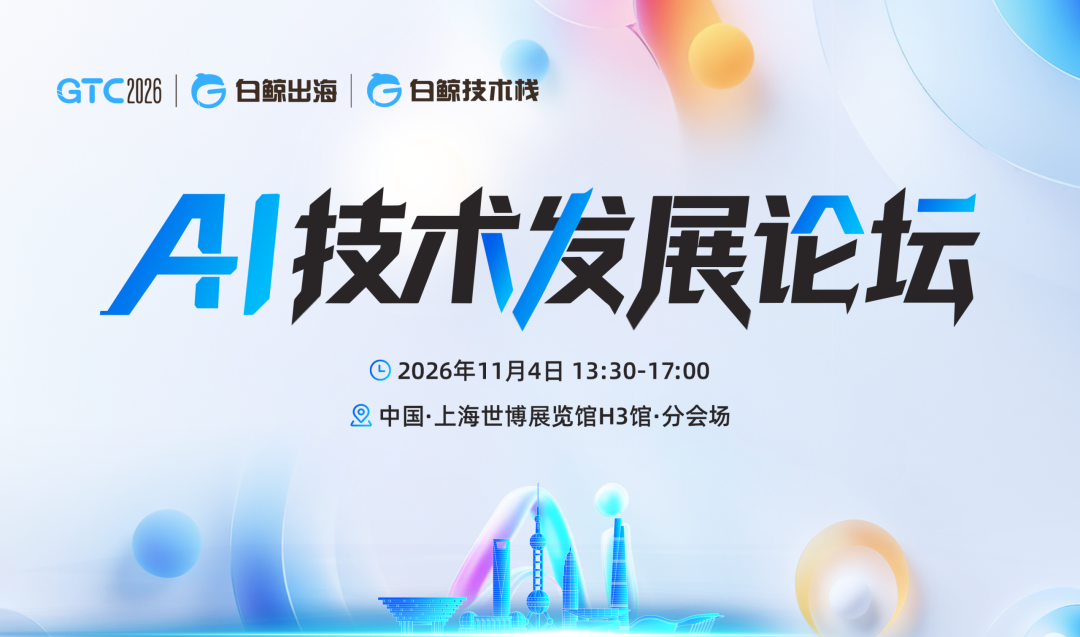
As the sub-venue with the highest “tech density” and “forward vision” at this show, the “AI Technology Development Forum” on the afternoon of November 4 is co-hosted by BelugaGlobal and BelugaGlobal Tech Stack, with Chidao Xiangxian (Equator Quadrant), an industry organization focused on AI-industry integration, serving as co-organizer.
The forum brings together hands-on tech practitioners including Li Yitong, founder of Chidao Xiangxian; Mei Jie, founder of Yushengyueban; and Ji Pan, founder of Jiding Shuchuang. They won’t just talk about PPT parameters — they will directly address concrete issues such as “why traditional + AI fails”, “how to rebuild overseas ad delivery workflows with AI”, “how voice interaction solves going-global localization”, and “how native 3D large models reshape content production”, sharing experience from the field.
Core highlights: from one-sentence delivery to rebuilding the physical world — six hardcore presentations
The forum refuses vague talk. Six speakers will cover product thinking, delivery workflows, voice interaction, underlying architecture, visual marketing and spatial intelligence, piecing together a complete frontier map of AI technology evolution.
Highlight 1: In the AI-native era, the “tech gravity” of global products
Why is the “+AI” model for traditional products failing? Li Yitong, founder of Chidao Xiangxian, will present “The Tech Gravity of Global Products in the AI-Native Era”. As a veteran entrepreneur who has continuously incubated two AI applications, she will share the hard-won lessons of the past 12 months of AI practice.
Highlight 2: From twenty dashboards to one sentence — let your AI run overseas ad delivery
This is a seismic shift most media-buying teams haven’t noticed yet. Natalia Gudimova (Lina), head of PropellerAds’ East Asia team, will present “From Twenty Dashboards to One Sentence: Let Your Own AI Run Overseas Ad Delivery”.
In H1 2026, Google, Meta and TikTok successively released official MCP services, meaning ad platforms are opening up to AI agents. Lina will dissect from a dual perspective how media-buying teams can use AI to rebuild delivery workflows and cut operating costs.
Highlight 3: Bringing characters to life — voice interaction LLMs reshape pan-entertainment experience
As pan-entertainment content accelerates its global expansion, whether a character can move people increasingly depends on “voice”. Mei Jie, founder & CEO of Yushengyueban, will share “Bringing Characters to Life: From AI Actors Who Can Act, to AI Companions Who Understand You — How Voice Interaction Reshapes Pan-Entertainment Experience”.
He will show how its self-developed interactive base model Luna lets AI characters do more than “read lines” — understanding plots, expressing emotions and maintaining a consistent voice persona across languages. From efficient dubbing for short dramas and anime on the content-production side, to emotionally resonant companionship on the interactive experience side, the voice engine is redefining what a character can be.
Highlight 4: Breaking compute shackles — the potential of recurrent models as a general AI architecture
In the AI era where compute is cost, model architecture innovation is critical. FaceMind CEO Lu Hongyuan will present “Recurrent Models as a General-Purpose AI Model Architecture”.
He will hardcore-dissect how general recurrent model architectures significantly cut HBM and compute demands, and share the architecture’s effectiveness across classification, LLMs, code agents, image and video generation. Per Information’s reporting, the much-watched model has become a benchmark in the industry.
Highlight 5: AI video agents reshape commercial and self-media video creation
High-quality video is a key vehicle for efficient information delivery. Fotor CEO Duan Jiang will share “Under the ‘Code-Generated Video’ Technical Route, How AI Video Agents Reshape Commercial and Self-Media Video Creation”. As a platform with tens of millions of global monthly active users, Fotor’s practice is a rare reference point.
From inspiration to deliverable film — how AI video agents help ordinary users produce professional 4K HD MG animation videos, and support creators across fields to make ready-to-deliver high-quality commercial and self-media videos.
Highlight 6: From 2D to spatial intelligence — native 3D large models reshape the digital content foundation
As generative AI moves toward 3D physical space, the pain points of traditional 3D asset pipelines — time-consuming, costly and hard to deploy across devices — are becoming more acute. Ji Pan, founder & CEO of Jiding Shuchuang, will present “From ‘What You See Is What You Get’ to Spatial Intelligence: Native 3D Large Models Reshape the Digital Content Foundation”.
Ji Pan, who has led five generations of 3D generative large models, will deeply unpack how techniques like adaptive geometric tokenization achieve minute-level production loops, and explore how AI 3D can empower global game development, UGC creation and the broader content industry.

At the main venue’s “AI + Going Global Summit” on the morning of November 5, and the “AI Manhua Salon & Short Drama Resource Matchmaking” on the morning of November 5, we will likewise build on the survey’s most-demanded topics to continue the deep dive.
In an age of information overload, the best answers are always on-site.
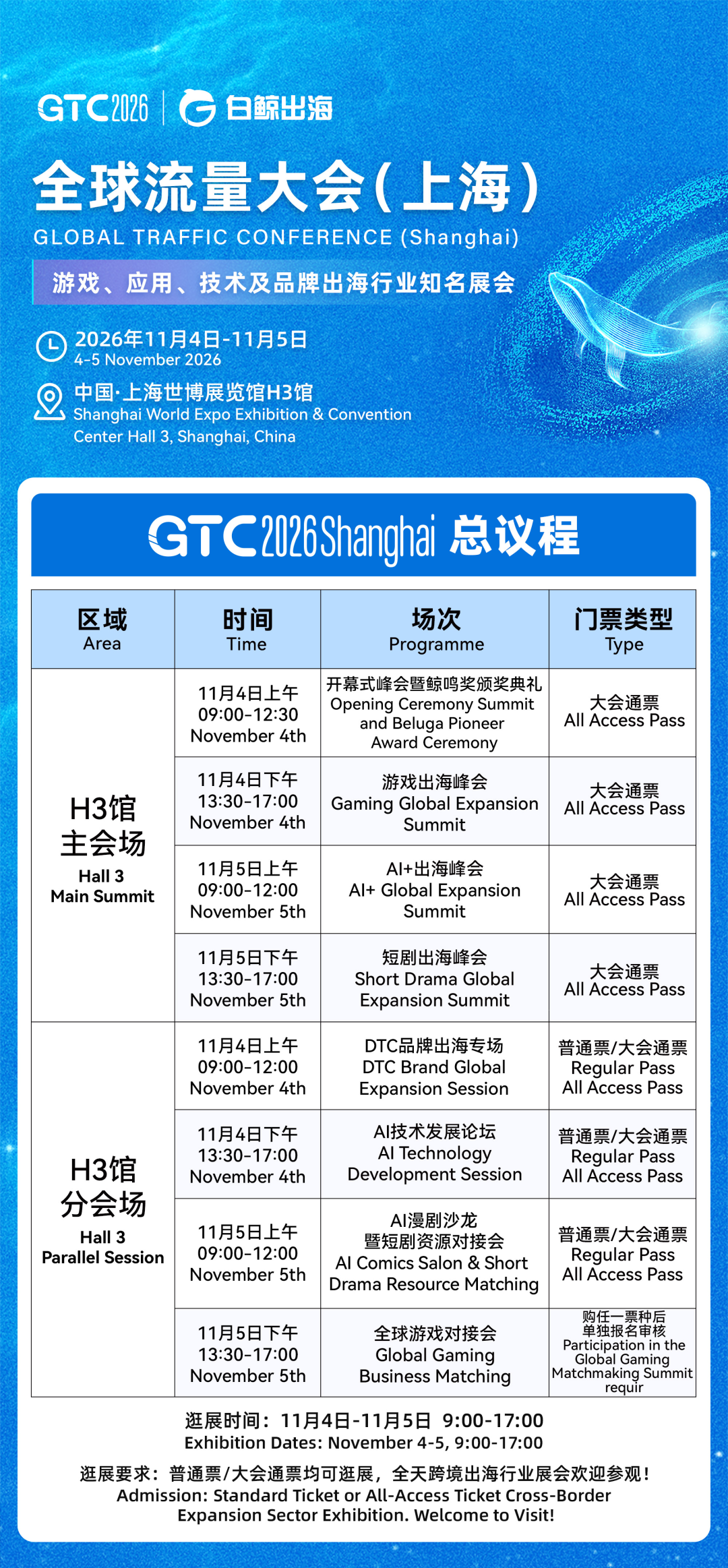
November 4–5, 2026, Shanghai World Expo Exhibition & Convention Center Hall H3. Bring the questions stuck in your business to GTC2026 Shanghai and talk face-to-face with the most insightful people. General tickets are currently free for a limited time — scan the QR code to lock your seat, with access to the two-day expo and sub-venue discussions; upgrade to a full pass to unlock all main venue content.

Scan to register. This November in Shanghai, let’s talk the real questions worth discussing in the AI era more clearly.