

Image source | pexels
"Meowdoku" is still scaling up, and Lexin Shengwen has rolled out a new title, "Sort Streak: Color Puzzle," this time turning color sorting into a combination of flowers and ropes. In late October, downloads of the game began to climb noticeably, with its daily peak on Brazil’s free puzzle chart reaching as high as No. 41, and Italy touching No. 28 intraday on October 25. By the end of October, Google Play
Compared with Lexin Shengwen’s titles that routinely rack up tens of millions or even hundreds of millions of downloads, "Sort Streak" is still a fledgling new release. But from "Meowdoku" to the recent "Twindoku," the company has never stopped experimenting with different puzzle mechanics. Looking at these products together, there is plenty worth examining in how mature gameplay gets repackaged and re-enters the market, and how different ad creatives and user-acquisition pacing are used to find users.
A Flower-Sorting Game: Lexin Shengwen’s New Experiment
The core of "Sort Streak" is still the familiar color-sorting mechanic, only the objects being manipulated are now flowers and ropes.
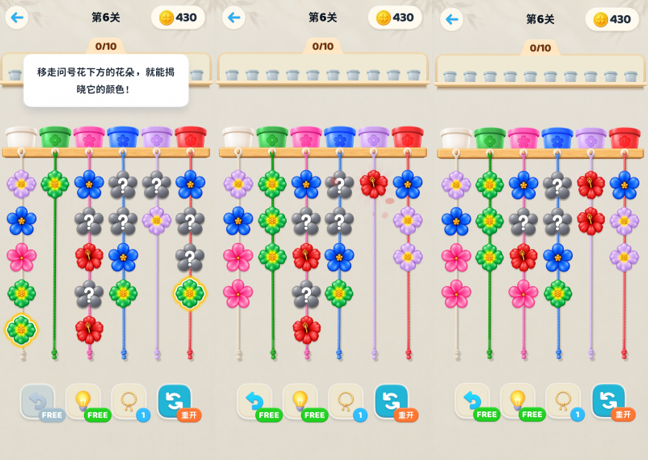
In each level, multiple hanging ropes carry flowers of different colors, while flower pots at the top mark the collection targets. Players need to move a single flower or a contiguous group of same-colored flowers into an empty rope, or onto a rope whose end color matches and still has room. Once the same-colored flowers are gathered, the whole group automatically enters the corresponding pot, and completing all collection targets clears the level.

The difficulty mainly comes from move order and spatial constraints. Players not only have to judge colors, but also reserve positions for later moves to avoid flowers blocking one another. As levels progress, mystery flowers marked with question marks, and locked flowers that require completing specific objectives before they can be operated, appear one after another, adding more uncertainty to the solving process.
The mechanic easily calls to mind water-sort and ball-sort products in the Color Sort genre. Over the past few years, color sorting has spawned a large number of repackaged variations, but most retain the basic goal of reclassifying mixed colors.
"Sort Streak" does not break from that framework, yet it changes how players handle colors. Flowers on the ropes are arranged in a line, and same-colored groups can move together, so players must pay more attention to the relationship between arrangement order and remaining space.
The pot-collecting mechanic, meanwhile, makes completion feedback more intuitive. Traditional sorting games usually clear a container or end the level once same-colored items are aligned; "Sort Streak," by contrast, sends the whole string of flowers into the matching pot, turning color classification into a continuous collecting process. Flowers, ropes, and pots also form a unified visual theme, making the acts of tidying, shifting, and hitting targets easier to showcase.
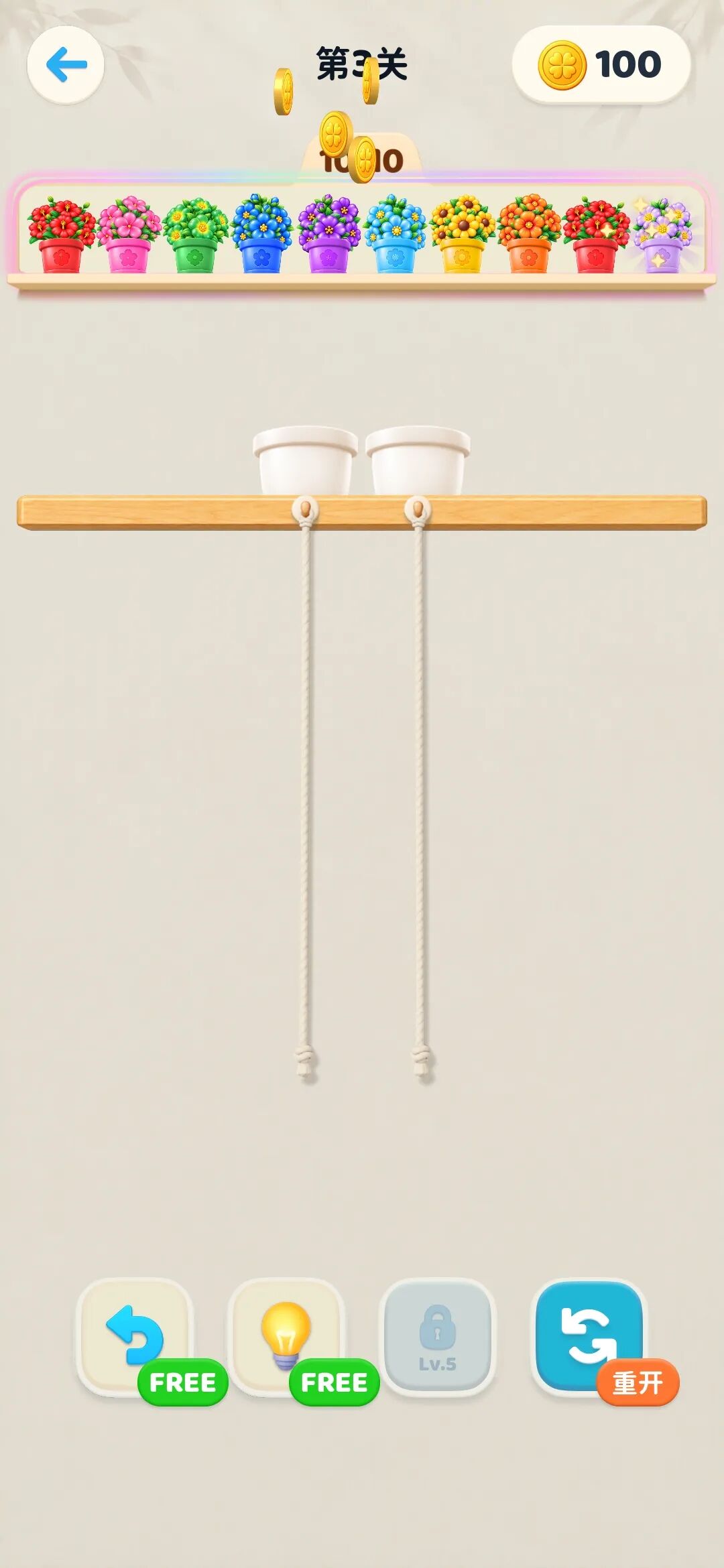
From hands-on experience, these changes are not complicated, but they give the game a different feel and visual feedback while preserving familiar rules.
A Fresh Wrapper for Mature Mechanics: Familiar Play, New Packaging
This kind of product reinvention is Lexin Shengwen’s signature move.
"Meowdoku," released in 2026, wraps grid-logic puzzles as a cat-finding game: each row, column, and colored region must contain exactly one cat, and no two cats may be adjacent. Its rules share obvious similarities with LinkedIn’s "Queens" and the earlier Star Battle-style puzzles.
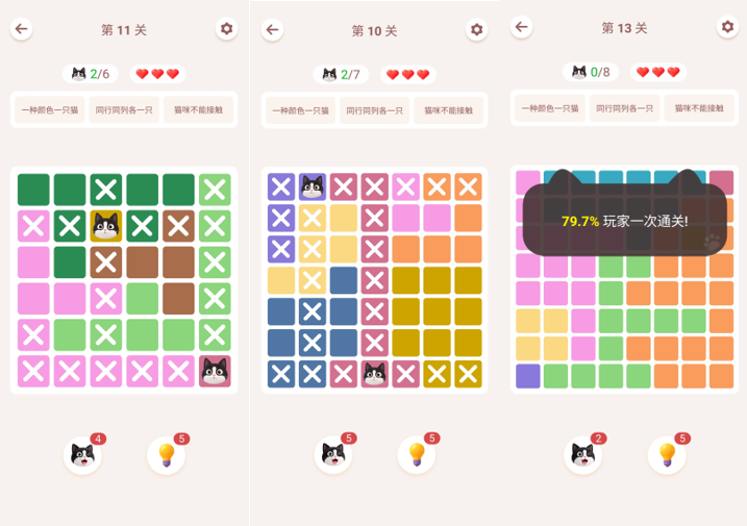
"Meowdoku"
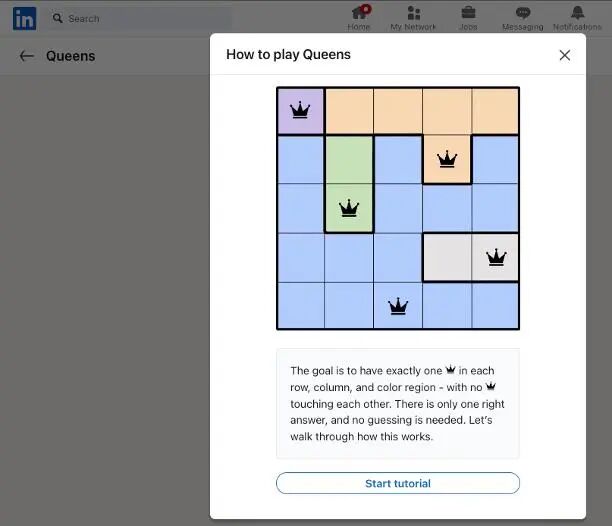
LinkedIn "Queens"
The subsequently launched "Twindoku" builds binary logic from suns and moons, requiring equal row and column counts, forbidding three identical symbols in a row, and expanding levels by adding constraints — rules akin to "Tango" and Takuzu. Another title, "Amaze GO!", opts for arrow puzzles, forming a clean level loop through path blocking and move order.
The core mechanics in these products mostly have mature precedents; Lexin Shengwen mainly adjusts theme, visual presentation, and level design, turning existing gameplay into mobile games that can keep delivering content.
Different mechanics also attract users in different ways: flower sorting emphasizes tidying and collecting, arrow puzzles can create contrast through wrong paths, and grid logic is better suited to showcasing reasoning challenges. These traits not only shape the in-game experience, but also carry over into the ad creatives that follow.
From New-Release Testing to Sustained Scaling: The UA Matrix of a Casual-Game Powerhouse
Lexin Shengwen is already one of the largest advertisers of ad creatives in the overseas casual-game market.
According to DataEye’s "2025 Overseas Mobile Game Advertising Report," Oakever Games ran roughly 550,000 ad creatives over the year, ranking No. 1 among overseas mobile-game publishers by creative volume, while Vita Studio, also under the Lexin Shengwen umbrella, appeared on the list separately. Into 2026, several of its titles have kept up high-intensity advertising. In the global Top 60 mobile-game publishers by creative volume for August, the Lexin Shengwen group had
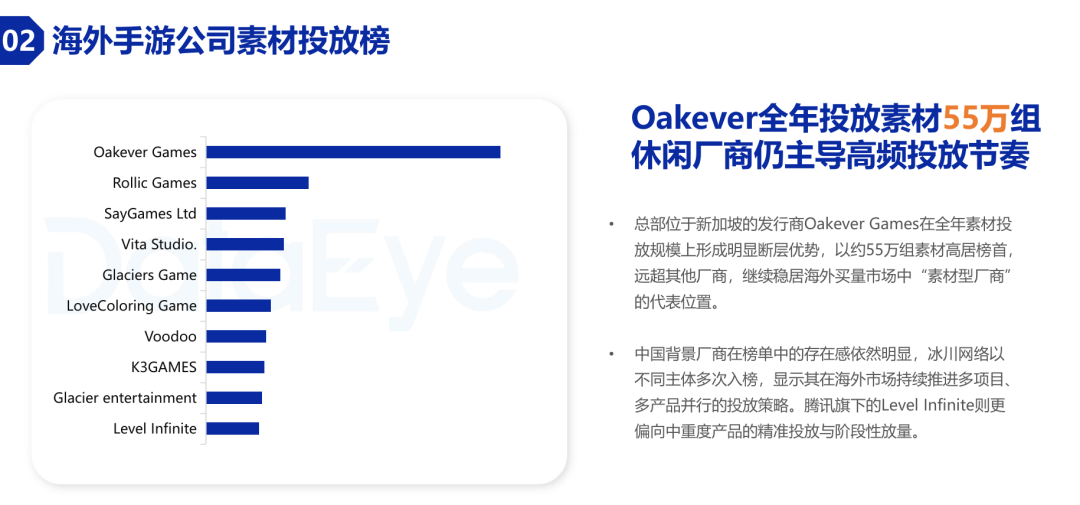
Lexin Shengwen’s massive UA footprint is spread across products in multiple casual genres and at different lifecycle stages.
Compared with those games that have already built sizable advertising volume, "Sort Streak" is still in its early promotion phase, yet its ad creatives already span a range of creative forms — from regular gameplay footage to live-action puzzle demos, playable ads, and gameplay showcases in different visual styles.
Gameplay ads usually start with a jumble of mixed-color flowers, show how players move, sort, and collect, then present the result through a level-complete animation. Live-action creatives place the solving process in scenes such as street whiteboards or family interactions, paired with challenge-style copy like "only people with an IQ above 130 can solve this," building a difficulty hook before cutting into the actual gameplay.
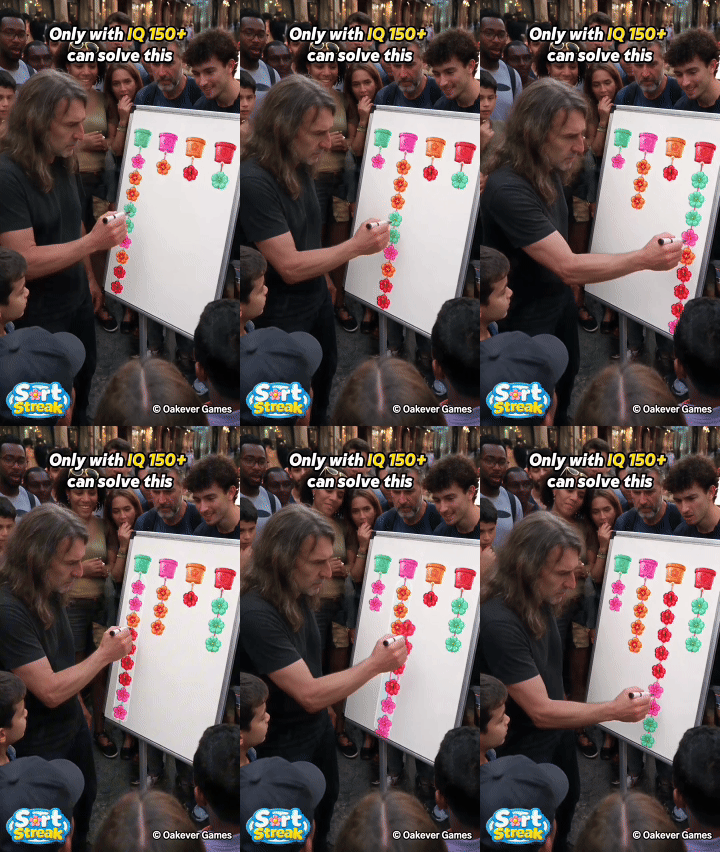
Some ads keep the original sorting rules but present them with hand-drawn or 3D floral styles. The same mechanic, wrapped in different scenes and visuals, can highlight either the intellectual challenge or the instant feedback of the tidying process.
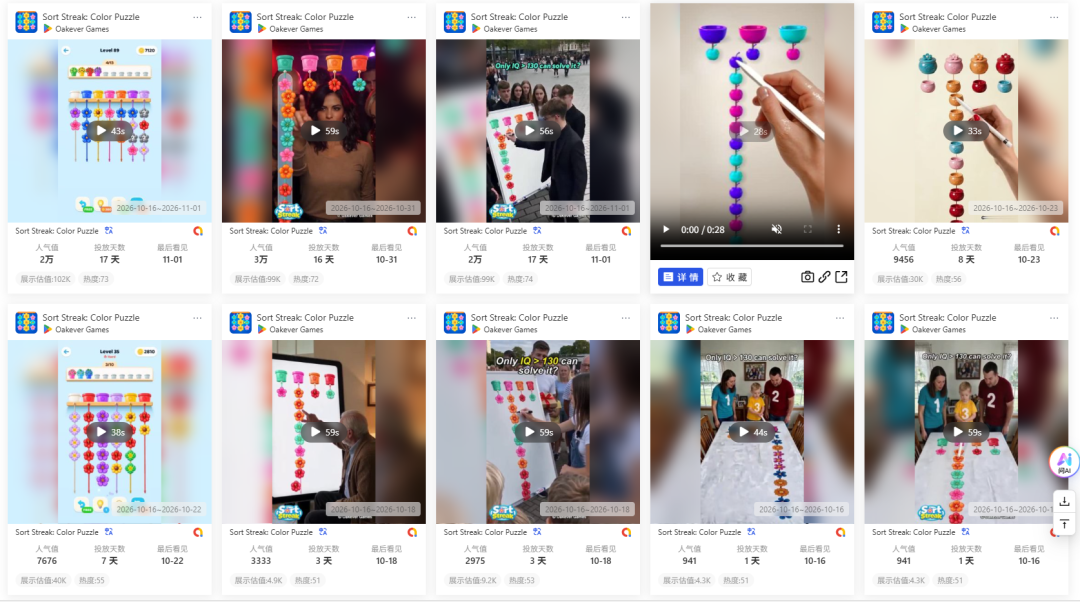
Source: Guangdada
This approach of designing ad content around gameplay traits can be seen in Lexin Shengwen’s other products as well.
"Amaze GO!" creatives lean into the contrast between wrong moves and the correct solution. Some ads first show arrows that cannot be removed, inviting viewers to judge the right click order, then reveal the answer through actual play.
Creative source: Guangdada
"Meowdoku," by contrast, mostly opens with a grid puzzle and guides players to reason along by progressively eliminating wrong positions. Unlike "Sort Streak," which directly shows sorting and collecting, these ads often require viewers to grasp certain logical conditions before a sense of involvement forms.
Across different puzzle genres, the hooks of UA creatives differ too: sorting games highlight the operation process and completion feedback, path puzzles use wrong demonstrations and right solutions to create contrast, and logic puzzles draw users in by posing a challenge and handing out clues step by step.
Beyond ad content, the pacing of "Sort Streak"’s market entry can also be set against Lexin Shengwen’s earlier new releases.
After the game launched on September 22, Chengguo Shuhang did not detect concentrated Google-family advertising until October 13. Two days later, live creatives on Unity and Meta reached 67 and 71 respectively, and advertising began spreading to more channels.
Around October 22, Meta spending showed another shift: live creatives held steady at roughly 76, but ad sets jumped from 123 to 531, with ad copy added in Italian, Spanish, and other languages.
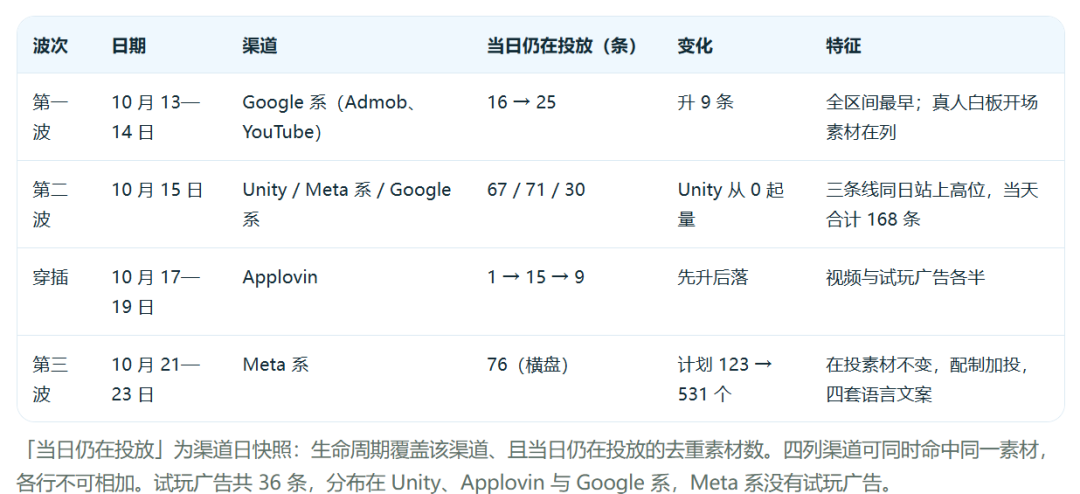
Source: Chengguo Shuhang
The number of new ad sets far outpaced the increase in creatives over the same period, suggesting this expansion did not rely entirely on producing new creative work — existing material was also being reused across more ad sets. Of course, more ad sets do not necessarily mean real budget or impressions grew in step, but they do reflect changes in delivery configuration.
Earlier, "Meowdoku" showed a similar pattern. Over 32 days from May 2 to June 2, Chengguo Shuhang tracked 367 creatives and 619 ad sets. On May 23, no new creatives were detected, yet 114 ad sets were added; by May 27, the company pushed out 141 creatives and 149 ad sets in a concentrated burst.
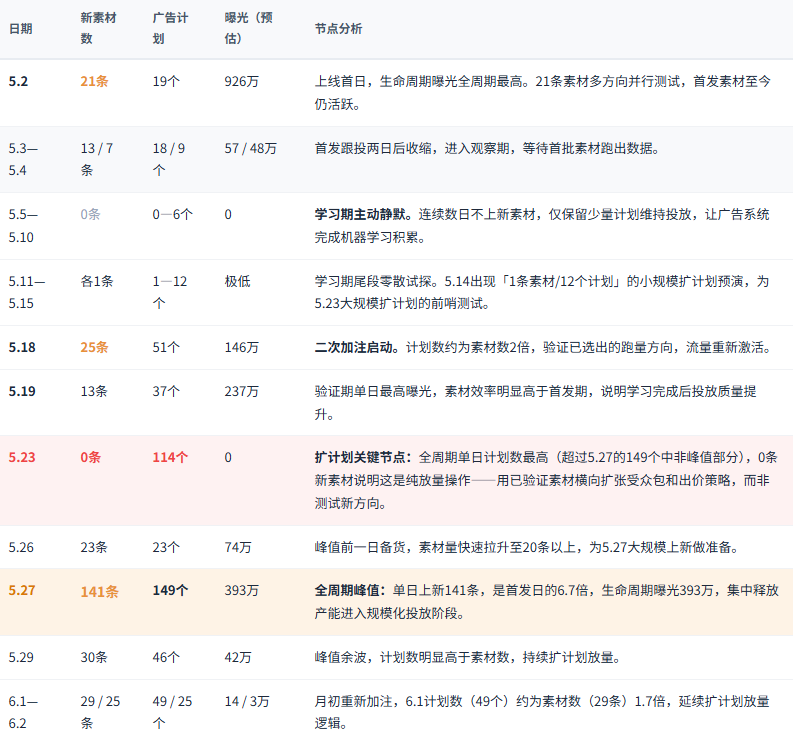
Source: Chengguo Shuhang
Judging from the delivery records of the two new titles, expanding promotion scale does not depend entirely on continuously adding new creatives; redistributing existing ideas across different ad sets is likewise a delivery move worth watching.
Still, the initial concentrated ramp-up reflects only part of the promotion story. Whether delivery can be sustained after download feedback arrives further reveals the stage of a product’s development.
"Amaze GO!" is a fairly complete case. Chengguo Shuhang began tracking related ads in late February, with daily new creatives of just 3 to 12 in early March. By April, the game added roughly 3,800 creatives and over 5,000 ad sets that month, and around 4,300 more creatives in May.
As promotion expanded, AppMagic estimated "Amaze GO!" gained about 21.8 million downloads in June. But user acquisition did not end with that round of growth. In September, the game still ranked fourth globally with 27,740 creatives, sustaining a sizable advertising footprint.
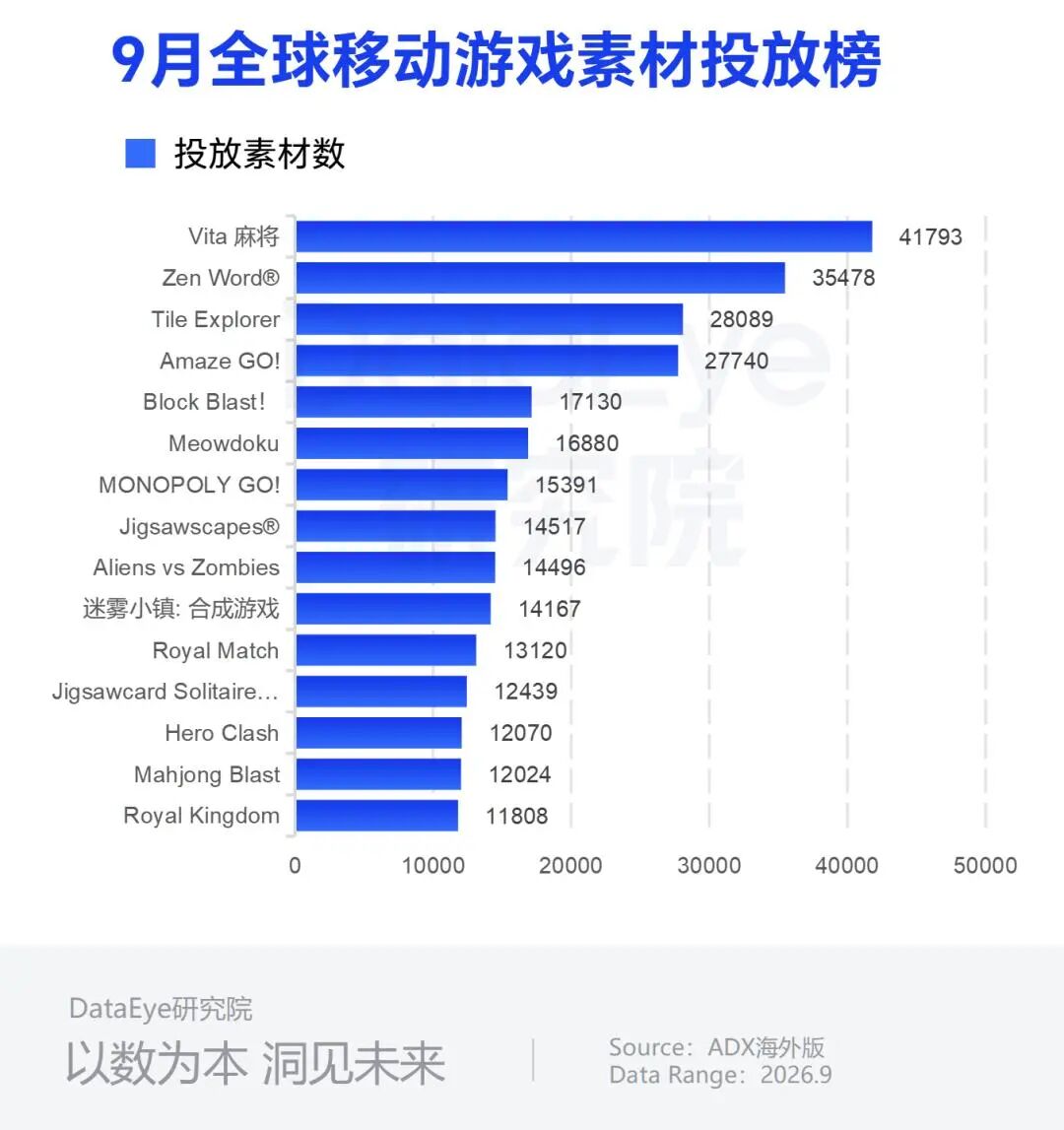
Source: DataEye Research
"Meowdoku" concentrated its early ramp-up in late May, with downloads approaching 9.4 million in June. By late October, Chengguo Shuhang tracked 12,986 active creatives and 35,370 ad sets for it over the trailing 30 days.
The two products did not ramp up at the same pace, but both kept up months of high-frequency delivery after download growth. Compared with a single concentrated burst of creatives or ad sets, whether follow-up delivery continues is a better signal of whether a product has moved from early market testing into a sustained user-acquisition phase.
More than a short-term ramp-up, whether high-frequency delivery can be maintained for months after download growth is what truly shows whether a new title has entered a sustained customer-acquisition stage.
"Sort Streak," for now, does not yet have a long enough observation window. In late October, its Meta ad-set expansion and download growth happened around the same time, but performance over this phase alone is not enough to tell whether delivery scale will keep growing.
For games already in long-term operation, the way ad creatives are used also differs.
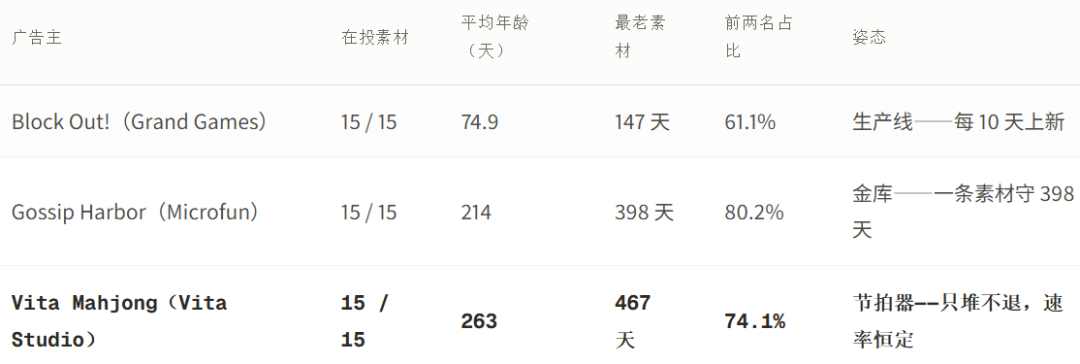
Of the 216 creatives tracked for "Sort Streak," 80 were re-runs, about 37%. AdMapix’s study of high-impression ads for "Vita Mahjong" in the U.S. market found some creatives with delivery records spanning more than 400 days, one reaching 467 days. At the same time, creatives launched in 2026 still contributed a large share of impressions.
Source: AdMapix
These figures reveal another trait of Lexin Shengwen’s UA matrix: new titles keep testing fresh ad performance, while mature products can keep updating creatives while retaining some long-lived material.
Final Thoughts
On one side are games like "Vita Mahjong" that have operated for years and still rely on sustained delivery to acquire new users; on the other, new releases like "Sort Streak" and "Twindoku" keep entering the market. For Lexin Shengwen, long-term management of mature titles and continuous experimentation with new mechanics are proceeding in parallel.
Interestingly, many of the core mechanics in these games are hardly new. Color sorting, arrow puzzles, and grid logic have been used over and over, yet they still reach new user groups through different product packaging and ad creatives. And as more mature mechanics get redeveloped, competition in the casual-puzzle market keeps extending beyond the products themselves.