
Original title: Effective November 1! TikTok Shop Philippines fee overhaul squeezes margins for these sellers
Author: Ye Nai
Source: Tuke Going Global (兔克出海)
Recently, TikTok Shop Philippines' local marketplace issued a fee adjustment notice that has caught many sellers' attention.
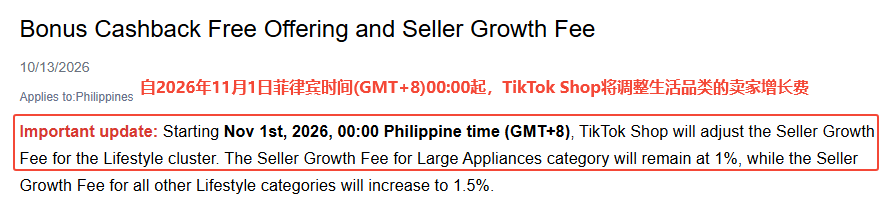
According to the notice, starting at 00:00 on November 1, 2026, the platform will adjust the seller growth fee (including VAT) for the Lifestyle cluster.

Source: seller-ph.tiktok
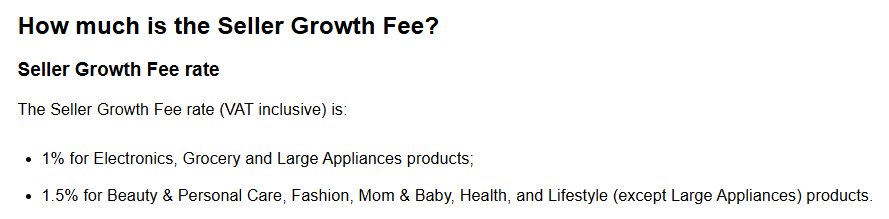
Specifically, electronics, groceries, and large home appliances will be charged 1%; beauty & personal care, fashion, mother & baby, health, and lifestyle products (excluding large appliances) will be charged 1.5%. That puts the maximum rate at 1.5%.
Source: seller-ph.tiktok
For local and cross-border sellers operating in the Philippines, this is not a number to ignore — especially for merchants moving high volumes of low-priced, low-margin goods, whose profit space will come under direct pressure.
What is the platform really doing?
TikTok Shop emphasized that the fee is meant to support a series of subsidies and initiatives, including improvements to logistics infrastructure, the development of innovative AI tools, and a better shopping experience, while also increasing reward cashback and platform subsidies in promotions.
In other words, the platform is not simply raising prices — it is trying to fund its ecosystem build-out by charging a growth fee on every successful order.
Source: seller-ph.tiktok
The rate varies by product category, reflecting the platform's differentiated approach across categories. Electronics, groceries, and large appliances carry relatively lower rates, while beauty & personal care, fashion, mother & baby, and other categories face higher rates — likely linked to competitive dynamics, subsidy intensity, or operating costs in those categories.
For sellers, understanding this logic matters: the fee increase is not an isolated event but part of a broader platform strategy. It adds cost pressure while also hinting at the possibility of continued investment in traffic and subsidies.
Subtle changes on the profit sheet
The most direct impact naturally falls on sellers' profit calculations. The growth fee is charged per successful order and includes VAT, which means every completed transaction requires sellers to hand a slice of their revenue to the platform.
For low-priced items, a 1% or 1.5% rate may seem modest, but stacked on top of other costs, the actual erosion of profit margins can be considerable.
In addition, because rates differ by category, sellers operating multiple categories must calculate costs by category rather than using a one-size-fits-all estimate.
For cross-border sellers, variables such as exchange rates and logistics add further layers, and the knock-on effects of the fee adjustment need careful assessment. The notice specifically reminds sellers to recalculate their profit margins before the fee takes effect — not an empty platitude but a genuine operational warning.
From passive pressure to proactive adjustment
Faced with the rate increase, sellers are not limited to passive acceptance. Recalculating profit margins is the urgent priority — especially for low-priced, low-margin items, which must be assessed against actual costs after the fee is layered on to determine which products can still sustain reasonable margins and which need price adjustments or cost-structure optimization.
Second, sellers can review their category mix: if high-fee categories account for too large a share, consider raising average order value through product upgrades, bundling, or other methods to dilute the impact of the fees.
Third, the subsidies and promotions the platform mentioned are worth close attention. Sellers can actively participate in reward cashback and platform subsidy campaigns, using platform resources to offset part of the fee pressure.
Closing remarks
With TikTok Shop Philippines raising seller growth fees this time, a maximum rate of 1.5% may look modest, but for low-priced, low-margin sellers, the impact is anything but negligible.
In the long run, healthy interaction between the platform and sellers is the cornerstone of ecosystem development. The window before the fees take effect is exactly the time for sellers to adjust their strategies — those who prepare early can respond with ease.