
Original title: Losing Ground in Europe, Temu and Its Peers Try New Moves
Author: Shuangmu @ AMZ123
Source: AMZ123 Cross-Border E-commerce

Cover image source | pexels
In recent months, Chinese cross-border e-commerce platforms have been hitting walls across Europe one after another.
According to data from the German E-Commerce and Mail Order Association, combined sales of Temu, Shein and AliExpress in Germany fell 35.5% year on year in Q3 2026 to €566 million, with combined market share dropping from 5.3% in Q2 to 3.1%.
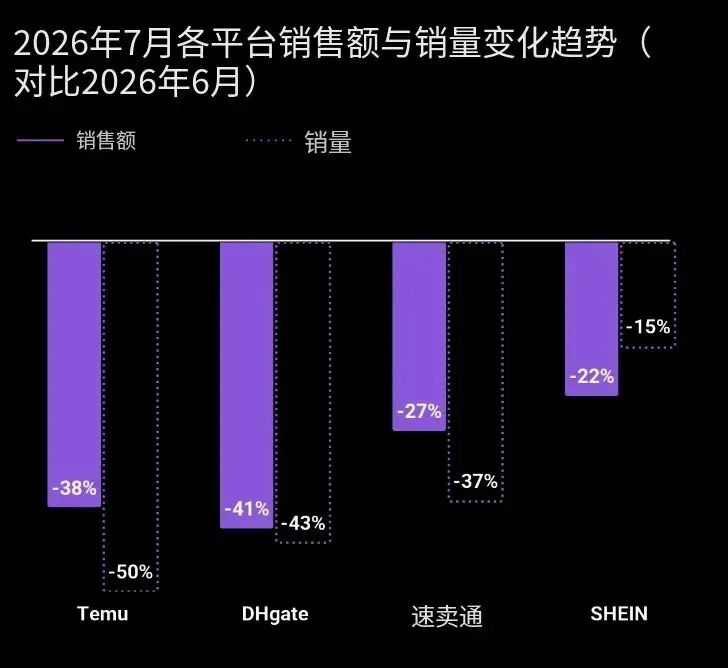
The cooling is not limited to Germany. French shopping app Joko’s data shows that in July 2026, Temu and AliExpress sales fell 38% and 27% respectively from June, with volume down 50% and more, suggesting the slowdown is spreading across Europe.
Two years ago, amid the whipsaw of U.S. tariff policy, Europe was seen by Chinese cross-border players as “the second market after North America” — Temu and AliExpress sat at the top of the rankings in multiple core European markets.
But now the competitive logic of this market seems to be quietly changing, and the Chinese e-commerce platforms have switched playbooks.
Europe sharpens its knives against cross-border e-commerce
Europe’s local industries have long suffered the impact of Chinese cross-border e-commerce platforms.
In recent years, platforms represented by Temu have leveraged ultra-low prices under the small-parcel duty exemption, rapidly seizing Europe’s lower-tier markets through direct-shipping small parcels and dealing a heavy blow to local European industries.
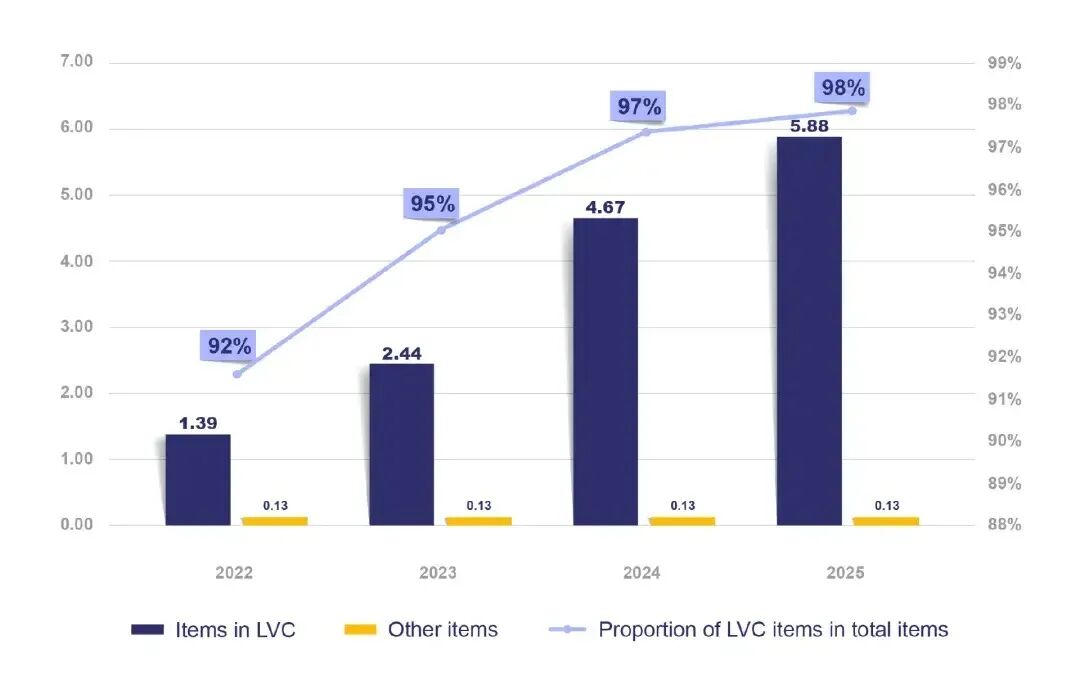
Data shows that from 2022 to 2025, parcels under €150 rose from 92% to 98% of EU import volume. In 2025, about 5.88 billion parcels under €150 entered the EU, dwarfing all other import channels.
The trigger was first pulled on the tariff front.
From scrapping the small-parcel duty exemption and imposing a €3 provisional tariff in July, to adding a €2 processing fee in November, the EU has rolled out successive tax hikes on imported parcels under €150, aiming squarely at the price advantage Chinese cross-border platforms were built on.
After the tax reform, the combined new cost per direct-shipped small parcel reached €5, squeezing margins to the extreme — take a product priced at €10 as an example: with a unit cost of €3.5, import VAT of €1.5 and first-leg air freight, the added cost alone leaves almost no room for profit.
Soon after the July rules took effect, Chinese cross-border platforms pressed pause on direct-shipping small parcels to Europe.
By mid-August 2026, parcels from China into the EU had fallen about 20%. In July alone, small parcels from China at Belgium’s Liège airport fell 53% year on year, and single-piece parcels from China to the Netherlands also declined sharply.
Logistics and express companies predict that if the trend continues for a year, parcels entering the EU could drop by 1 billion pieces annually.
Looking further out, the EU tax reform will keep advancing. The current €3 flat fee only applies to the transition period from July 1, 2026 to July 1, 2028, and the market broadly expects further tariff measures after July 2028.
By category, exports of low-value-added products such as 3C accessories, apparel and small home goods are expected to be hit. These categories account for a huge share of Chinese platforms’ sales; most items are cheap to begin with, and tariff costs could send their prices soaring.
Survey data shows some EU consumers have already shifted to second-hand and local platforms less affected by tariffs. In Spain, for example, Data.ai’s ranking of Spanish shopping apps shows that in September 2026, Temu and other Chinese platforms slipped down the download charts.
Notably, beyond tax reform, the EU is also tightening compliance controls on cross-border products — from price marketing, product safety, data privacy, tax compliance and platform liability — continuously raising the market’s entry bar.
Over the past six months, the EU has issued multiple heavy fines to Chinese platforms under the Digital Services Act. Among them, AliExpress was fined €550 million (about RMB 4.25 billion) on July 20, 2026.
Meanwhile, recent reports say the European Commission is also drafting a new European Product Law, further tightening oversight of low-value goods imported via cross-border channels — including strengthening platforms’ primary legal liability and requiring platforms to verify product compliance certificates.
It is clear Europe has built a regulatory system targeting cross-border e-commerce products and platforms.
But faced with rising entry barriers, the Chinese platforms are far from helpless.
Platforms are switching engines
Zooming out, the platforms’ slowdown in Europe partly reflects a deliberate pivot of direction.
Among them, Temu and others are reducing reliance on the direct-shipping small-parcel model and deepening localization.
Per industry sources, Temu has set up over 10 self-operated warehouses in Germany, Poland and other European countries over the past six months, leased and operated independently, mainly serving semi-managed inventory and goods from local European sellers. Once goods enter overseas warehouses, they can directly avoid the small-parcel tariff burden.
Industry insiders also say Temu’s European sites updated store fulfillment assessment standards in Q3, requiring local warehouse fulfillment to account for 80% of orders, with many orders shifting from direct-shipping small parcels to local fulfillment — sharply cutting the direct-shipping ratio.
To a degree, the platforms’ focus is pushing inventory forward into Europe and restructuring cost structures through localized fulfillment.
AliExpress, by contrast, chose a different lever — using branding to hedge tariff costs. Having operated in Europe for years, AliExpress already runs official warehouses in Spain, France and Poland, with a relatively high share of local fulfillment.
Public data shows that during the August 2026 sales campaign, AliExpress’ Brand+ assortment grew 97% year on year in the EU market, with Brand+ sales penetration exceeding 50% in 11 countries including Germany, France and Poland, delivering growth against the trend.
The underlying logic is easy to understand: European consumers value product quality and brand reputation, and are quite receptive to quality Chinese brands and brand premiums. Tariffs hit low-priced white-label goods hard, but for brands with pricing power and a fixed customer base, the impact is limited.
Looking at these moves together: facing market pressure, Temu is accelerating European local warehouses while AliExpress is growing against the trend with its Brand+ assortment. Their paths clearly diverge, but they are essentially doing the same thing — using brand and localized fulfillment to offset tariff costs.
The rules of the game for sellers have also changed
One fact that cannot be ignored: Europe’s pie is not shrinking. According to the 2026 European E-Commerce Report, European B2C e-commerce will reach €961 billion in 2026, up 5% year on year.
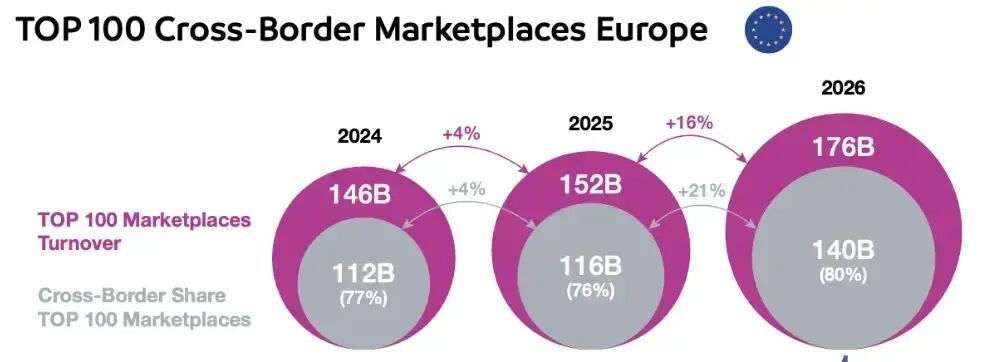
Cross-Border Commerce Europe data also shows that in 2026, among the TOP 100 European e-commerce platforms it tracks, cross-border platforms’ transaction value reached €139.8 billion, remaining a substantial share of the total.
But the leading platforms collectively changing course sends sellers a clear signal: the way the pie is divided has changed.
Sellers who relied purely on supply and low-price direct shipping are seeing their tickets invalidated. In the past, thanks to the small-parcel duty-free dividend, sellers could pile on inventory and cut prices low enough to win traffic, sell products and stay profitable.
Now, with EU tax reform in effect and compliance tightening, platforms are using qualification scrutiny and traffic tilting to accelerate the elimination of non-compliant, low-efficiency supply. Sellers relying on the direct-shipping small-parcel model are first in line, increasingly feeling growth hit a ceiling.
Platforms are also passing the market’s compliance pressure down to sellers: product safety, qualification verification and tax filing — issues that could once be deferred — have now become mandatory items for sellers to keep stores running normally.
Under this trend, more and more cross-border sellers unwilling to give up Europe are following the platforms’ steps and switching their going-global path:
On one hand, they are gradually reducing the share of pure direct-shipping small parcels and shifting to an overseas-warehouse stocking model;
On the other, they are optimizing product structures — choosing categories with pricing power and lower compliance risk, eliminating thin-margin, high-risk small items, and trying to build their own core competitiveness, including brand upgrades and differentiated product development, to strengthen resilience.
In the new path, sellers face greater operational pressure and higher costs — but once they complete the switch, they may earn a more sustainable position than in the era of pure price competition.