Japan’s sleep deficit has reached the scale of a national predicament.
An earlier RAND Corporation study put average sleep in Japan at just 6.3 hours, far below the global standard. The annual economic loss caused by the population’s sleep deprivation runs as high as $100 billion — about 3% of Japan’s GDP, the highest such share in the world. More recently, Japan’s 2023 white paper on measures to prevent karoshi (death from overwork) found that more than 40% of respondents sleep less than six hours a day.
That environment has produced a remarkably varied sleep economy.
From the mobile game Pokémon Sleep, to the many snacks and drinks marketed for their “sleep-aiding” effects, to the Japanese government’s sustained investment in sleep research, concern about sleep runs through every layer of the society.
Annual economic losses from insufficient sleep by country (left); Yakult’s drink for improving sleep quality and Ezaki Glico’s sleep-aid chocolate (right) | Source: RAND Corporation, web
Lately that attention has moved to hardware.
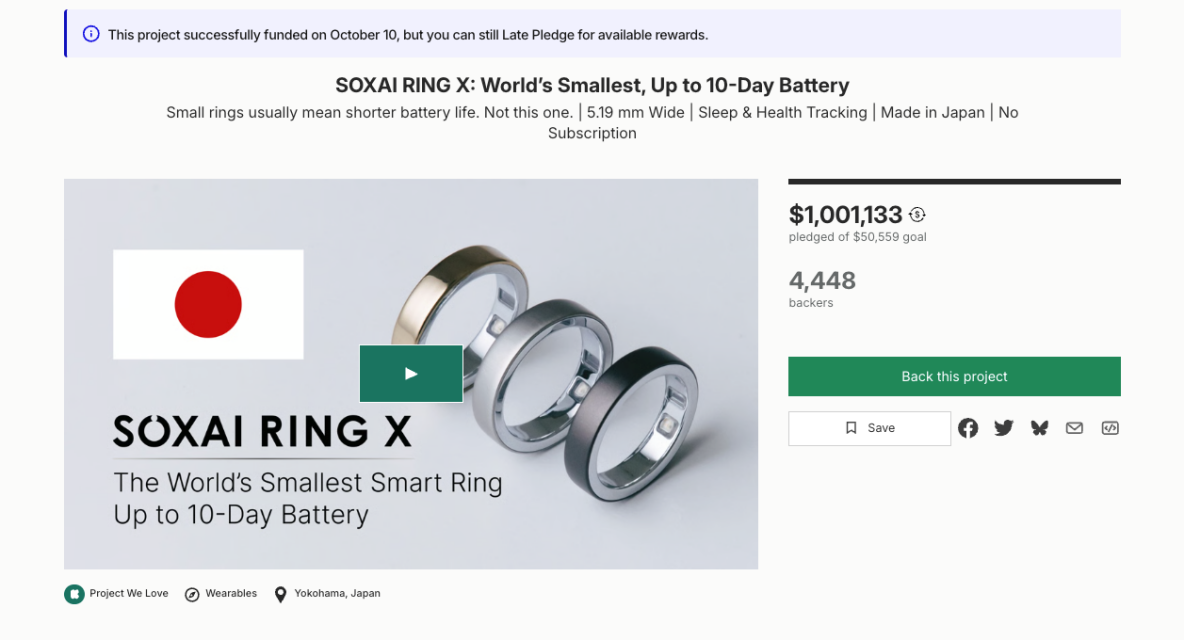
SOXAI RING X — an AI smart ring built by a Japanese manufacturer and pitched squarely at sleep tracking — has closed its Kickstarter campaign with pre-orders of more than $1 million.
Fifteen of its tracked metrics are about sleep alone
For people with sleep problems, the issue is often not simply that there isn’t enough time. Plenty of people lie in bed for eight hours and still sleep badly. What they face is a cluster of specific complaints: trouble falling asleep, shallow sleep, waking repeatedly through the night. Without data to work from, it is very hard to tell which remedies are doing anything at all.
SOXAI RING X enters at exactly that point, positioning itself as the user’s “dedicated sleep companion” and using continuous monitoring to help people find the causes of their insomnia and verify whether any change has worked.
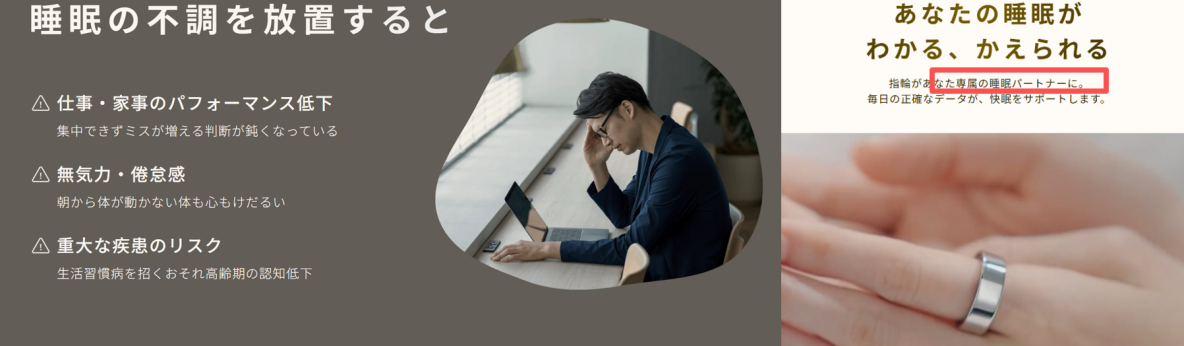 The ring becomes your personal sleep companion; accurate daily data in support of sound sleep (right) | Source: official site
Most ring makers on the market today build on a base of sleep, heart-rate and blood-oxygen data and then add stress tracking, period reminders and the like, heading in the direction of “more and broader.”
SOXAI RING X does not depart from that mainstream path, but judging by how it is marketed, it is clearly far more focused on sleep — to the point that even some of its baseline metrics exist to serve sleep analysis.
The SOXAI RING X companion app (left). On the blood-based monitoring that wearables generally offer, Japan’s Pharmaceuticals and Medical Devices Act keeps blood-glucose and blood-pressure measurement under strict control. SOXAI therefore explicitly does not measure either, sidestepping medical compliance risk and underlining the safety boundaries of consumer-grade health monitoring (right) | Source: Kickstarter
SOXAI RING X tracks 28 metrics in total, divided into Sleep (15 metrics), Readiness (7) and Activity (3).
Sleep accounts for more than half of them — from sleep stages and duration to the number of awakenings and changes in respiratory rate, covering very nearly every problem that can arise over the course of a night. Several of the Readiness metrics are closely tied to sleep as well, and exist to support a better analysis of what is causing a user’s problems.
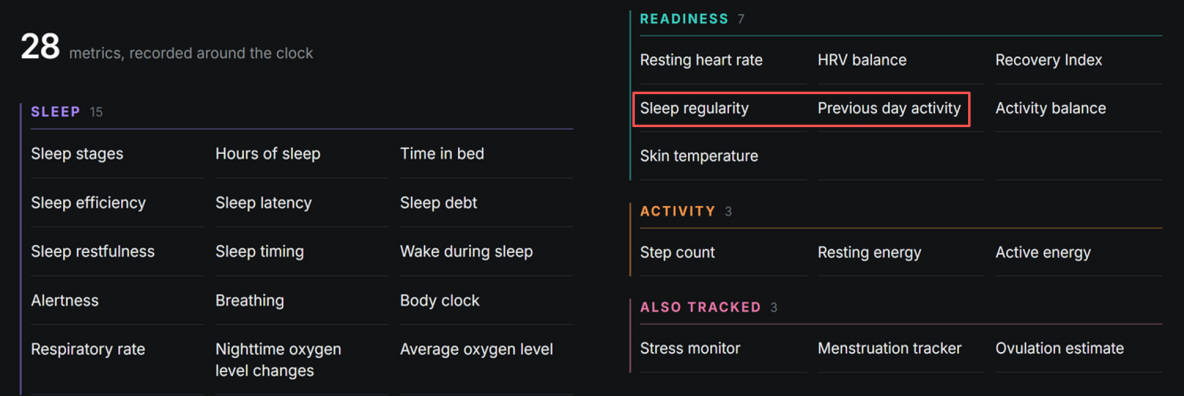 Boxed in red: sleep regularity and previous-day activity. The “hot” metrics that major vendors have been racing to add — stress, menstrual and ovulation tracking — are all consigned by SOXAI to Also Tracks (three metrics in the other category) | Source: Kickstarter
SOXAI says the choice of metrics is meant to help users clearly understand their own body clock and sleep patterns; as usage accumulates, its AI also helps users interpret those patterns and the factors behind any changes.
On top of that data, SOXAI offers a “five-step sleep improvement method.”
First, understand your current state from the measured data; then adjust your behaviour accordingly (for instance improving pre-bed habits, or tuning daytime exercise against observed sleep fluctuations); then keep tracking; and finally confirm from the data whether the change worked, and iterate. The logic is clean enough: data-guided adjustment in place of blind trial and error.
To make the idea easier to grasp, SOXAI maps the logic of its five-step sleep improvement method onto the process of losing weight (left); from a user’s habitual sleep and daily rhythm, SOXAI infers their chronotype — morning-leaning or night-leaning (right) | Source: SOXAI official site
On the technical side, to achieve precise monitoring, the optical sensor in SOXAI RING X carries the company’s own Deep Sensing™ technology, which uses multi-wavelength and spatially-resolved sensing to capture light information in finer detail.
For the equally important analysis step that follows, the ring’s AI algorithms were developed by SOXAI together with the Japanese Society of Sleep Research, the University of Tokyo and the UK’s University of Essex, with a focus on accuracy in classifying sleep stages. By the company’s own account, SOXAI RING X now performs at the highest level in sleep-stage determination.
*Note: Deep Sensing™ has a Japanese patent pending, and measures heart rate (HR), heart-rate variability (HRV), blood oxygen saturation (SpO₂) and related data.
That “industry-academia-research” character also shows up in SOXAI’s development plans.
According to a company announcement this September, SOXAI has partnered with the Japanese food giant Meiji in what sounds, at first, like an unlikely direction: gut health and sleep analysis. But per the official statement, research suggests a link between the gut environment and both sleep and mental state, and the partnership aims to draw on Meiji’s work in gut-environment research to offer users more personalised guidance.
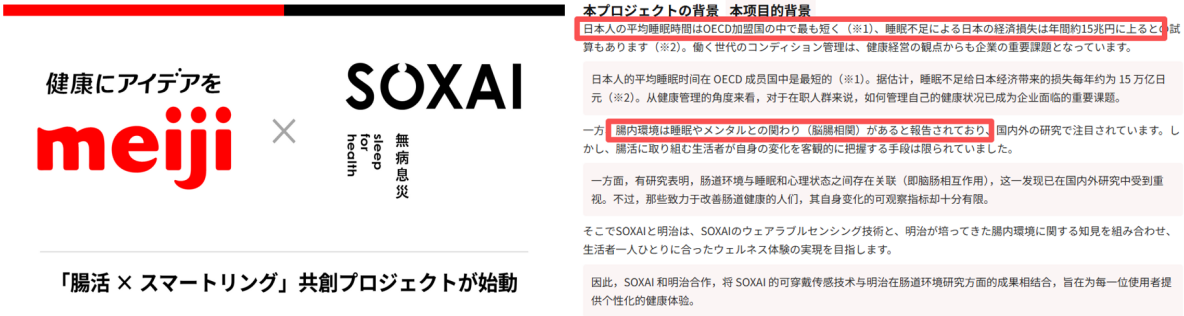 The company stresses the severity of Japan’s current sleep shortfall and points to a scientific link between gut health and sleep | Source: SOXAI official site
Behind SOXAI RING X’s whole apparatus of scientific method, though, sits another important problem. For monitoring hardware, however precisely you tune the sensor, it counts for nothing if the user doesn’t wear it.
Western brands such as Lumysi and Lumia have answered that by turning the hardware into jewellery. SOXAI chose a different road.
The narrowest AI ring on the market
Given the Japanese cultural context — consumers who demand a great deal of detail, and a comparatively understated aesthetic — SOXAI RING X looks, at a glance, much like an ordinary plain band, while the team pushed to make it as light and as narrow as they could.
Source | Kickstarter
Thanks, the company says, to repeated refinement by Japanese engineers and decades of manufacturing experience at SOXAI’s maker, SOXAI RING X squeezes its width down to 5.19mm — the narrowest currently on the market. The body uses a lightweight titanium alloy at roughly 2.4g, and holds battery life of about 10 days.
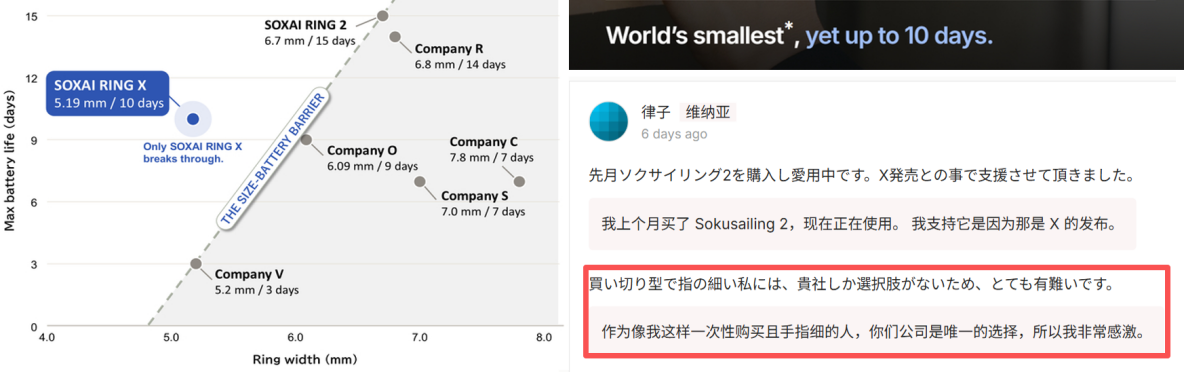 SOXAI’s own comparison chart across ring brands (left); the very narrow design has also become a reason to buy for some users with slim fingers (bottom right) | Source: Kickstarter
On thickness, though — which matters more to how a ring actually wears — SOXAI RING X comes in at about 2.6mm, not far off other smart rings.
With the team holding to a “researched, manufactured and tested in Japan” message, SOXAI RING X has nonetheless drawn a large number of domestic backers; its campaign comment section is almost entirely home-market voices.
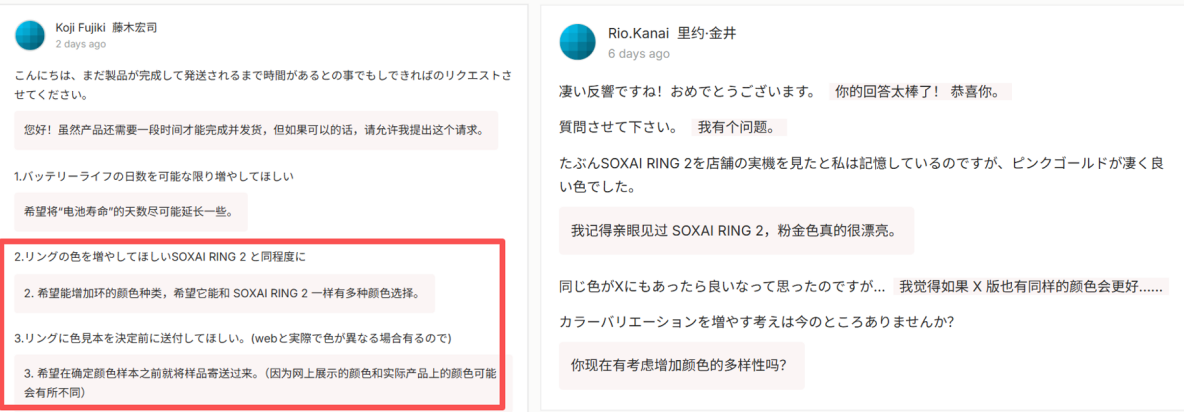 Many comments praise the industrial design and ask for more colourways | Source: Kickstarter
Trace SOXAI’s development, however, and it becomes clear the team is using this campaign to explore markets beyond Japan.
From home market to overseas — not quite there yet
Founded in 2021, SOXAI had in fact already released four rings before this campaign; SOXAI RING X is the fifth generation.
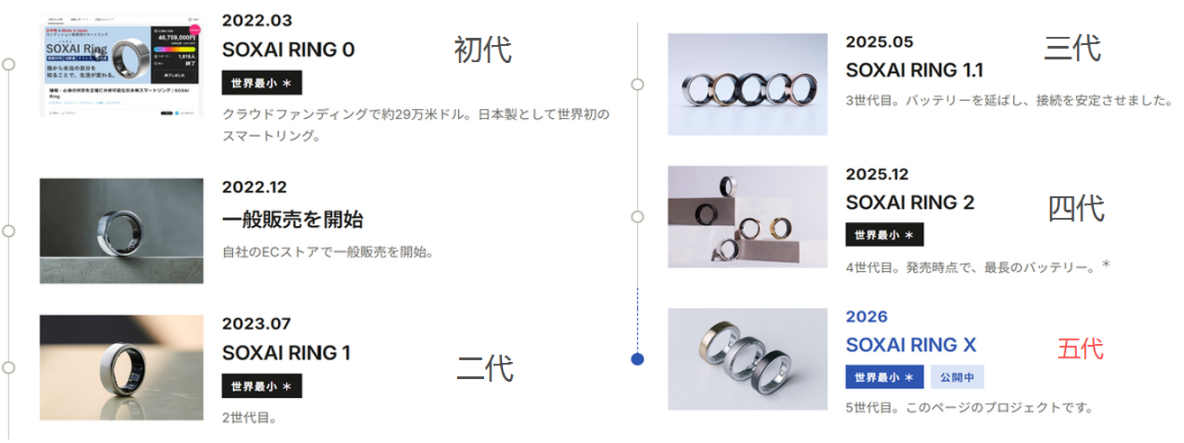 The “world’s smallest” claim in the image is the conclusion SOXAI reached from data publicly available at each launch; BelugaGlobal has not verified the earlier products. The fourth-generation SOXAI RING 2 was compared against smart rings with four-plus days of battery life. For the latest product, SOXAI RING X, see above | Source: Kickstarter
In March 2022, the first-generation SOXAI Ring launched on the Japanese crowdfunding platform Makuake.
Covid-19 was still shaping daily life then, and long stretches at home had disrupted many people’s routines and mental state. SOXAI — whose name draws on the Japanese phrase mubyo-sokusai (to live in health, untroubled by illness) — launched that first SOXAI Ring on the strength of sleep and “melancholy level” tracking, raising about ¥47 million, roughly $300,000.
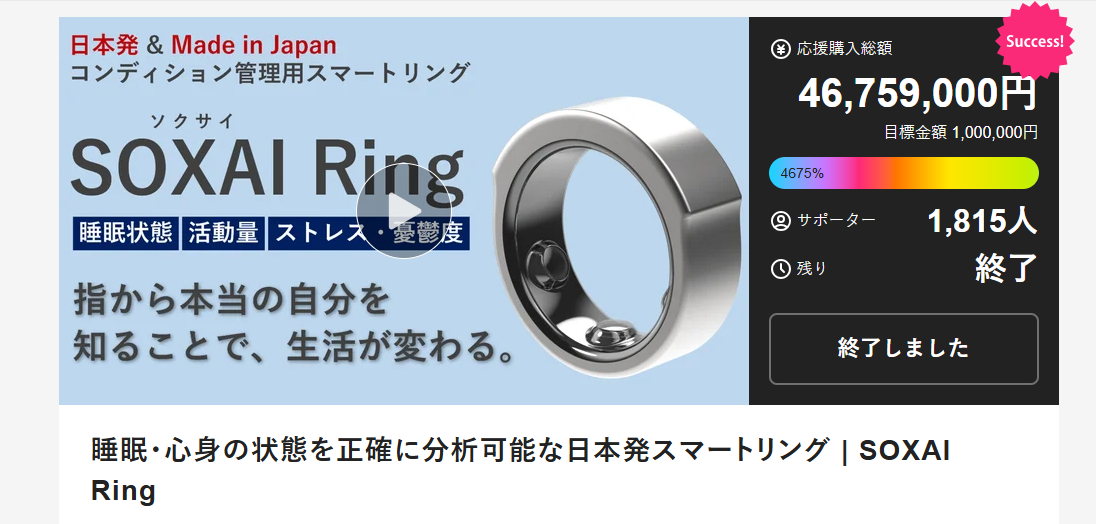
Testing the waters with that first ring and pulling $300,000 out of the single Japanese market hardened SOXAI’s conviction. Later products followed the same line, with little change in overall feature design but a tighter focus on “sleep plus an ultra-narrow build.” By the company’s figures, SOXAI now ranks first in Japan in its category by smart-ring app downloads.
The move to Kickstarter comes out of a larger ambition.
In its early market analysis, SOXAI wrote that despite Japan’s sizeable wearables market, not a single Japanese company sits in the global top five for wearable devices. In this field, SOXAI argues, Japan’s advantage as a “manufacturing powerhouse” no longer exists — and the company frames its own mission as strengthening Japan’s competitiveness in wearables.
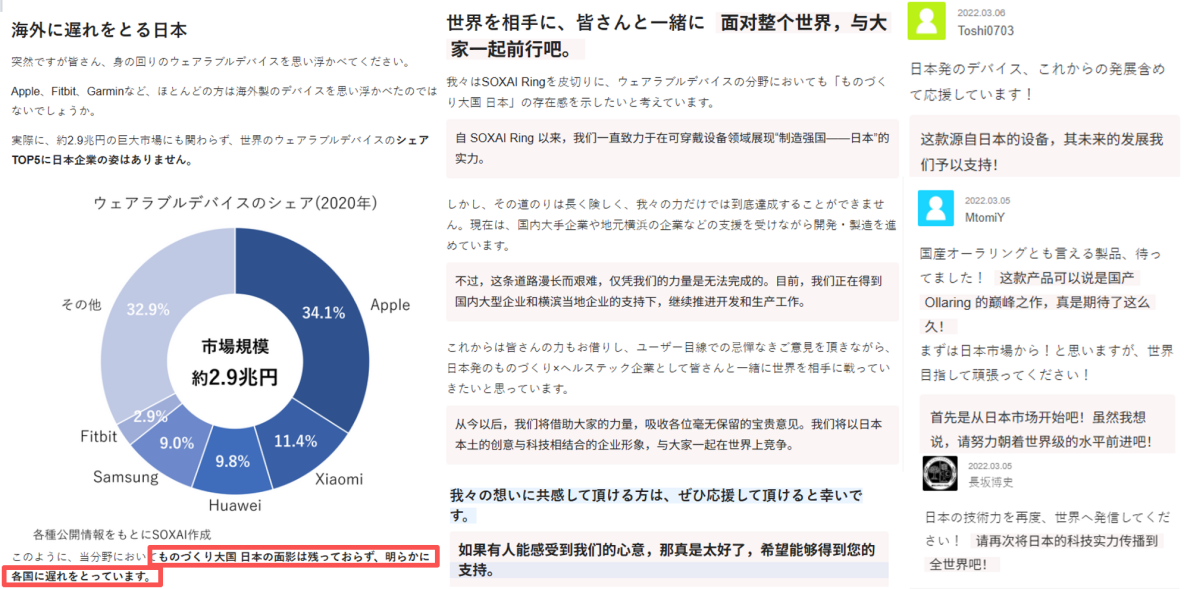 The red box reads: “In this field, the Japan once called a manufacturing powerhouse no longer exists. Japan has plainly fallen behind other countries” (left); SOXAI’s manifesto and user comments (centre, right) | Source: Makuake
Under that firm conviction, SOXAI’s manifesto and its user comments carry a distinctly Japanese earnestness. Judging by the response on Kickstarter so far, though, whether SOXAI can expand into more markets remains to be proven.
Looked at from another angle, SOXAI’s case also gives companies with an interest in the Japanese market a useful subject to study.