Recently, the hottest thing in the Chinese rap scene is that Melo got married. Ma Siwei, KnowKnow, ICE, Top Barry, Xie Di, and friends from Digi Ghetto all showed up at the venue. At this wedding that generated over 100 million exposures, among the guest favors that attendees took home and spontaneously shared online appeared an AI companion toy with glowing eyes—Fuzozo (芙崽).
Fuzozo is the No. 1 AI companion-raising toy in China. Since launching in July 2025, it has sold over 300,000 units cumulatively, won the iF DESIGN AWARD and JD/Taobao Tmall annual trend new product honors, and this year set the highest record in the AI pet category on Japan's Makuake crowdfunding platform.
How did such a star product embed itself precisely into this top-tier traffic without spending a single cent on celebrity appearance fees? The story begins with several rounds of matchmaking.
The fact that I got to know Fuzozo co-founder Yuna was itself a matchmaking. TTC's Wendy introduced us. After talking, I liked the simplicity and sincerity of the Fuzozo team.
At that time, I was looking to do some event marketing that could genuinely attract attention. Coincidentally, an old friend at 88rising proactively mentioned Melo's wedding guest favors to me and helped arrange the connection. I thought of Yuna and Fuzozo, whom I had just met: it was a gift guests would be willing to take away, and it also suited appearing in wedding photos. So I facilitated Fuzozo's participation, and Fuzozo became one of the guest favors.
Melo, in turn, connected Fuzozo with his celebrity friends around him. Everyone took photos with it and posted pictures and videos—we did not purchase those celebrity posts. Wedding-related topics accumulated over 100 million exposures in total, and Fuzozo gained a huge amount of brand attention along with these shares.
At the wedding with over 100 million exposures, guests spontaneously shared Fuzozo
Wendy matched me with Yuna; the 88rising friend brought the wedding opportunity to me; I facilitated Fuzozo's entry into the wedding; Melo then brought it to his friends. A piece of marketing was ultimately accomplished through one real connection after another.
But this also raises a question: if a brand has to wait each time for someone who knows Melo to appear, how far can growth go?
I'm Vio, and I serve as CMO at AhaCreator. Over the years, I have worked on overseas growth and creator marketing, and I have always enjoyed introducing the right people to each other. From the domestic rap scene to the overseas celebrity circle, I have gotten to know quite a few friends, including people in the circles of Shao Ailun, Lil Wayne, and Roc Nation. Fuzozo at Melo's wedding was one presentation of this art of matchmaking.
I joined AhaCreator not so that brands could borrow my contact list. What I want to do more is to make "who suits whom, and how to make the cooperation happen" a bigger thing: so that when a brand enters an unfamiliar market, it does not have to spend years getting to know local people first, but can still find creators who are willing to cooperate and can truly tell the right audience about the product.
Photos with friends from the domestic rap scene and overseas celebrity circles
What overseas influencer marketing has lacked was never just a list of names
If a brand wants to enter the German market, finding a thousand German-speaking accounts is not hard. What is hard is identifying whose audiences might need your product, who can explain it clearly, who is willing to cooperate, quotes a suitable price, and can deliver on time.
Next, the team has to communicate across time zones, compare quotes, ship products, review content, confirm licensing, and arrange payment. If one link fails, the "great influencer" found earlier may become just a name on a spreadsheet that has lost contact.
This is the real bottleneck for many brands doing overseas influencer marketing. The more markets and the denser the cooperation, the more easily teams get filled up with searching, coordinating, and chasing, leaving no energy to judge the most important thing: why is this product worth this creator talking about? Why would his audience want to listen?
AhaCreator starts from this question.
Brands come to the platform with products, target markets, and budgets; creators enter the platform with their content, audiences, and willingness to cooperate. What AhaCreator needs to accomplish is not just letting both sides see each other, but helping them judge whether they fit, and advancing a cooperation from invitation to delivery.
AI can read product information and creators' recent content, helping to screen based on audiences, markets, and cooperation conditions; the system can advance invitations, communication, and progress tracking. Brands are responsible for selecting people, judging content, and deciding budgets, while the platform coordinates contracts, fulfillment, settlement, and data collection. For creators, clear needs and transaction arrangements also make a cooperation easier to accept and complete.
This is what a two-sided matching platform should do: make "the right people" a deal that can be negotiated, done well, and continued.
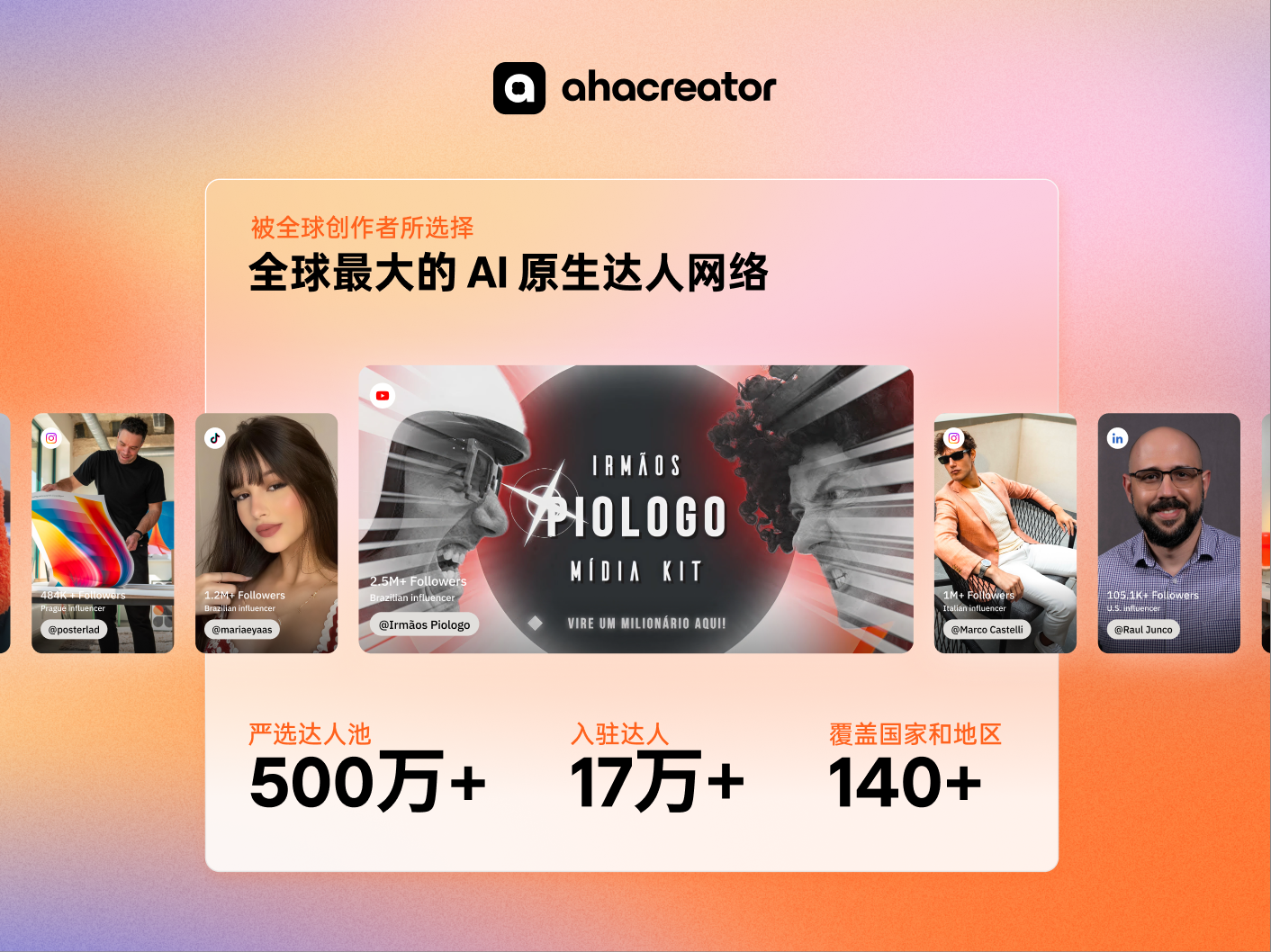
The underlying logic of AhaCreator is to use AI to finish the dirtiest and most tiring work in going-global marketing. As our investor and well-known investor Zhu Xiaohu said: "Dirty and tiring work is the moat, three main streets away from the big tech giants." Currently, AhaCreator has connected more than 5 million real and reachable influencers globally, of which over 170,000 are active creators already available to take orders on the platform, with a network covering more than 140 countries. With this infrastructure capability, we have not only obtained financing from institutions such as Jinqiu, GSR Ventures, Lenovo, Chuxin, and BlueFocus, but have also become Feishu's first overseas influencer marketing AI Agent partner, a deep strategic partner of BlueFocus, and have been listed among Influencer Marketing Hub's 2026 Best AI Agents.
Find the right people, and the product gets a chance to be truly understood
Haiyi SeaArt is a star product in the AI creation community category. What they needed was not generic tech bloggers, but creators who actually use AI generation every day. Through AhaCreator's precise matching, a large number of creators matching the profile integrated SeaArt into their real creation workflows. These authentic demonstrations and shares helped SeaArt's MAU leap from 1 million to 50 million, achieving more than 50x growth.
And when brands face extreme batch delivery requirements, AhaCreator's two-sided transaction network shows system-level fallback capability. A globally renowned smart hardware brand needed to publish 1,000 UGC contents across five continents and 19 countries, and required influencers to already own the product to eliminate the sample-shipping step. This is almost a coordination task impossible to complete manually. But AhaCreator completed precise screening and matching of 300-400 influencers within 48 hours, with a screening pass rate of over 70%, supporting the project to deliver all 1,000 contents within less than a month, with an average CPM of under $4.
And for products in the validation stage, finding people who can explain the functionality thoroughly often directly translates into real users. For example, CodeFlying, a zero-code application generation tool, quickly matched tech-savvy, hands-on geek groups through AhaCreator. In a typical campaign, it took only 15 days to bring 140,000 new users to CodeFlying.
These cases involve different products, but the growth challenges are similar: what brands need is not a cold list of account names, but getting the product into the right content and the right communities, and making cooperation happen at scale.
What we want to change is the way brands cooperate with influencers
Good matchmaking first needs to answer three questions.
The first is whether the content fits. Can the creator put the product into the expression they are good at? Only when a real usage scenario is found do viewers have a reason to keep watching, and only then does the product get a chance to be remembered.
The second is whether the cooperation can be done. Is the selected person willing to reply, can the price be negotiated, and can content, timing, and licensing be aligned? AhaCreator connects the work scattered across inboxes and spreadsheets, letting brands keep their energy for choosing people and judging content.
The last is whether the experience can be retained. Who responded, who closed the deal, who delivered well, and what content got feedback—these records should inform the next choice. After a campaign ends, a brand should not be left with only a screenshot of total exposure.
Only with these three layers of capability does KOL/KOC scaling become possible. Brands can work with more suitable creators of all sizes across different markets, audiences, and usage scenarios; the platform is responsible for continuously advancing matching, communication, delivery, and data collection, and brands then decide based on performance which content is worth amplifying and which creators are worth re-investing in. The value of scaling is not just posting a few more videos, but letting the product be seen and explained in more authentic content contexts.
This is also the UGC 3.0 we want to roll out next: when creator supply, cooperation execution, and content feedback are connected, UGC has the opportunity to evolve from one-off procurement into a growth capability brands can continuously iterate. We will talk about it specifically later.
Fuzozo at Melo's wedding was a beautiful matchmaking driven by people. What AhaCreator wants to do is let more brands, even without a CMO who has accumulated years of relationships, find creators worth cooperating with in the global market; and let every good cooperation leave a basis for the next growth.