

A wave of tax compliance reminders is lighting up the backends of Vietnam local stores.
Tax compliance meets “traffic hostage-taking”
Over the past two weeks, Vietnam seller groups have seen steady feedback: some sellers received pop-up notifications in their backends reading, “Shopee has noticed that your tax information is mismatched, invalid, or not found on the tax portal…”
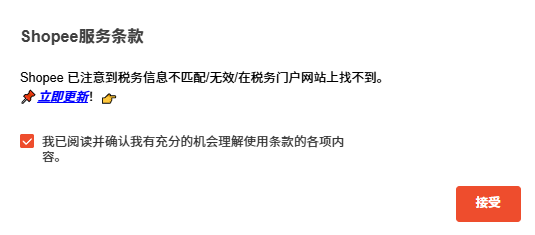
Screenshots shared by sellers show the platform asking sellers to update their tax information promptly, or their product listings will be restricted. Meanwhile, sellers hit by the checks suspect their stores suffered a sharp traffic drop over the past month — “down 77.15% month over month” — with the tax issue the likely culprit.
Sellers’ self-diagnoses may not be perfectly accurate, but the glaring pop-ups in the backend and the strict penalty clauses are indisputable facts.
After consulting service providers, our team confirmed that the tax crackdown in Vietnam is in full swing — a “blanket check.” And it is by no means targeting individual sellers only: many sellers who operate fully compliantly with accurate tax information have also received the notices.
On October 14, Shopee’s Vietnam local site rolled out a major update that directly ties tax information compliance to store traffic.
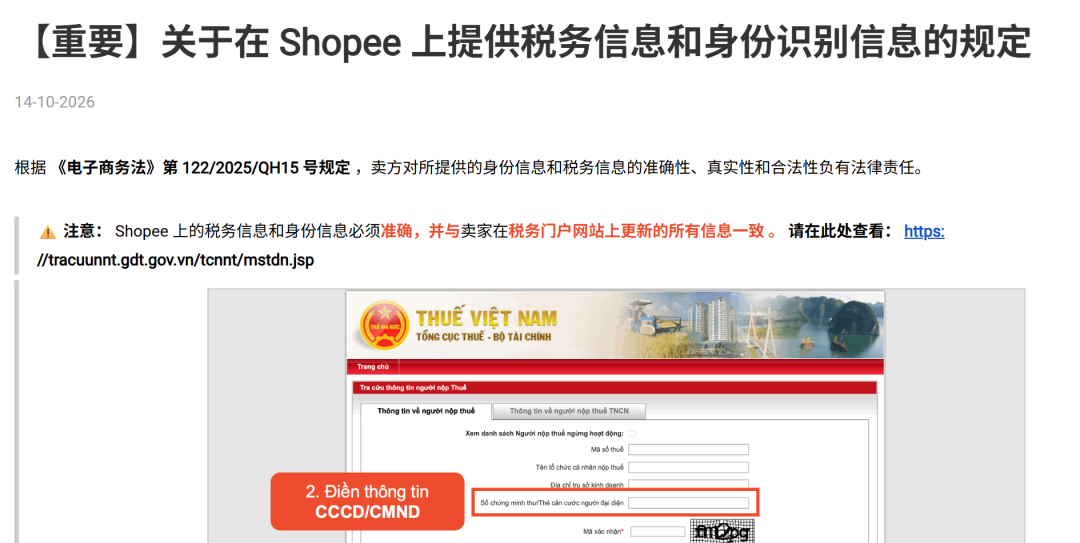
Vietnam’s E-Commerce Law took effect as early as July 1, 2026. Article 21 explicitly requires sellers to complete identity verification first, with local sellers required to go through the national electronic identity system (VNeID). Under this legal framework, platforms with online ordering and payment functions must withhold and remit VAT and personal income tax on each transaction, deducting them instantly once a deal is completed.
To withhold taxes per transaction, the platform needs tax numbers, and those tax numbers must match the entity’s qualifications; if they fail to align, compliance risk and fines land on the platform itself. Facing this tough battle, traffic — what sellers care about most ahead of big sales events — has naturally become the most effective gate in the platform’s hands.
Therefore, Shopee says tax and identity information on the platform must be absolutely accurate and fully consistent with all data sellers have registered on the tax portal.
That means tax numbers must be findable in the official system, ID documents must match the person, and addresses, company names and bank accounts must all be precisely aligned.
For sellers already operating by the book, this is just a routine verification; but for stores with compliance gaps from earlier days, it is time to move fast to patch the loopholes.
As October draws to a close, this is the final golden window for submitting, price-locking and stocking up for the Double 11 campaign — the buffer time left for sellers is running out.
Shopee has issued a stern warning: sellers who fail to update or pass review may face restricted store visibility, an inability to list or modify products, livestreaming bans, or loss of the “Preferred Store / Preferred Store+” label.
More than 56,000 stores squeezed out of the game
Speaking of traffic, how is the Vietnam market doing lately?
When the platform’s compliance stick and cost squeeze hit simultaneously, different sellers have different fortunes.
A Vietnam local seller specializing in general merchandise revealed that during the 2023–2024 boom, his store could easily handle over a thousand orders a day. But as platform commissions, shipping costs, discounts and all kinds of hidden costs ballooned, total platform expenses swallowed up as much as 30% to 40% of each transaction.
Other sellers shared similar predicaments in discussions. Some noted that the difficulty of operating on the Vietnam site depends heavily on the specific category, and that “the return rate ranks first among Southeast Asia’s five sites.” Still, some sellers believe the overall Vietnam market remains sizable — “as long as you can break into the top tier, there is still room to profit.”

Faced with extremely price-sensitive Vietnamese consumers, sellers simply cannot pass on costs by crudely “raising prices.” In the end, many small and mid-sized sellers chose to cut their losses — voluntarily deregistering their stores and exiting e-commerce.
The latest report from data aggregator Metric confirms this large-scale “ebb tide”:
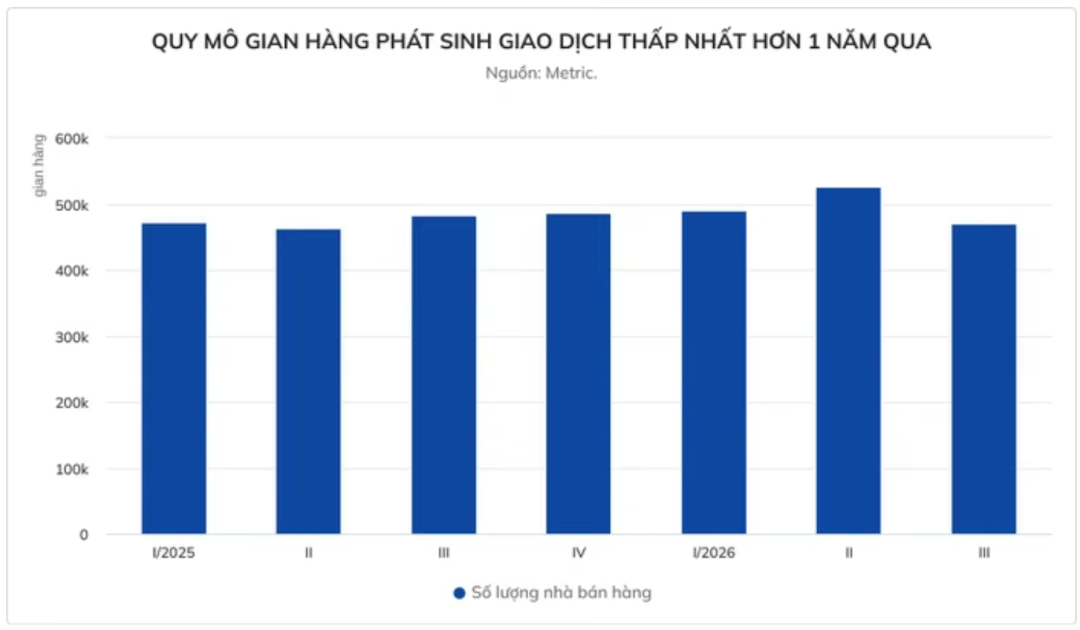
In Q3 2026, total sales across the four major platforms — Shopee, TikTok Shop, Lazada and Tiki — surged to 150.38 trillion VND (up 45% year over year and 5% quarter over quarter). Yet beneath the veneer of market prosperity, the number of active stores with selling capability in Q3 fell to about 470,000, down 56,200 in a single quarter (down nearly 11% quarter over quarter), and roughly 12,000 fewer than the same period last year (down 2.5% year over year).
In other words, there is more water in the pool, but fewer people can drink it. Traffic is concentrating toward the top at an unprecedented speed.
The data reveals three striking industry trends:
1. Per-store output for going-global stores is higher, but more are eliminated: the “average” sales per active store in Q3 exceeded 320 million VND, up nearly 49% year over year. After 56,000 exits were eliminated, the overall market is being carved up by a handful of top sellers.
2. Mall stores are swallowing traffic: Mall stores — just 3.54% of all stores — captured nearly 37% of the platform’s sales. On average, a single Mall store moves 16 times the volume of an ordinary store.
Shopee has entered a “farming the existing base” phase: Mall store count fell 8% year over year, but Mall store sales jumped 43%, showing the platform is tilting premium traffic toward the very top.
TikTok Shop keeps aggressively expanding its territory. Mall store count surged 76%, directly driving Mall store sales up 65%.
Some sellers are deregistering and leaving, while others grit their teeth and hold on. The seemingly ever-expanding market is essentially a story of rising concentration among top merchants and brand stores — an era of refined operations dominated by compliance barriers and brand premiums is gradually taking hold, and the market no longer seems to reward pure “lucky winners” who sit back and profit by chance.