


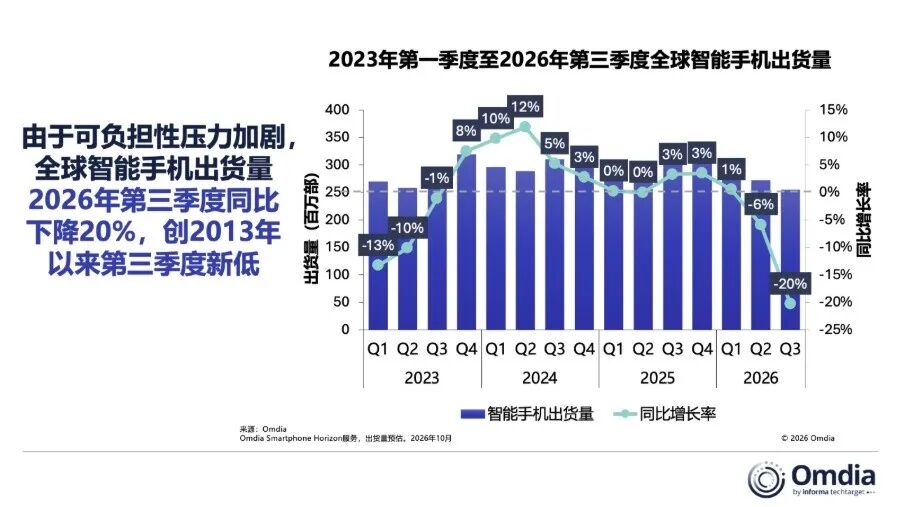
According to Omdia, global smartphone shipments fell 20% year over year in Q3 2026 to 254.7 million units, the lowest third-quarter level since 2013. Continuously rising smartphone prices continue to dampen consumer demand, especially in emerging markets. Ahead of the holiday selling season, distributors and retailers are also cautious about replenishing inventory, because higher device costs increase working-capital requirements and thus limit the scale of stocking.
Vendor performance
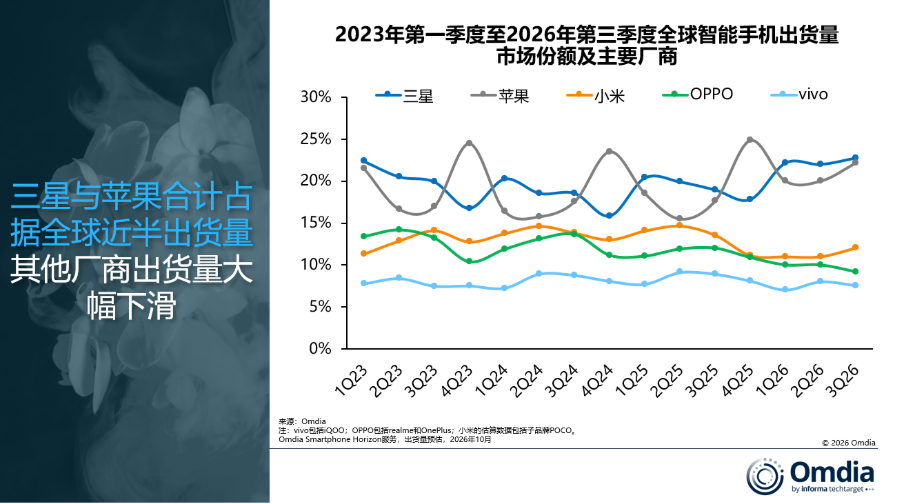
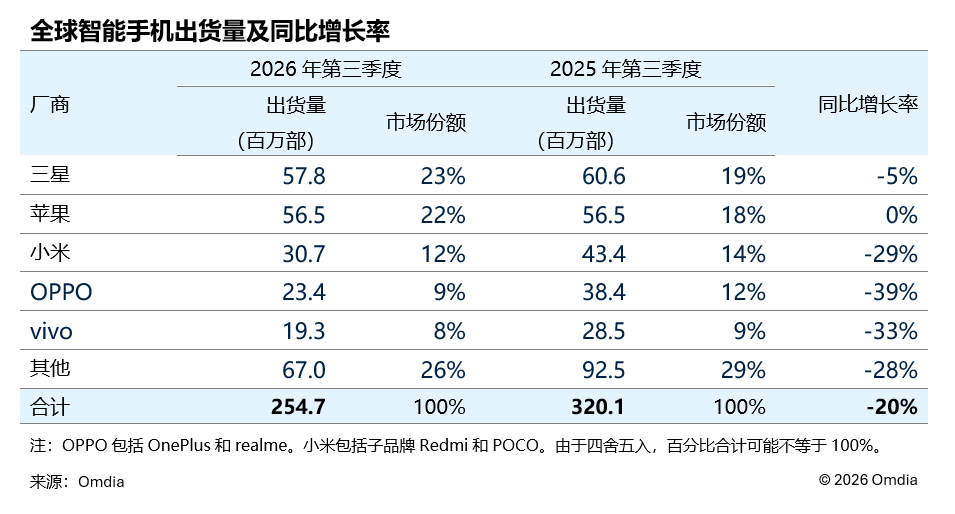
Samsung retained its position as the world's No.1 smartphone vendor by market share, shipping 57.8 million units, down 5% year over year. With other Android brands facing constrained memory supply and rising prices, the entry- and mid-tier Galaxy A series helped Samsung stay competitive, underpinning its shipments and global market leadership. Meanwhile, the Galaxy Z8 series launched in August, supported by trade-in and upgrade programs, further consolidated Samsung's position in the premium segment.
Apple shipped 56.5 million iPhones in Q3 2026, flat versus the year-ago period despite the global market decline. Sustained demand for the iPhone 17, together with channel stocking ahead of expected price increases, supported demand resilience in China and North America, offsetting weak performance in key emerging markets. In September, Apple unveiled the iPhone 18 Pro, iPhone 18 Pro Max and its first foldable, the iPhone Duo, while postponing the base iPhone 18 to 2027. The strategy extends the iPhone 17 sales cycle while concentrating holiday-season new-product demand on the premium lineup.
Xiaomi held third place with 30.7 million units, down 29% year over year, with shipments in China and India falling 20% and 28% respectively. Facing rising component costs, Xiaomi kept adjusting prices across markets to protect margins, which had a more pronounced impact on price-sensitive emerging-market shipments. The Redmi A7 Pro and Redmi 17 provided some support but were not enough to offset the overall decline.
OPPO (including realme and OnePlus) ranked fourth with 23.4 million units, down 39% year over year, while vivo took fifth place with 19.3 million units, down 33%. To cope with rising component costs, both vendors continued to raise prices in core markets, making channel inventory planning more challenging.
Market dynamics: affordability pressure intensifies, with emerging markets seeing the steepest declines
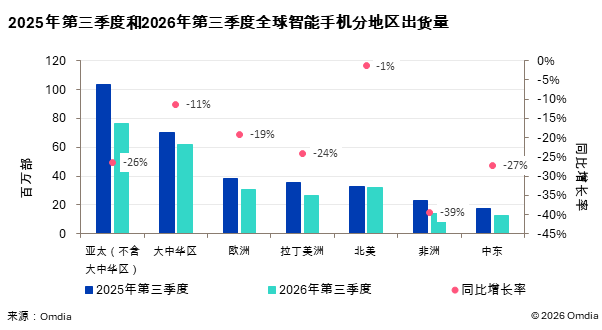
Omdia Chief Analyst Sanyam Chaurasia said: "Emerging markets, once the main pillar of global smartphone shipment growth, now bear the brunt of price increases. Africa fell 39% year over year, the largest decline. Although underlying demand remains, rising costs are shifting vendors' focus from aggressive expansion and share-grabbing toward protecting margins and selective shipping. Shipments in Asia-Pacific excluding Greater China, the Middle East and Latin America also declined by more than 20% each. Currency depreciation, inflation and rising living costs further eroded purchasing power, prompting consumers to delay upgrades or turn to refurbished smartphones; in some low-income markets, consumers have even had to choose feature phones. By contrast, North America held up relatively well, thanks to its premium-heavy market mix and mature carrier device financing, trade-in and upgrade programs."
Against persistently constrained component supply, vendors that mainly target the mass market are increasingly prioritizing profitable markets and core product portfolios. To stay competitive, they are adjusting RAM and storage configurations, streamlining SKUs and selectively absorbing part of the cost increases themselves, while expanding higher-value product mixes to protect profitability.
Market outlook: rising costs and inventory pressure weigh on smartphone demand in 2026-2027
Amber Liu, head of Omdia's smartphone business, said: "Omdia expects global smartphone shipments to decline 12% in 2026. Further price increases, combined with limited room for promotional discounts, are expected to curb holiday-season demand. Besides rising component costs, vendors face growing inventory risk as they balance existing stock against new-generation products. Telecom operators and large retailers are better positioned to cope with higher device prices and increased working-capital needs. Meanwhile, independent retailers, squeezed by slower inventory turnover and thinner margins, may accelerate their exit from the market."
The global smartphone market is expected to keep declining in 2027, but at a narrower pace. The persistent shortage of high-bandwidth memory (HBM), compounded by constrained conventional memory supply, is expected to keep costs elevated, offering smartphone vendors little relief on cost pressure. Vendors are expected to optimize sales, retail and marketing costs while seeking additional revenue through software, services and after-sales operations. Solid balance sheets, lean inventories and efficient operations will be key to building competitive advantages for vendors and channel partners alike.
US$4.8B AI Equipment Deals Draw Scrutiny as Megaspeed Faces Questions Over Chip Flow and Intelligence Allegations
A US investigation into Megaspeed, a Singapore-based AI cloud services company, highlights the increasingly complex commercial risks behind the globalization of AI computing power.
Phantom Blade Zero Hits 500,000 Concurrent Players Within 9 Hours of Launch
Phantom Blade Zero launched on October 29 and quickly surpassed 500,000 concurrent players on Steam within nine hours, backed by a pre-release media score of 88.

After 3-Plus Years of Relentless User Acquisition, Downloads Surpass 1.1 Billion: This Game Company Achieved a Transformation
From 500 million downloads in April 2022 to 1.6 billion by December 2025, Turkish casual game studio Unico Studio added more than 1.1 billion downloads in three-plus years of persistent user acquisition. Old games are still welcoming new players — and whether those new players stay will shape how much R&D and promotion budget the team invests next.