Original title: Global Smartphone Shipments Fall in Q3 but Revenue Rises 3% Year on Year; Apple Posts a Record for the Same Quarter
Author: Counterpoint
Source: Counterpoint Research

Cover image source | pexels
According to the latest market monitoring service from Counterpoint Research, although global smartphone shipments fell sharply by 19% year on year in Q3 2026, global smartphone revenue still grew 3% year on year to reach USD 114 billion. Rising average selling prices (ASP) propped up market revenue and offset the impact of the shipment decline. Premiumization, a better product mix, and storage-driven price increases across every price tier pushed global ASP up 27% year on year to USD 442, the highest level ever recorded for a single quarter.
Shilpi Jain, Senior Analyst at Counterpoint Research, said: “The smartphone market is increasingly facing a trade-off between volume and price. Although higher ASP has cushioned the revenue impact of falling shipments to some extent, that does not mean profitability will improve in tandem. As memory costs keep rising and margins come under pressure, phone makers are responding by raising product prices, trimming SKUs with low marginal contribution, and prioritizing core products and strategic markets. The entry-level segment has been hit hardest, because low-end phones simply have very little price headroom to absorb higher costs without sacrificing profit. For OEMs, the bigger challenge ahead is not only defending shipments, but also keeping products affordable while protecting margins.”
The global smartphone market in Q3 2026:by revenue share, average selling price (ASP) and shipment share.
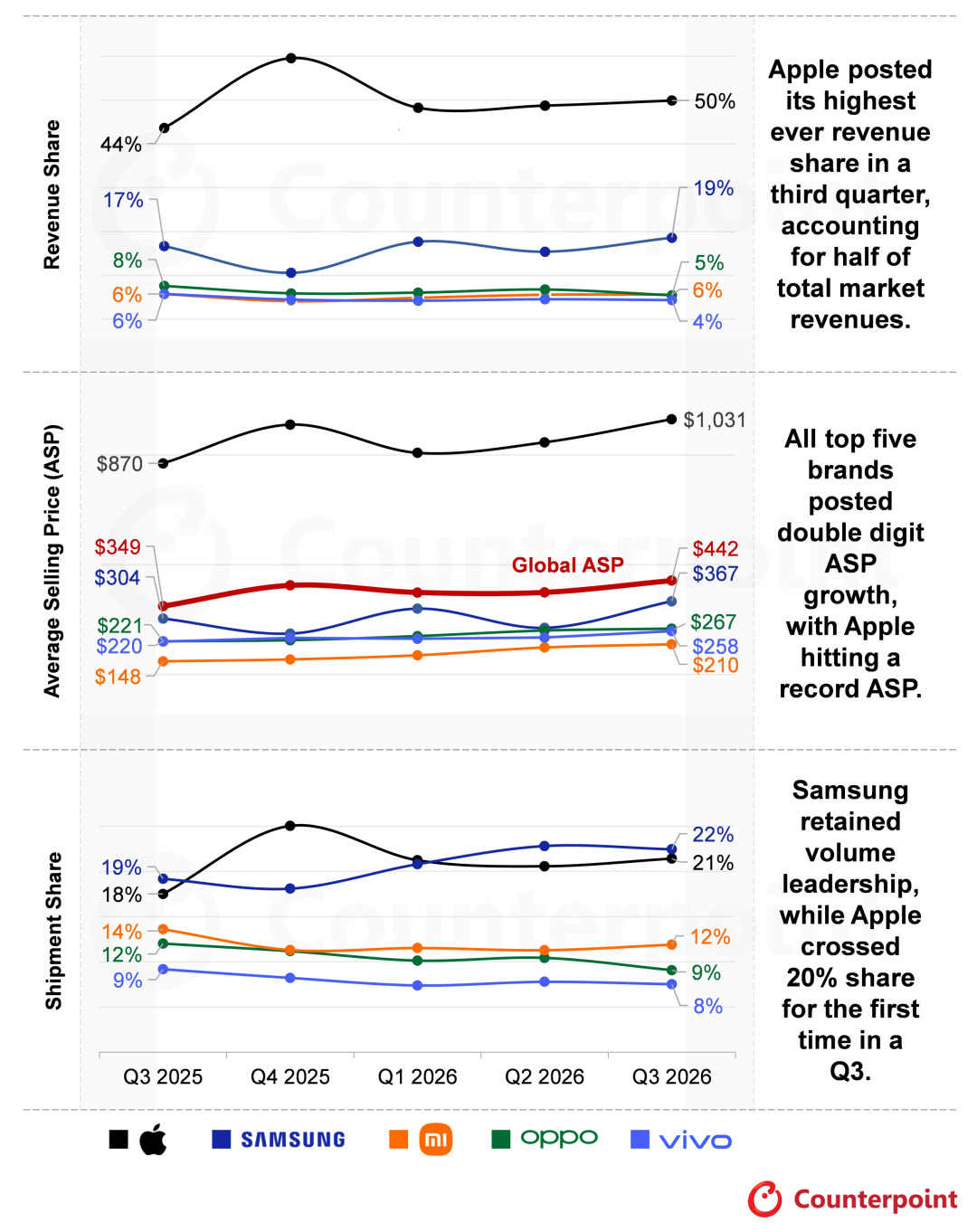
Source: Counterpoint Research Market Monitor preliminary data, Q3 2026 (OPPO figures include OnePlus and realme in every quarter shown; ASP is calculated on a wholesale price basis)
Apple posted its highest-ever third-quarter revenue, up 17% year on year, and captured a record 50% share of global smartphone revenue in that quarter. At the same time, Apple’s ASP rose 19% year on year, driven mainly by continued demand for the iPhone 17 series and the strong early market performance of the iPhone 18 Pro series.
Tarun Pathak, Research Director at Counterpoint Research, said: “In Q3 2026, Apple remained the most resilient major brand, with shipments essentially flat year on year. Apple has strong pricing power and can absorb rising memory costs and pass them on to consumers with little impact on demand. At the same time, the higher launch price of the iPhone 18 Pro series, the absence of a simultaneous iPhone 18 base-model launch, and Apple’s September price increase on some older models together drove ASP growth. Taken together, these factors helped Apple deliver strong revenue growth in a challenging market.”
Samsung ranked second with a 19% revenue share and revenue up 14% year on year, while retaining global market leadership with a 22% shipment share. Revenue growth was mainly helped by a 21% year-on-year rise in ASP to USD 367. Price increases on the volume-driving A series, along with strong performance from the Galaxy S26 Ultra and Z Fold8, supported ASP growth. Early strong demand for the Fold8 further reinforced its premium portfolio, while Samsung’s integrated supply chain helped buffer pressure from rising memory costs.
Xiaomi’s Q3 2026 revenue was essentially flat year on year, but ASP achieved double-digit growth and partly offset the shipment contraction. The change mainly stemmed from passing component costs through to retail prices and a product mix that gradually shifted from the entry-level segment toward the mid-range and upper-mid-range. A higher revenue contribution from high-value models further supported ASP growth. In Xiaomi’s core markets, the Redmi Note 15 series and Xiaomi 17T series both became important drivers of revenue growth.
OPPO and vivo saw Q3 2026 revenue fall 26% and 22% year on year respectively, as the impact of lower shipments outweighed the support from higher ASP. Both vendors prioritized profitability, pulled back from non-core markets, and focused resources on flagship and core products to strengthen brand positioning and drive revenue growth. OPPO’s ASP growth in the mid-range was mainly helped by the strong performance of the OPPO A6 series, reflecting an improving product mix. vivo’s ASP growth was concentrated in the upper-mid-range and high-end, with the vivo S60 5G, V70 and X300 series contributing to its market performance.
The revenue resilience shown so far is expected to be hard to sustain into the next quarter. In Q4 2026, the decline in smartphone shipments is expected to outpace ASP gains, turning global smartphone revenue to a year-on-year decline. However, continued ASP increases in the first three quarters are still expected to support full-year 2026 revenue growth. Looking to 2027, higher memory costs will keep squeezing OEM margins and push end prices up further. Global smartphone shipments are expected to fall again, but at a narrower rate than in 2026, while ASP gains are expected to lift revenue growth above the 2026 level. Cost pressure is not expected to ease until 2028, when OEMs may reinvest the savings into product upgrades rather than price cuts.