Original title: Li Jiaqi Ignites Southeast Asia’s “Next Blockbuster” — 100,000 Orders Sold in Half an Hour
Author: Feng Feng
Source: Southeast Asia E-commerce Observer

Cover image source | pexels
“Three, two, one — link is live!”
On the evening of November 2, Li Jiaqi’s livestream put a category on the shelf that you cannot touch or see: Tokens. It was the first time a top streamer had placed AI compute on an e-commerce shelf as a standalone product.
In this livestream collaboration with Alibaba’s Qwen, what was actually sold was the Qwen Office personal membership monthly card. It sold 50,000 units within 10 minutes of launch and nearly 100,000 units within half an hour, equivalent to about 2 trillion tokens of AI compute.

A token is the unit by which large models process information. Now that it has been packaged as a consumer product and put on e-commerce shelves, it marks AI compute services completing their move from the enterprise side into the mass consumer era.
And this wave is now, quite naturally, blowing toward Southeast Asia, a new red ocean of the digital economy.
A new category breaks into Southeast Asian shelves
Southeast Asia has responded to this AI wave faster than expected.
In Yiwu, a best-selling “Motutu” AI companion dog had merchants from the Middle East and Southeast Asia fighting to place orders on the spot. Some sellers say that compared with traditional plush toys, these smart products with built-in AI interaction lift the average order value by roughly 60% to 70%.
Separately, data from Lazada Malaysia shows that in the fourth quarter of 2025, searches for smart robot toys in that market jumped 156% year over year. Data platform ToysChart directly reveals that monthly sales of AI and robot toys in Southeast Asian countries are seeing explosive growth in 2026: Indonesia has broken 50,000 units a month, Thailand over 40,000, Malaysia about 35,000 and the Philippines 25,000.
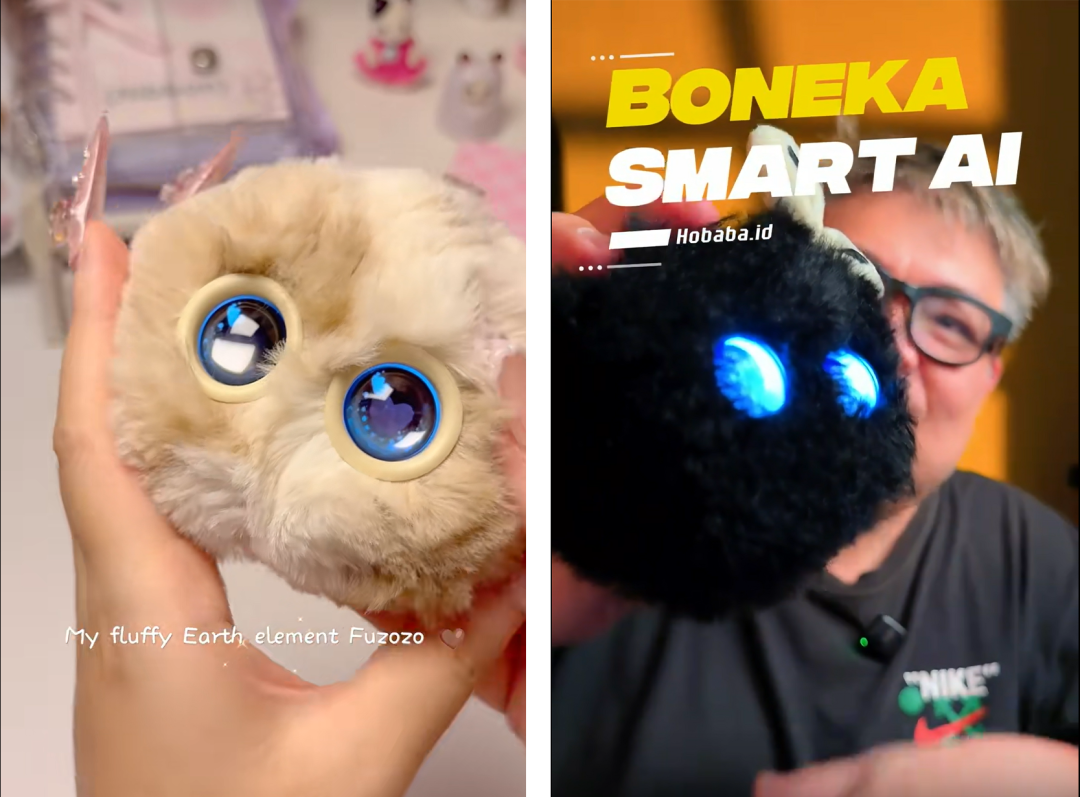
AI hardware is also accelerating into the market. Rokid, a leading Chinese smart brand going global, focuses on AI smart glasses that support real-time Indonesian translation, voice interaction and AI Q&A. Its TikTok Shop store in Indonesia now generates more than 1.4 billion Indonesian rupiah in monthly sales.
Users are buying toys and glasses, but what they are actually consuming is the compute behind them.
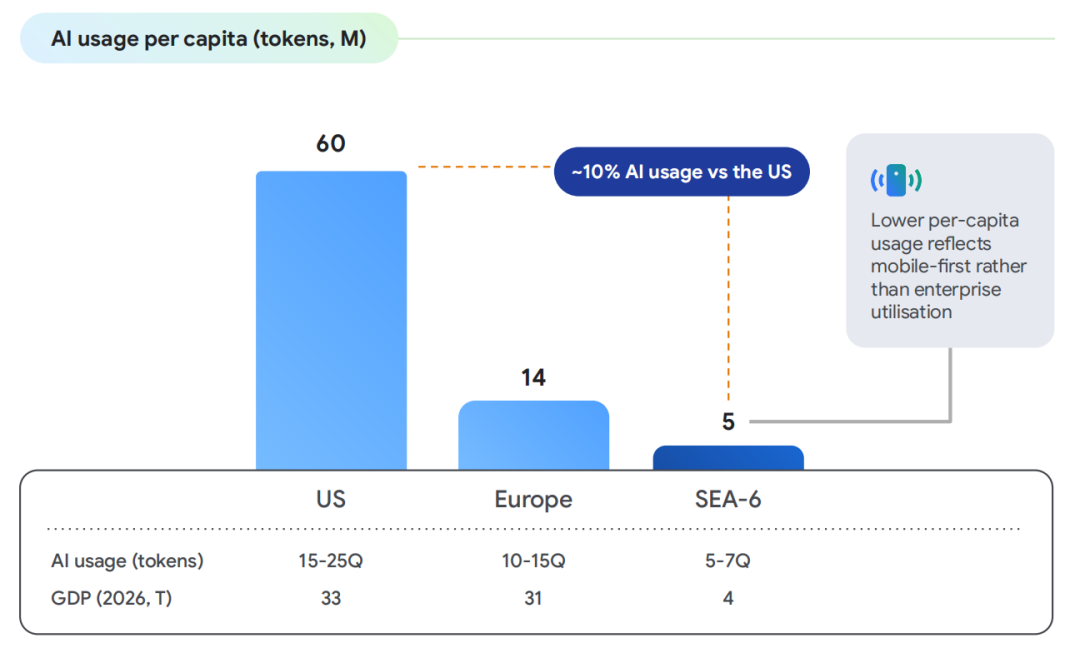
The “e-Conomy SEA 2026” report jointly released by Google, Temasek and Bain shows that 243 million people across six Southeast Asian countries already use generative AI, and half of them call on it every week, spreading faster than the internet did in its day. Driven by this extremely high stickiness, per-capita token consumption has quietly climbed to a high of about 5 million.
Of course, the market is clearly tiered. Singapore and Malaysia, as mature markets, see enterprise workloads account for 45%–60%, showing a high degree of commercial deployment; while in markets such as Indonesia, the Philippines, Vietnam and Thailand, about 80% of AI usage comes from personal consumption and everyday learning and entertainment, meaning there is still enormous room for growth on the consumer side.
This scene of “everyone burning tokens” makes the consumerization of AI feel utterly real.
Big tech pours money into AI infrastructure
Shifting our view from the consumer end to the supply side, the moves of big tech reveal the surge even more clearly.
At the 2026 Tencent Global Digital Ecosystem Summit, Tencent Cloud explicitly named Southeast Asia as the core battleground of its overseas AI strategy.
Specifically, relying on its three existing data centers in Indonesia, Tencent Cloud provides compute externally through TokenHub, which aggregates Hunyuan and third-party models, and its office agent WorkBuddy also landed in Indonesia in July this year.
Alongside these intensive investments, Tencent Cloud is also seeing results: over the past year its overseas active customer count has doubled, its total deployed servers worldwide have passed 2 million, its services cover more than 150 countries and regions, and international demand for AI products and services has recorded triple-digit growth.
Southeast Asia has become a must-win region for global tech giants, and a compute infrastructure race is also under way in the regional market.
Chinese leaders are staking out territory — ByteDance is adding $2.4 billion to lock in nodes in Malaysia and Indonesia, and Alibaba Cloud’s Johor region announced further expansion after officially going live.
Western giants keep pushing in — Microsoft and Amazon have poured tens of billions into Indonesia, Malaysia and Singapore, while OpenAI has not only set up its first overseas application lab in Singapore, extending services to five Southeast Asian countries, but also partnered with local giant Grab to train tens of thousands of drivers and merchants to use AI.
But whether laying foundations or building ecosystems, all of it ultimately needs a landing scenario that can monetize at scale and be called on at high frequency.
The ultimate battlefield where compute lands
“e-Conomy SEA 2026” shows that e-commerce contributes the largest transaction volume in Southeast Asia’s digital economy.
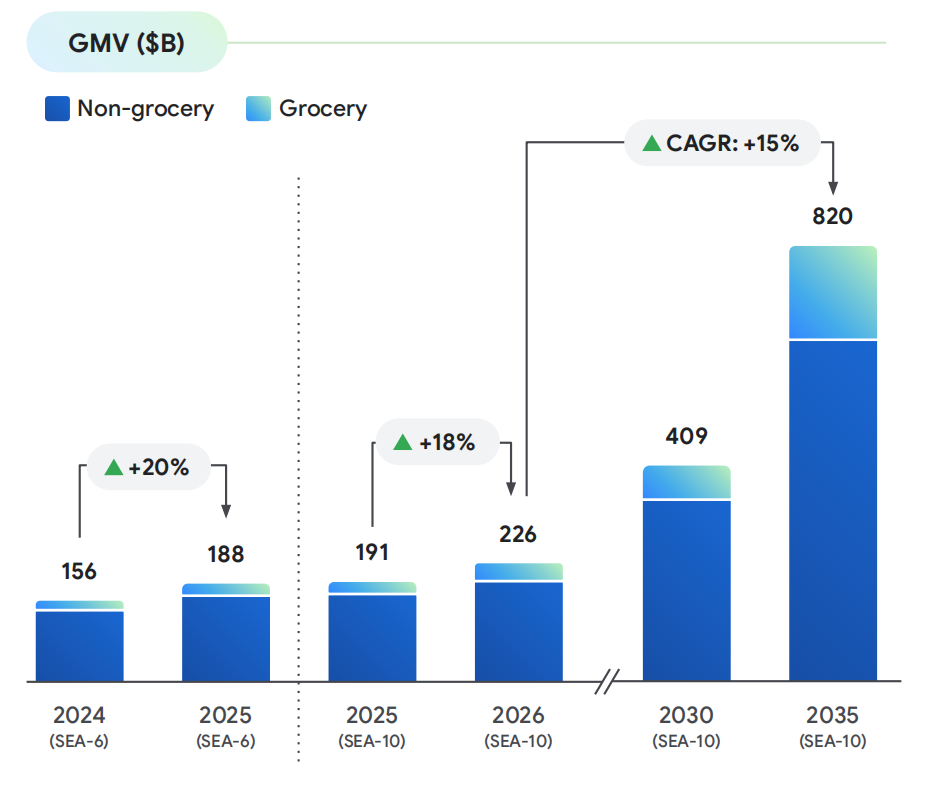
Southeast Asian e-commerce GMV is expected to reach $226 billion in 2026, a strong 18% year-over-year increase. The report also notes that the core drivers are higher consumer engagement, improved logistics efficiency and higher average order values, with AI standing out as an important lens across multiple indicators.
69% of surveyed shoppers said they already habitually use AI to help compare complex products such as electronics, with categories that involve complicated parameters, like baby products and consumer electronics, showing the strongest pattern.
A further 75% of users said they would be willing in future to let AI “find the lowest price and place the order directly” on their behalf, and 45% would be willing, within preset rules, to hand final purchase decisions entirely to an AI agent.
This extreme consumer dependence on AI is pushing e-commerce platforms to accelerate their ecosystem build-out.
On June 22 this year, Shopee announced full integration with ChatGPT across eight sites including Indonesia, Malaysia, the Philippines, Singapore, Thailand and Vietnam: consumers can discover products inside an AI conversation and then jump back to place an order, and eligible sellers can use ChatGPT for Business to auto-generate listings, produce marketing copy and take over customer service workflows. Sea disclosed on its earnings call that AI customer service already handles about 80% of inquiries, cutting customer service costs by roughly 30% year over year.

Recently, Shopee’s parent company also announced plans to commercialize Sea Cloud externally, directly targeting Amazon AWS, Alibaba Cloud and Google Cloud (GCP).
Lazada takes an in-house route backed by Alibaba: it has turned product selection, price adjustment, marketing, customer service and business diagnostics into five intelligent agents that together form an Agentic smart steward. As of the first half of 2026, Lazada’s AI shopping guide had accumulated nearly 100 million users, more than half of its product detail pages use AI, and more than 330,000 stores have enabled AI customer service.
TikTok Shop, for its part, puts its effort into content. Its AI creative suite Symphony opened fully in January this year, with script writing, digital human appearances and voiceover in more than 30 languages all built into the platform. Official data says AI-generated videos average 20% to 30% more views than ordinary sales videos, and a 15-second sales video can be produced in 5 minutes, saving the cost of hiring foreign models and presenters.
The operational moat that once required piling on manpower is now being fully converted into direct consumption of compute.
The real dilemma of putting tokens “on the link”
Big tech is frantically “building roads” at the front end, and e-commerce sellers are busy embracing AI tools to improve efficiency… yet this compute frenzy in Southeast Asia sits at a delicate and awkward turning point:
A massive user base and soaring token volumes have yet to translate into mature, sustainable commercial revenue.
The “e-Conomy SEA 2026” report points squarely at the current “lots of applause, little box office” dilemma:
First is the lack of depth of use. Per-capita token consumption in the six major Southeast Asian markets is only one-tenth of that in the United States, and the overall structure leans heavily toward the consumer end: about 60% of token consumption is concentrated in personal users’ general entertainment and light everyday assistance, while high-value, high-stickiness enterprise commercial applications still have plenty of room to grow.
Second is the extremely fragile paid conversion. In the six major Southeast Asian markets, only about 1% to 2% of the population will pay for AI services, and the vast majority of users remain in the free tier.
Take Li Jiaqi’s livestream as an example: the AI experience monthly card originally priced at 28 yuan was pushed down to one cent, ultimately bringing in only about a thousand yuan in actual transaction value — its educational value far outweighs any actual commercial transaction.
Still, viewed positively, this experiment also gave sellers an idea for breaking through.
In the past, selling relied on physical SKUs; now general service-type demand, as long as its delivery boundary is clearly defined, can likewise be packaged as a standardized product and put on the shelf. Looking at the bigger picture, sellers can also proactively explore new categories rather than staying within the traditional matrix.
At the same time, when a rule-breaking new category appears on the market, the ice-breaking role of creators is multiplied. Although top streamers test a seller’s resources, in Southeast Asia seeding by mid- and small-tier creators and KOC amateurs is often more persuasive than hard brand advertising.
By using a large volume of mid- and tail-tier creators to reduce complex technical features into everyday pain-point solutions that buyers can understand and use, sellers can likewise drive high-stickiness repeat purchases and conversions at a low entry threshold.