
Interviewee: Wu Tong, founder of WalkColor
About this interview:
In the wave of Vibe Coding, apps are springing up everywhere, yet few manage to keep users engaged and turn a profit after launch. In the image-creation tools space, most products are here today, gone tomorrow. WalkColor — built by the "1.5-person team" we once profiled — has escaped the "one-hit wave" trap through frequent updates, dynamic photo play, and user recipe sharing. This week, we learned that WalkColor has been acquired by Xuanshine, an AI-native imaging company.
In this conversation, Baijing sits down with WalkColor's founder to explore, from the startup thinking and product development experience: how a small team validates demand and iterates continuously, why the product accepted an acquisition, the criteria for choosing the acquirer, and the product and monetization roadmap ahead — offering independent developers a reference for long-term growth.
In mid-August, we published a feature on the image tool WalkColor (How China's "1.5-person" Team Pushed a "Photo Toy" Up the Korean Charts), ending with two open questions: with intensive updates and heavy reliance on one developer's personal input, how long could the "1.5-person team" sustain the pace? And with every launched feature free, how did WalkColor plan to monetize?
Two months later, the answers arrived. Baijing has learned exclusively that WalkColor has been acquired by AI-native imaging company Xuanshine, and founder Wu Tong has joined the company. Xuanshine's core product, Xuanshine AI, offers AI beauty retouching, AI outfit-changing and other imaging capabilities. Public information about the product and team is scarce; according to Wu, Xuanshine AI has covered 120 countries and regions worldwide with nearly 10 million users in just over a year since launch. What we were curious about: why did WalkColor accept an acquisition, and why choose Xuanshine? What value did Xuanshine see in WalkColor?
On the monetization front, the product has launched a subscription tier. Earlier, peer product PhotoColors drew heavy criticism after introducing subscriptions — how WalkColor's would be received was another thing we wondered about. With these questions, we sat down with Wu Tong for an in-depth conversation; the dialogue below has been edited and polished by our editorial team.
1. Creativity Is Hard to Defend as a Moat — the Only Way Is to Keep Outrunning the Hype
Baijing: We understand WalkColor was built by a "1.5-person team." Can you tell us about your backgrounds, how you divide the work, and how much each of you invests? How did you decide to build together?
Wu Tong: The product was co-developed by my boyfriend and me. I work on it full-time; he puts in roughly 20 hours a week — hence "1.5 people."
I previously worked at an advertising agency, then ran a self-media channel for a while after quitting. My boyfriend used to be a software engineer in the U.S. and now develops indie games from home. On the division of labor, I mainly handle creative presentation, feature design and polish; he handles engineering and lower-level work. The earliest features — the embosser and collage — we optimized together; later, we basically each took ownership of a feature end to end. For example, the camera feature was done entirely by him, and most of the rest by me.
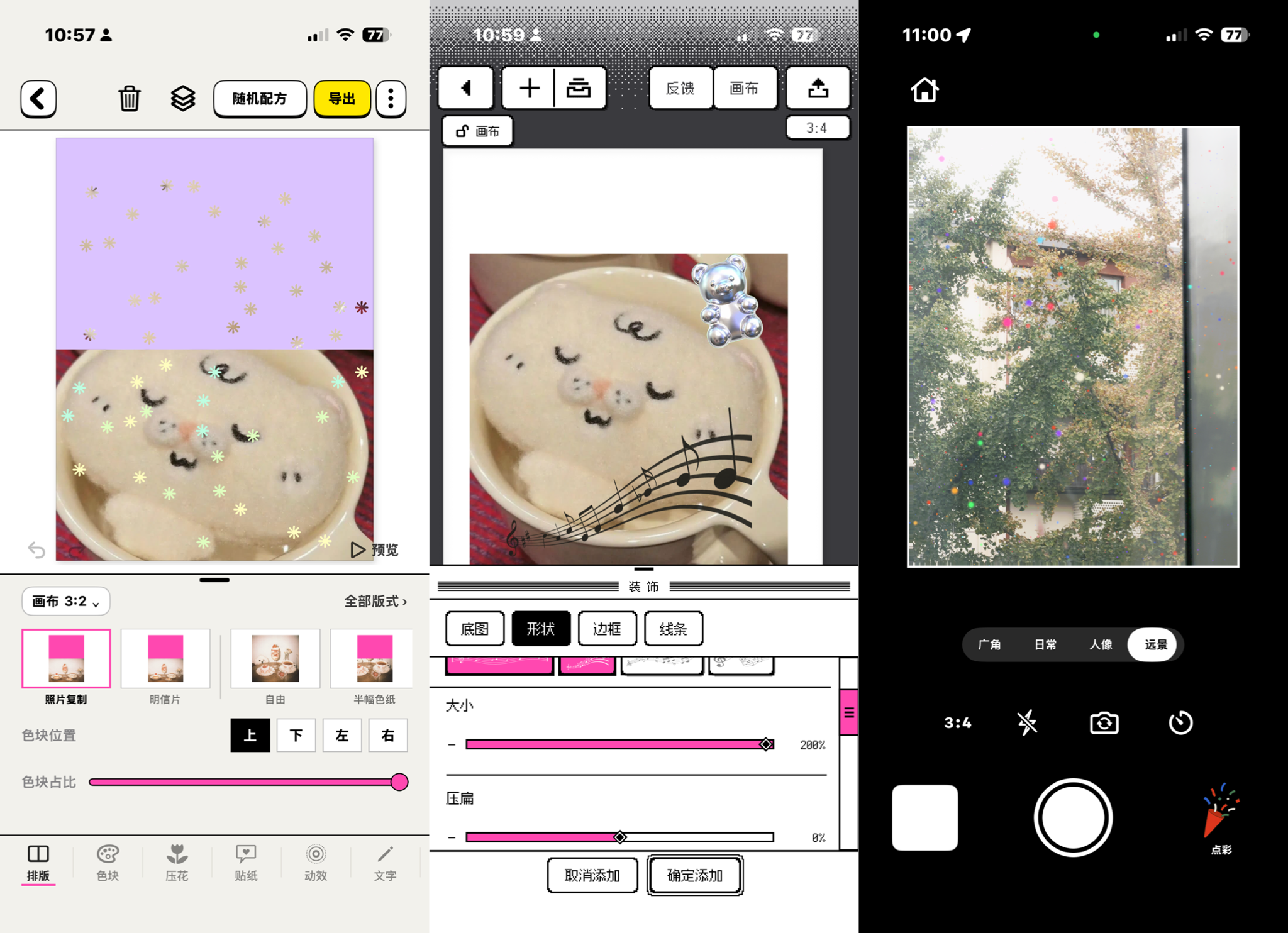
From left to right: WalkColor's pop embosser, pin collage, and camera. The embosser adds dots and shapes to photos; the collage combines and decorates multiple photos; the camera offers different filters and play modes | Source: product screenshots
Baijing: Why did you choose the image-creation track? Does it relate to your past experience? How do you read the current image-tool landscape?
Wu Tong: Honestly, WalkColor started as just one episode of my self-media channel.
When I was doing self-media, I planned a video series where each episode Vibe-Coded an app and turned the development process into an entertaining mini-story. At the time, the goal was simply to get views — I wasn't thinking about long-term operations. We'd built an earlier product called "Chuchu" that went almost unnoticed; WalkColor was our second product, and it drew huge attention.
My choice of the visual track came more from personal interest. I've always been into art, visiting exhibitions often and building up knowledge of art history and contemporary art. Through self-media — learning topic selection, scripts, storyboarding and editing — I accumulated a lot of visual creativity and gradually developed a sense of popular aesthetics and user preferences.
On the image-creation tools track, I'd say it's fiercely competitive on one hand, and far from saturated on the other.
Competitive, because visual creativity rarely forms an absolute moat. Once a play style goes viral, other indie developers and mature apps quickly follow. The real challenge isn't producing an occasional hit feature — it's continuously shipping new play modes to keep the momentum alive. Unsaturated, because most existing image tools focus on static pictures; Live Photos still have tons of unexplored possibilities. Dynamic openings, transitions and frame-by-frame animations from vlogs, for instance, could all be turned into Live Photo effects — but today users still have to open a video editor and do complex frame-by-frame work.
So WalkColor chose to enter from Live Photos: on one hand, turning complex dynamic effects into a lighter, more convenient tool so users can get a finished image with one tap instead of frame-by-frame editing; on the other, Live Photo play has more room for innovation, letting the product keep shipping new features and stay hot.
Baijing: Can you walk us through the journey from the initial idea to launch? What tools did you use, how long did it take, and what was the hardest problem?
Wu Tong: Around April this year, the "Color Walk" aesthetic trend was all over the internet. ("Color Walk" means picking a color, finding and photographing same-colored scenes during a "walk," then collaging the photos together and sharing them.) While playing with Color Walk, I wanted to make embosser/collage-style images with existing retouching apps, but it was extremely fiddly and the results looked bad. Since I also wanted to make Vibe Coding content anyway, I decided to build this feature as a web app.
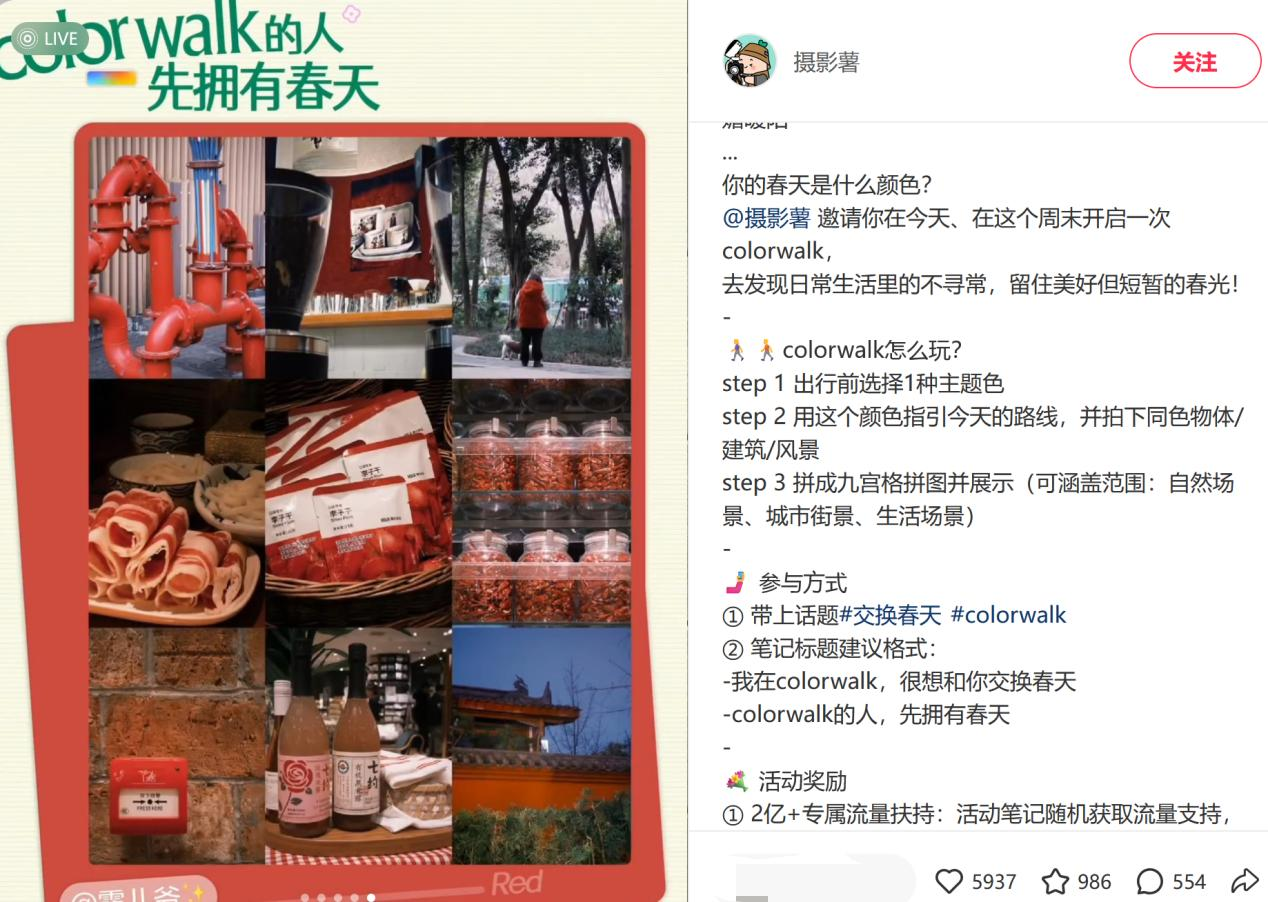
The "Color Walk" aesthetic trend and play | Source: Xiaohongshu
Halfway through, I happened to see on Xiaohongshu that someone had already built a similar site — and it was hugely popular. I didn't lose heart; instead I rushed to finish the site and launch, and posted a video to drive traffic. The video went absolutely nowhere at first, and I was pretty down, because I was sure the topic was a guaranteed hit. Then I reworked the opening — cut some filler, adjusted the pacing — and when I reposted, it blew up.
Looking back, every one of those moments mattered. Miss the launch window, or give up when the video had no data, and there would be no WalkColor today.
Once the hype took off, we quickly decided to put it on the App Store. Users poured in every day with feedback — bug fixes, feature requests — and I went from self-media creator to real product developer, putting all my energy into the product.
On tools, we started with Claude Code; now it's Claude Code plus Codex in parallel. Our workflow: Claude Code acts as the "boss" — understanding goals, drafting plans — while Codex executes tasks with clear boundaries and explicit requirements. When the product first got hot, I wasn't familiar with development and had to discuss a lot of unknowns with the AI while cramming programming fundamentals, mainly around keeping code stable and safe. Early Vibe Coding wasn't as smooth as today — a feature often took many rounds of back-and-forth with the AI. Later, as model capabilities improved and we found better workflows, the friction almost disappeared.
On the development side, basic features aren't technically hard — if you can express your idea clearly enough, the AI can basically build it. What truly differentiates the product is creativity — for example, different "distribution" modes like the mini umbrella or light beams. Similar sites may all do embossing, but the "distribution" play was something we pioneered; even users of competing products come back to WalkColor to try these fresh modes.
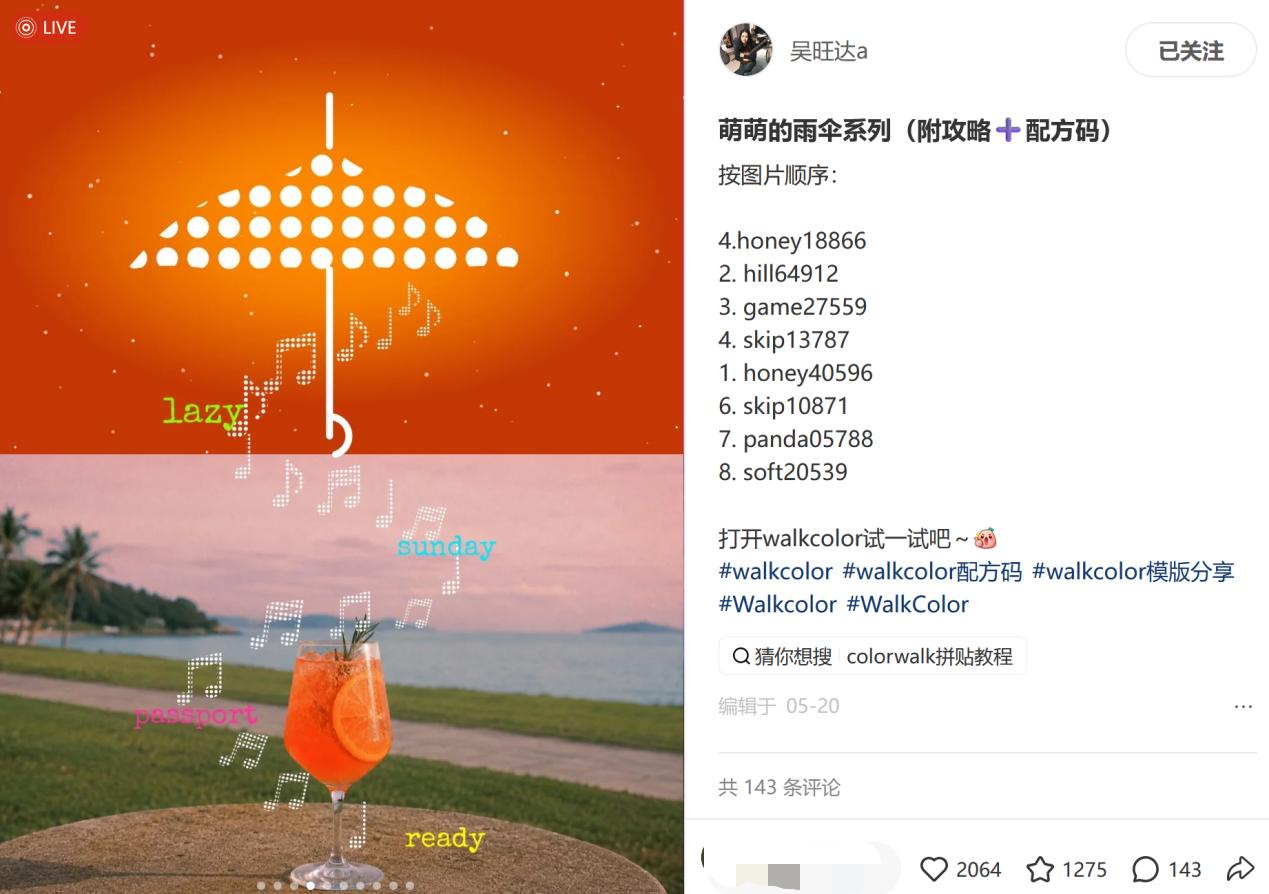
An example of the "mini umbrella" distribution play — users can place visual elements across a photo by different rules | Source: Xiaohongshu
The biggest challenge in development was the unknown. We didn't know whether the next feature would hit, or how long the hype would last — we could only race the clock, building as fast and as completely as possible before the traffic ebbed.
2. Keep Shipping New Plays and Let Users Do the Marketing
Baijing: We've noticed WalkColor ships updates very fast, constantly turning trending visual effects into new features. Where do you usually get inspiration, and how do you decide which trends are worth building? Can you share one complete journey from spotting a need to shipping a feature? How does the team keep up the high update cadence?
Wu Tong: My inspiration is quite eclectic. I browse a lot of visual content to build a mental library — whenever I see an eye-catching image, video or visual effect online, I ask myself whether it can be productized, then flesh it out in my head and extend it into something that belongs to WalkColor.
Take the "Find the Word" feature: I first saw people sharing images where one word was circled among many characters, but I felt circling alone wasn't interesting enough, so I added collapse-and-fall animations to it. I still have lots of feature prototypes in my head; there just isn't time to build them all right now.
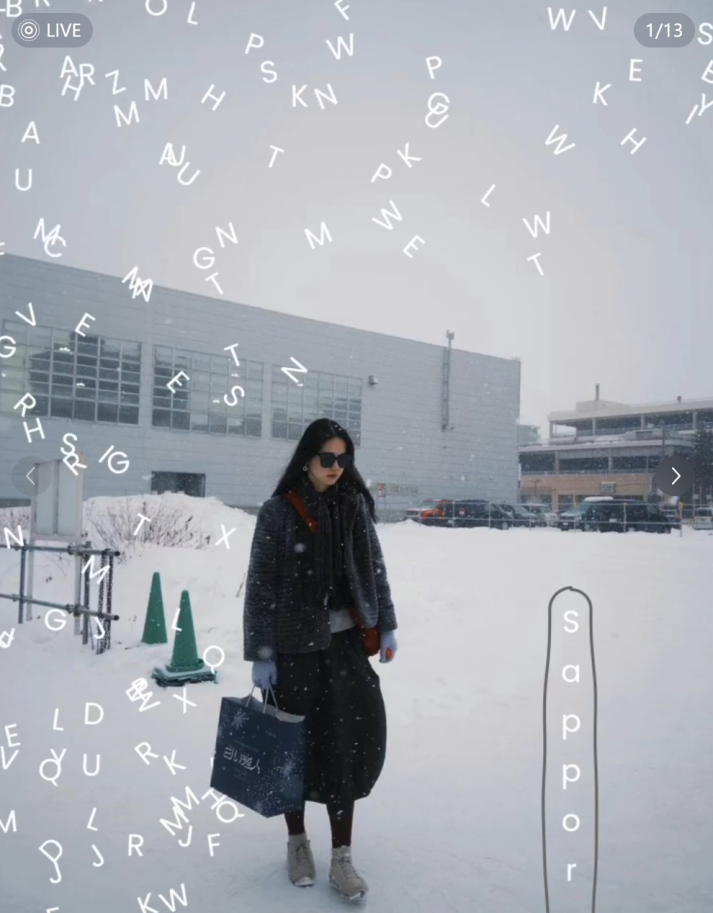
"Find the Word" highlights the selected word in a block of text while the rest exits with collapsing, falling or flickering animations | Source: developer's Xiaohongshu
The shipping process: after spotting a need or inspiration, I make an initial judgment, then discuss implementation with my boyfriend and the AI. If the feature isn't feasible at our cost or technical level, we set it aside; if it is, we ship a quick first version and then polish UI, interaction and details bit by bit. Our advantage: no back-and-forth handoffs between product, design and engineering — the two of us move very fast.
There's no shortcut to the high update cadence either — it's time and relentless polish. From April to August I spent roughly 16 hours a day on WalkColor. Before bed I'd set up long-running tasks for the AI to continue; sometimes I'd already be lying in bed and still get up to check how it was doing.
Baijing: The product saw download peaks in May, July and August. From your perspective, what drove those waves? What do retention and active-user numbers look like now?
Wu Tong: Those growth waves were basically triggered each time by users discovering a new feature. When users find a play fun, they post their creations or the process on social media, driving new downloads. But a feature's launch and its traffic spike aren't always in sync — some features only get seen widely after a while. "Weaving Lab," for instance, sat quietly after launch and only gained real heat later, after bloggers shared it.
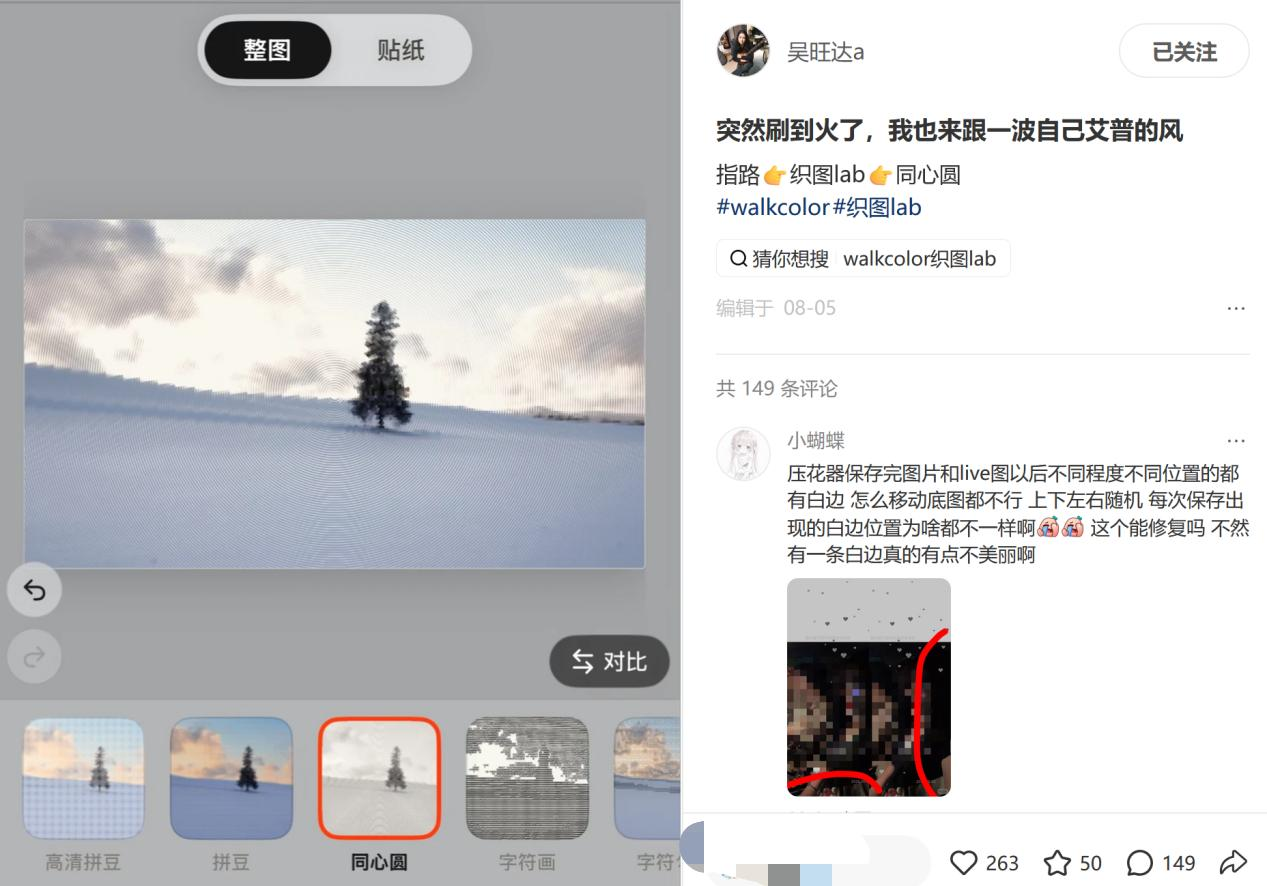
"Weaving Lab" applies filters to regular photos, turning them into fabric-like, perler-bead-like textures. Launched on July 6, it "suddenly blew up" in August | Source: Xiaohongshu
Social media has always been a major traffic source, but apart from my own accounts, we've done zero marketing — it's almost entirely organic. For example, when WalkColor's web version first launched, a Douyin blogger who shares websites made a video about it that got roughly 270,000 likes; we didn't even see the video for a long time — that's how we found out why user numbers had surged that period.
WalkColor now has just over 1 million users, with 400,000–500,000 monthly actives and a ~25% next-month return rate among MAUs. Our current problem: many users only open the product when they need to make an image or feel inspired — they don't use it daily. We want to raise usage frequency.
We'll tackle it from several angles. First, keep shipping features steadily to maintain freshness; second, bring community into the product, moving the whole "share → request recipe → recreate" loop in-house; third, add more everyday play modes to lower the barrier — like the camera; fourth, run themed activities, pop-ups or limited-time features. For example, time-boxing a feature — taking it down twenty-plus days after launch — using scarcity and urgency to boost engagement.
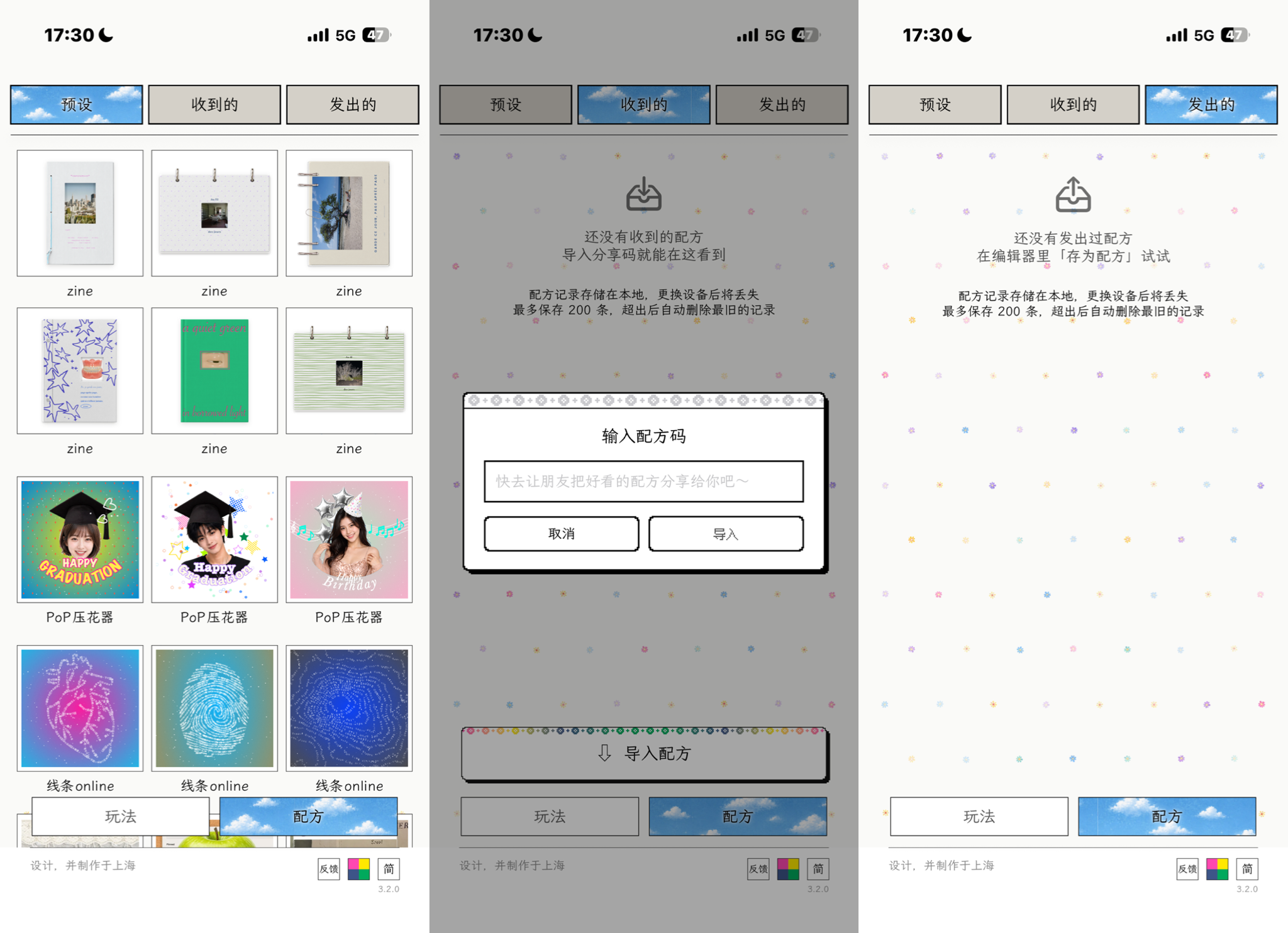
WalkColor's "recipe" is a set of reusable creation parameters. After finishing a work, users generate a recipe code; others can import it to reproduce the same layout, motion and typography, then swap in their own photos and keep creating. The mechanism has already formed a "show work → ask recipe → apply → recreate" loop on external social platforms | Source: product screenshots
Baijing: WalkColor has repeatedly ranked high in photography charts in Japan, Korea and other markets. Have you invested in marketing there? Which regions will you focus on next?
Wu Tong: We've never marketed overseas — growth in Japan and Korea also comes almost entirely from organic sharing. By the numbers, Japanese users retain exceptionally well: 30-day retention is about 2.5x that of the home market. Korea saw a clear download surge too, though retention there isn't as strong as Japan's.
Next phase, our focus will shift more overseas. The product itself won't change much per market; we may optimize post-export sharing — making it easier to share directly to Instagram and other global socials — but marketing content and pricing strategy will get some localization.
Geographically, we'll start with markets that already have heat — Japan, Korea, Southeast Asia — then gradually move toward Europe and the U.S. I believe everyone wants fresh, fun visual products; it's not a single-country thing. European and American audiences are increasingly into K-pop and Korean aesthetics too, so play modes that take off first in Japan, Korea and Southeast Asia can plausibly find fans in the West.
3. Building the "Pop Mart in Your Phone"
Baijing: There's little public info about Xuanshine. Can you introduce the team? What was the journey from first contact to closing the acquisition?
Wu Tong: Xuanshine is an AI-native imaging company. Its core team includes people from ByteDance, Meitu and Tsinghua — many have deep years in content and imaging products, understanding both technology and users. Its core product, Xuanshine AI, has nearly 10 million users across 120 countries and regions in just over a year. Before many apps shipped AI local-precise editing or AI outfit-changing, Xuanshine had already built in-house algorithm capabilities from its Tsinghua lab roots.

Xuanshine AI product overview | Source: Diandian Data
It started with Xuanshine's founder Mark DM'ing me on Xiaohongshu, saying he loved WalkColor and wanted to chat. After we got in touch, I looked into Xuanshine and found the two sides quite complementary. WalkColor lacked more mature monetization, product and operations capabilities; Xuanshine wanted a product direction closer to young users' aesthetics and more fun. Both sides lean toward execution and shipping, so there was no long, drawn-out back-and-forth — once things were clear, we moved forward.
Q: When you first built WalkColor, how did you envision its long-term path? Had you considered an acquisition? What conditions or capabilities from Xuanshine made you decide to partner?
Wu Tong: I hadn't completely ruled out an acquisition, but I leaned toward independent development — shipping new sections and features at my own pace, then trying monetization at the right time. When seriously considering joining Xuanshine, my biggest worries were losing product autonomy and whether I could adapt to the rhythm of a much bigger team.
In the end I agreed to partner, first because Xuanshine has a mature monetization and product workflow — exactly what we lack. We can create ideas fast, but we lack experience in running a product long-term, pricing it, and building out a full team.
Second, the founder Mark's personal appeal. After getting to know him, I felt Xuanshine is a very typical AI-era native organization: culturally diverse, compatible and open. Mark is highly capable and inclusive — he can accept everyone's way of working, find the right rhythm for each person, and let people maximize their strengths. Mark emphasized to me: "Work exactly the way you've always worked — stay in the state you feel most comfortable in." That sentence put my mind at ease.
Third, community. I'd long wanted to build a community inside WalkColor — I think community is a huge retention anchor. But it takes enormous effort, too heavy for a "1.5-person team." The Xuanshine founder has also built community products like Baidu Tieba, with mature community experience to help us. Something we'd always wanted to do but could barely pull off on our own now has a real chance to land.
Q: What value does Xuanshine value most in WalkColor? How does this acquisition connect to its existing business? What role will WalkColor play going forward?
Wu Tong: At the core, I think we want to do the same thing. Xuanshine's mission is "create beauty, connect beauty," and from day one WalkColor has been about "giving Live Photos another life" — helping users relive the beautiful moments their photos captured.
Long term, Xuanshine doesn't just want a creation tool — it wants the full chain from shooting, to creation, to interactive consumption. In that chain, Xuanshine AI leans "useful" — helping users take and retouch better photos; WalkColor leans "fun" — enabling every photo to be re-created and making image-making itself enjoyable. The positioning and users of the two products happen to complete each other's circle.
On top of that, Xuanshine is building a new female-focused product, PoJoy AI — novel and fun, it lets content jump off the screen and connects digital creations in the phone with physical objects like fridge magnets and e-ink displays. PoJoy AI goes into public beta from late October to November. With that, the three products cover the full chain: shooting and retouching, playful creation, and interactive experiences once content enters the real world.
Baijing: After the acquisition, will the original team keep running WalkColor? How will development and operations be split? What resources will Xuanshine put in?
Wu Tong: After the acquisition, I'll keep running WalkColor. Short term, until we hire the right people, Xuanshine's front-end and back-end engineers will support the work; long term, WalkColor will have its own dedicated team. Xuanshine will also support user acquisition, overseas promotion, localized operations, monetization, community and core AI capabilities — especially overseas, where we can directly reuse Xuanshine's mature go-to-market paths and localization experience.
On R&D, we're exploring a new workflow. Visual-focused teammates can, with AI, code features directly into the product that don't affect the underlying codebase; engineers don't just execute product documents — they join development with product thinking and more flexibility. Only when the goal and the implementation are both crystal clear do we fall back on the traditional "product writes docs, engineering executes" process.
On operations, I'll first mentor one or two people to really understand what content spreads and how to express it so it spreads, then gradually build a marketing playbook for WalkColor; we also plan to work with more creators to broaden the product's content reach.
Baijing: Will WalkColor's core positioning change after the acquisition? What features will come next? What's on the product roadmap?
Wu Tong: Strictly speaking, WalkColor's core positioning won't change. From the start we never wanted it to be a plain photo-editing tool. Retouching apps solve how to make photos look better; WalkColor wants to make creation itself more fun. Our thinking has always been "everything can be embraced" — whatever is interesting and doable, we "wrap it in." We'll keep shipping new features fast; with Xuanshine's AI capabilities, features we couldn't build before due to technology, time or cost can now land quicker and at a lower barrier.
In my mind, WalkColor's positioning is "the Pop Mart in your phone" — constantly offering users new play modes and emotional value. The core value isn't any single feature; it's unpredictability and delight. Users open the product like unboxing a blind box, finding fresh, interesting plays that keep updating.
On the long-term roadmap, similar to PoJoy AI, we want users to bring creations from the digital world into reality. For example, the "Booklet" section: after designing an e-booklet on the phone, users may one day turn it into a real physical book.
Baijing: WalkColor stayed free until recently, and you'd said launched free features would never be charged. The product now has a subscription entry. Why launch subscriptions at this point? How do you gauge willingness to pay? How were pricing and benefits designed?
Wu Tong: We started planning monetization in August — the idea was to ship a large batch of new sections and features first, then charge once there was enough content. Xuanshine suggested we not overthink it: ship first, go live, and hear real user feedback as soon as possible. So we launched subscriptions around the National Day holiday. That actually fits how I've always run WalkColor — done beats perfect; testing beats planning. Rather than waiting for some "perfect" state, ship it now and let the market tell us the answer.
We still honor the earlier promise: launched free sections and features won't be charged. Subscription benefits mainly cover new sections and recipes. Right now it's monthly and annual plans; pricing was a rough average from a survey of peer products I did in August. As content grows, pricing will adjust — ordinary new sections and recipes can go into the subscription, but sections that continuously call APIs and incur clear per-use costs may not fit the current subscription price. Going forward we'll judge and test by project type and actual cost, adjusting the model accordingly.

WalkColor subscription pricing | Source: product screenshots
Since subscriptions went live, actual paid content is still limited, but some users already pay for a specific recipe or booklet style. Feedback has been better than I expected — almost no negative reactions. When the subscription feature had a bug, users even left messages asking why they couldn't subscribe. I think part of it is that the free features are already abundant, and part is that we did deliver on what we'd promised — users understand the developer.
Baijing: On the creation community — what are the team's plans? After joining Xuanshine, where do you want to take WalkColor?
Wu Tong: The community will roughly take the form of bringing the sharing loop now scattered across Xiaohongshu and other external platforms back into WalkColor: users can publish their own recipes, browse and apply others' recipes with one tap, and like and bookmark each other's work. When users open the app, they won't just make images — they can browse content, find inspiration and share aesthetics. Whether the community will be monetized later isn't fully decided; we'll figure it out as we go.
We believe fun visual creation has a chance to produce a product with over 100 million users. With Xuanshine's mature experience behind us, our goal is to take WalkColor to 10 million users within a year.
For now I've set myself two small goals. First, make WalkColor support a team; second, make that team run independently. That way I can free up energy to get involved in more interesting products. In the future, I hope when people mention WalkColor, Xuanshine AI and PoJoy AI, they think not just of tools, but of a way for young people to express themselves, record life and connect with one another. Xuanshine is currently raising a new round of funding — investors interested are welcome to reach out and chat~
[This article is original content of Baijing. For reprints, contact us for authorization; unauthorized reprints are strictly prohibited!]
Friendly reminder: Baijing currently has only WeChat and QQ groups. We have not created groups on Telegram or other social apps. Please beware of imposters asking our users and partners for fees or money.