
Original title: Muse launches in Singapore today, with Shopee, Lazada and Grab all plugging in
Author: MomentumWorks (ID: MomentumWorks)
Editor’s note: This article was originally published by MomentumWorks in the BelugaGlobal column. For republication or reuse, please visit the author’s profile page to seek the author’s permission.

Cover image source | Unsplash
On October 28, Meta announced the official launch of its personal AI agent product, Muse, in Singapore. A batch of partners was unveiled alongside it, including Shopee, Lazada, Grab, Singapore Airlines, cashback platform Shopback, and several OTAs — Booking-owned Agoda, Trip.com, and Klook, which recently fell short in its US IPO push.
Muse is Meta’s personal AI agent product launched in September this year. It started in the US and Canada, then entered Japan, and this is its first foray into Southeast Asia. Muse runs on Meta’s self-developed Muse Spark large model, built by Meta Superintelligence Labs, led by Alexander Wang, who notably avoids wearing designer labels (though the team does not brand itself as an “SI agent”).
As an AI agent, Muse can be connected by users to their Google Mail, calendar or social accounts, so it can handle emails, arrange schedules, and — through connections to other services — help with shopping, hotel bookings and itinerary planning. For sensitive operations such as sending emails or making payments, Muse still requires user confirmation.
Below are several use cases Meta shared with local partners in its press materials:
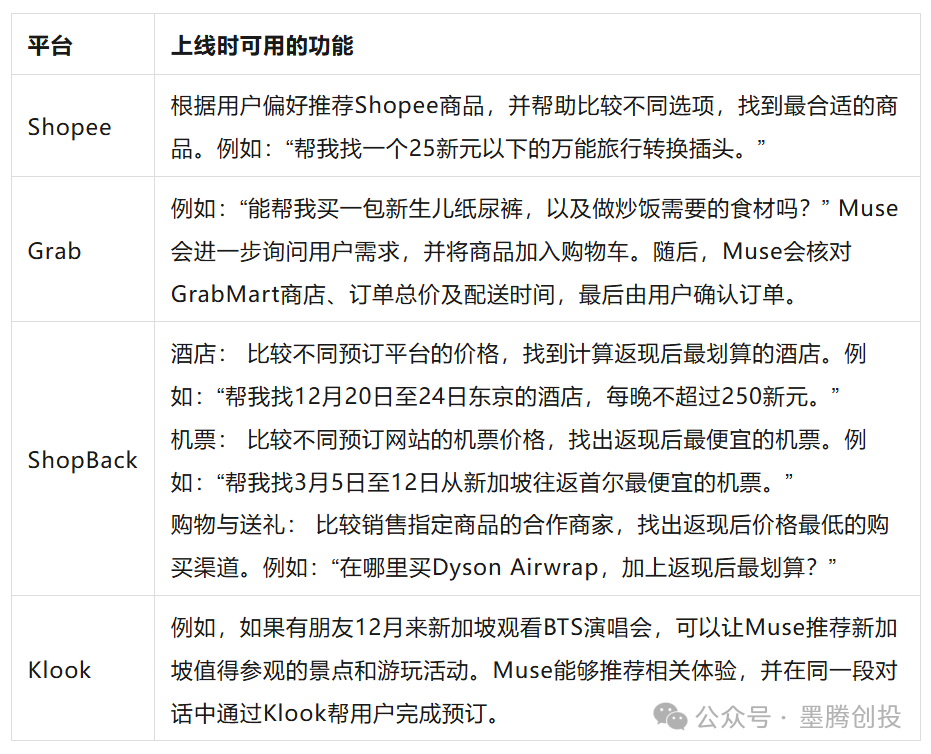
Of course, how much Muse can actually do for users depends both on Meta’s own technical capabilities and on how many features partner platforms are willing to open up. According to Meta’s materials, Shopee currently supports product search, recommendations and comparisons; the Grab partnership covers instant-retail GrabMart and dine-in service Grab Dine Out, with cart-building support for users; and Klook has already confirmed support for booking directly within a Muse conversation.
Muse has already run into platforms unwilling to open up in the US. In September, Amazon reportedly asked Meta to stop Muse from accessing its shopping site. After Meta declined, Amazon blocked Muse from accessing the site automatically, including browsing products and placing orders. Amazon said third-party AI agents cannot enter websites on behalf of consumers without platform authorization.
The interesting thing about personal AI agents is this: in the past, consumers who wanted to shop would usually open Shopee or Lazada, and would go to Agoda to book hotels. If an AI agent like Muse can genuinely complete shopping and bookings, consumers may one day simply tell the AI what they want, and let the AI search across different platforms for products and services.
For these platforms, plugging into Muse could theoretically bring new traffic and orders. For instance, a Shopee executive in charge of brand and growth marketing said in a press release that working with Muse helps users discover products through AI and move from discovery into Shopee’s purchase journey.
But that is corporate courtesy. As anyone who has been treated to milk tea knows, truly large-scale adoption of AI agents in shopping still has plenty of issues to solve, including user behavior. Some platform friends have told us their own in-house agents are a money-burning black hole. Shopee’s own Migoo has also “evolved” from a standalone consumer-grade agent entry point into an assistant embedded in the platform and a productivity tool for platform staff.
Still, Meta is not TikTok — it at least shows little appetite for building a closed loop of its own. Every transaction platform also wants a piece of the action; Alexander Wang is no Yann LeCun, but what if he actually pulls it off?
So it makes sense that TikTok Shop is absent from the first batch of partners.
Meta and TikTok are direct competitors anyway, and TikTok Shop does not need third-party platforms to funnel traffic into transactions. It has a grander mission: helping sustain ByteDance’s AI ambitions.
Muse has just entered Singapore, and how far it can go will largely depend on product experience and on how Meta’s leadership balances burn and monetization.
One thing is certain: friends in Singapore are once again ahead of much of the world when it comes to trying new things.